







Definition & Meaning
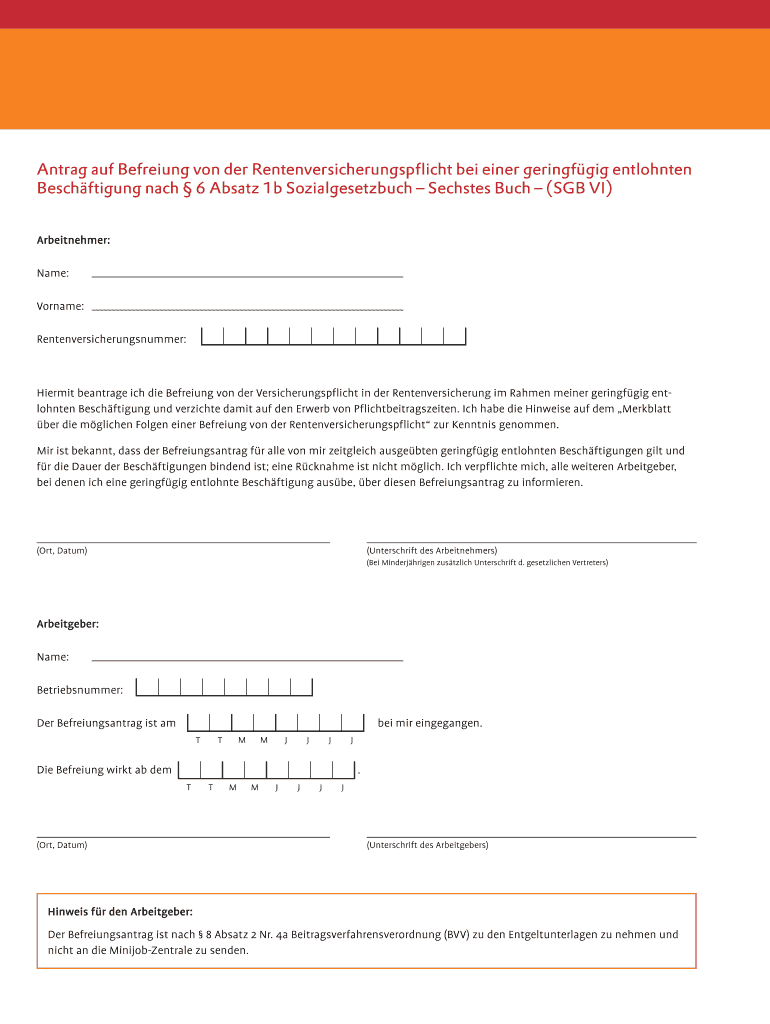
The "Antrag auf Befreiung von der Rentenversicherungspflicht bei einer" is a form used by employees engaged in marginally paid employment in Germany to apply for an exemption from mandatory pension insurance. This exemption, applicable under § 6 Absatz 1b of the Social Code Book VI (SGB VI), allows employees to opt out of the statutory pension scheme under specific conditions. The intention is to relieve employees in low-income jobs from pension contributions, thus increasing their immediate net income.
Marginally paid employment, commonly referred to as "mini-jobs," is characterized by limited working hours and income, typically not exceeding a set monthly threshold. Applying for this exemption requires a clear understanding of its implications, as forgoing pension contributions can affect future retirement benefits.
Eligibility Criteria
To be eligible for the exemption, employees must meet certain criteria. The primary requirement is employment in a mini-job, where earnings do not exceed a specific limit, often set at a monthly threshold decided by regulatory authorities. Typically, this applies to secondary employment situations alongside other significant employment or as a sole employment for students, retirees, or individuals seeking supplemental income.
The employer must also consent to the exemption, which involves adjusting payroll processes to reflect the absence of pension deductions. It's crucial for applicants to evaluate their long-term financial strategy before opting for this exemption, considering the potential impact on future pension benefits.


How to Obtain the Antrag auf Befreiung von der Rentenversicherungspflicht bei einer
Obtaining the form involves a few straightforward steps. Typically, it is provided by the employer, as they are often responsible for initiating discussions about pension contributions. Alternatively, employees can visit the official website of the Deutsche Rentenversicherung (German Pension Insurance) to download the form.
For those unable or uncomfortable with the online process, digital document management platforms like DocHub can offer a user-friendly way to access, complete, and sign the form electronically. These platforms simplify the management of forms, enabling secure digital exchanges with employers and other stakeholders.
Steps to Complete the Antrag
- Gather Personal Information: The form requires basic details about the employee, such as name, address, and tax identification number.
- Specify Employment Details: Include the name of the employer, job title, and employment duration.
- Acknowledge Understanding: The form contains a section where applicants must confirm their understanding of the exemption's implications on future pension benefits.
- Obtain Employer Signature: The employer must sign off on the exemption, verifying the terms of the mini-job and agreement to adjust paycheck processing accordingly.
- Sign and Submit: Finally, the employee's signature completes the application, which is then submitted to the employer. Employers typically forward it to relevant pension authorities if necessary.
Why Apply for Exemption
Applying for the exemption primarily aims to increase take-home pay by reducing mandatory contributions. This is particularly beneficial for employees who may not rely on pension schemes for future financial security, such as students or short-term workers.
It's also attractive to those expecting a limited career duration or who have alternative pension plans. The exemption can provide immediate financial relief and flexibility, albeit with the trade-off of lower pension accumulation over time.
Key Elements of the Form
The form consists of several key sections that need thorough completion:
- Employee Identification: Full legal name, date of birth, and contact information.
- Employment Details: Information about the employment arrangement, including employer data.
- Exemption Declaration: The most critical part, where the employee declares the decision to opt-out.
- Terms and Conditions: Legal statement ensuring that the applicant understands and accepts all potential consequences of the exemption.
Legal Use and Compliance
Understanding the legal ramifications is crucial when utilizing this form. The opted exemption is irrevocable and valid throughout the duration of the mini-job, ensuring employees cannot reverse their decision until employment conditions change. Missteps in the application can result in penalties or forfeited benefits, thus necessitating precise adherence to submission protocols.
Required Documentation
Applicants must provide supporting documentation alongside the application, illustrating eligibility. This can include:
- Proof of Employment: A contract or letter confirming employment and compensation.
- ID Verification: A copy of valid ID to verify identity and employment status.
- Consent from Other Employers: If applicable, acknowledgement from other employers recognizing the exemption request.
Application Processing & Approval Time
Typically, after submission, the employer processes the exemption, ensuring compliance with national pension regulations before formalizing it. Approval timelines vary, depending on employer diligence and any additional documentation required by the pension authorities. Usually, within a few pay periods, employees can notice adjustments in their salary reflecting the exemption.
This section-wise approach assures comprehensive understanding and practical utility for users engaging with the "Antrag auf Befreiung von der Rentenversicherungspflicht bei einer."




