






Definition & Meaning
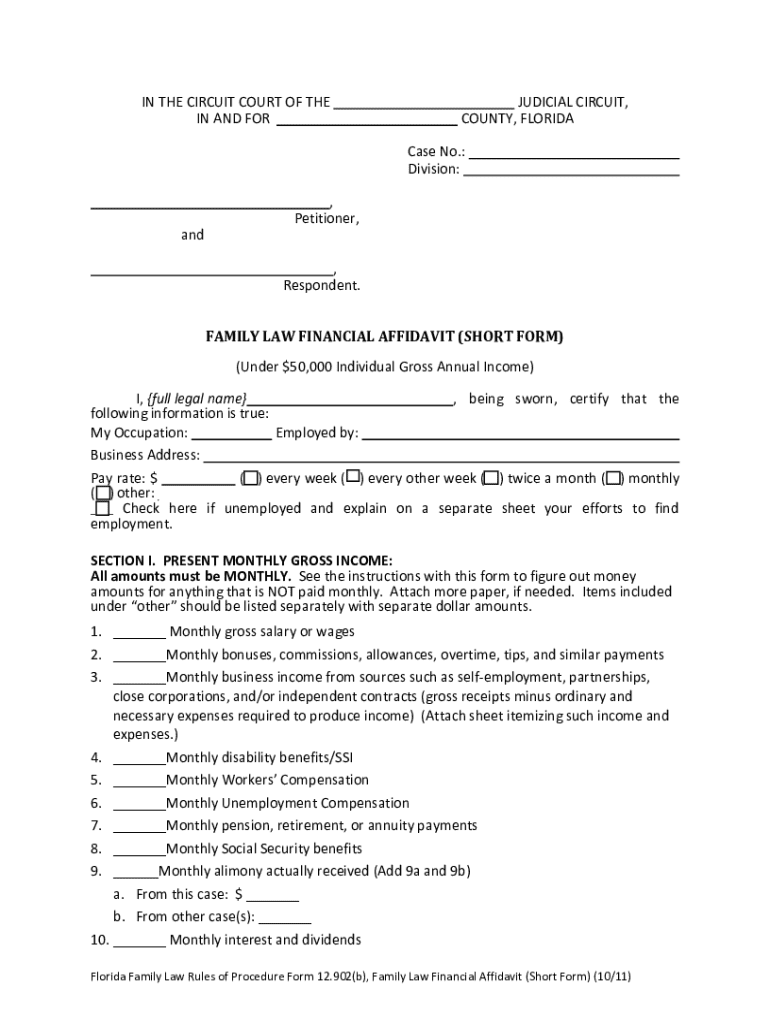
The Family Law Financial Affidavit (Short Form) is a legal document used in family law proceedings in the United States. It serves to outline an individual's financial situation, detailing income, expenses, assets, and liabilities. This form is especially relevant in cases of divorce or child support, where an accurate depiction of financial standing is critical. The "Short Form" is designed for individuals with a gross annual income of less than $50,000, providing a streamlined version of the financial disclosure necessary in such proceedings.
How to Use the Family Law Financial Affidavit (Short Form)
To effectively use the Family Law Financial Affidavit (Short Form), individuals should first gather all necessary financial information, including pay stubs, bank statements, and credit card bills. The form is then filled out by detailing monthly income sources, such as wages and any other earnings, alongside monthly expenses, such as rent or mortgage, utilities, groceries, and transportation. Accurately recording assets, like real estate and vehicles, and liabilities, such as loans and credit card debt, is also necessary. Once the form is completed, it must be reviewed for accuracy and then filed with the appropriate family law court as part of the legal proceedings.
Steps to Complete the Family Law Financial Affidavit (Short Form)
-
Gather Financial Documents: Collect recent pay stubs, bank statements, utility bills, and any other documents that reflect your financial situation.
-
List Income: Record all sources of monthly income, including wages, bonuses, and any other regular earnings.
-
Detail Expenses: Include housing costs, utilities, medical expenses, insurance, transportation, and other regular expenses.
-
Declare Assets and Liabilities: List all personal and real property owned, as well as any debts or outstanding financial obligations.
-
Review for Accuracy: Ensure that all information provided is accurate and complete, as any discrepancies can impact legal proceedings.
-
Sign and Submit: Once reviewed, sign the affidavit before submitting it to the court as part of your family law case filings.
Key Elements of the Family Law Financial Affidavit (Short Form)
- Income Disclosure: Includes wages, bonuses, and other earnings.
- Expense Reporting: Encompasses housing, utilities, medical, and other essential expenses.
- Asset Declaration: Covers real estate, vehicle ownership, and personal property.
- Liability Listing: Details any outstanding debts or loans.
- Legal Compliance: Ensures that all information aligns with legal requirements for disclosure.
State-Specific Rules for the Family Law Financial Affidavit (Short Form)
Different states may have variations in the requirements for the Family Law Financial Affidavit (Short Form). For instance, some states might require additional documentation or specific sections to be completed. It is crucial for individuals to consult state-specific guidelines or seek legal advice to ensure compliance, particularly with respect to income thresholds or asset declarations, which can vary based on jurisdiction.
Important Terms Related to Family Law Financial Affidavit (Short Form)
-
Gross Income: The total income before deductions, such as taxes.
-
Net Income: Income after taxes and deductions.
-
Assets: Items of value owned by the individual, including bank accounts, real estate, and vehicles.
-
Liabilities: Debts or financial obligations owed by the individual.
-
Affidavit: A written statement confirmed by oath or affirmation for use as evidence in court.
Who Typically Uses the Family Law Financial Affidavit (Short Form)
This form is typically used by individuals undergoing divorce proceedings or those engaged in child or spousal support negotiations. Attorneys representing clients in these cases also use the form to gather a comprehensive understanding of a client's financial standing. It is particularly suited for individuals with a gross income below $50,000, for whom the short form provides a more streamlined option for financial disclosure.


Examples of Using the Family Law Financial Affidavit (Short Form)
-
Divorce Proceedings: A couple is divorcing, and one party must submit their financial affidavit as part of the division of assets and determination of spousal support.
-
Child Support Modifications: A parent seeks to adjust child support payments based on a change in financial circumstances, requiring updated financial disclosure.
-
Legal Separation: In cases of legal separation, financial affidavits may be used to negotiate settlements or interim support arrangements.