






Definition and Meaning of the Preschool Evaluation Scale
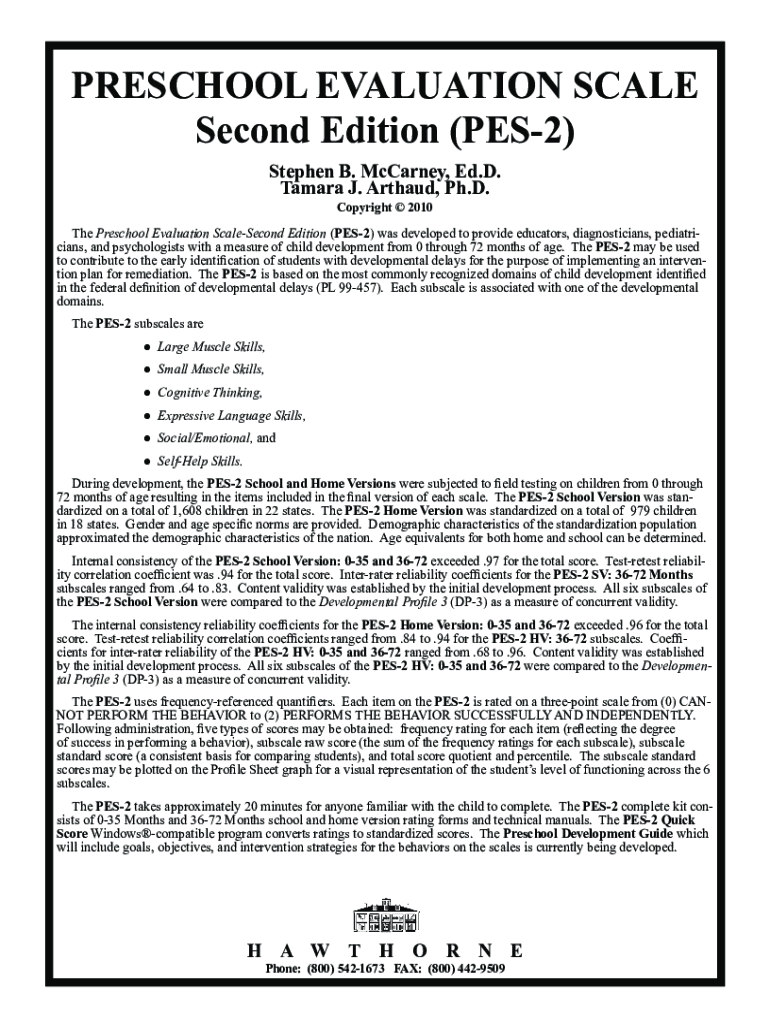
The Preschool Evaluation Scale (PES-2) is an essential tool designed for assessing the developmental progress of children from birth to 72 months. Used primarily by educators and healthcare professionals, PES-2 provides a framework for identifying developmental delays and strengths across six critical areas: Large Muscle Skills, Small Muscle Skills, Cognitive Thinking, Expressive Language Skills, Social/Emotional Skills, and Self-Help Skills. This form utilizes standardized scoring and reliability measures derived from comprehensive field testing, thereby facilitating early intervention planning.
Key Elements of the Preschool Evaluation Scale
The PES-2 comprises several elements vital for a thorough evaluation:
- Developmental Domains: Focus on six specific areas crucial for assessing a child's development.
- Standardized Scoring: Implements a uniform method for interpreting children's developmental levels.
- Reliability Measures: Ensures that results are consistent and dependable over time.
- Observation-Based Assessment: Allows evaluators to record behaviors and skills during natural interactions.
How to Use the Preschool Evaluation Scale
Using the Preschool Evaluation Scale requires familiarity with its elements and scoring methods:
- Preparation: Gather comprehensive background information on the child, including age and medical history.
- Observation: Engage the child in activities to observe behaviors across various developmental domains.
- Scoring: Apply the standardized measures to assess and document each domain's outcomes.
- Interpretation: Analyze scores to identify areas of strength and potential developmental delays.
Steps to Complete the Preschool Evaluation Scale
Completing the PES-2 involves specific procedures to ensure accuracy:
- Record Initial Observations: Note initial impressions during the first interaction.
- Evaluate Each Domain: Assess skills and behaviors in all six developmental areas.
- Score Consistently: Use the standardized scoring key to evaluate responses across domains.
- Compile Results: Consolidate the findings into a cohesive report for further analysis.
- Review and Plan: Discuss findings with stakeholders to develop an intervention strategy if needed.
Who Typically Uses the Preschool Evaluation Scale
The PES-2 is utilized by a range of professionals, including:
- Educators: School psychologists or special education teachers use it to identify learning needs.
- Healthcare Providers: Pediatricians and occupational therapists assess developmental milestones.
- Early Intervention Specialists: These professionals develop targeted interventions based on the scale's results.

Examples of Using the Preschool Evaluation Scale
Consider these scenarios illustrating the application of PES-2:
- A preschool teacher identifies a student struggling with fine motor skills and uses PES-2 to assess and develop an intervention plan.
- An occupational therapist evaluates a child's cognitive and social skills to guide therapy goals.
- A pediatrician utilizes the scale during routine check-ups to monitor developmental progress and offer early intervention resources.
Legal Use of the Preschool Evaluation Scale
In the United States, the PES-2 must align with educational regulations and health guidelines:
- Compliance: Ensure evaluations are conducted ethically and align with state and federal standards.
- Confidentiality: Secure and manage evaluation data following privacy laws like FERPA and HIPAA.
- Documentation: Maintain accurate and thorough records of the assessment process for legal and educational purposes.
Who Issues the Form and How to Obtain It
The Preschool Evaluation Scale is typically available through:
- Educational Institutions: Schools and early learning centers providing the scale for teacher use.
- Healthcare Facilities: Clinics and hospitals offering the form to qualified healthcare professionals.
- Online Educational Resources: Specialist websites providing access to purchase or download the scale.
State-Specific Rules for the Preschool Evaluation Scale
While the PES-2 is globally recognized, state-specific guidelines may impact its implementation:
- Differential Reporting Requirements: Some states have unique reporting protocols.
- Specific Certification: States may require specific certifications or training for evaluators.
- Eligibility for State Programs: The PES-2 may contribute to qualifying for local intervention programs, with criteria varying by state.
These elements ensure that the Preschool Evaluation Scale not only aids in assessing developmental milestones but also complies with relevant legal and educational standards, thus supporting both educators and healthcare professionals in their roles.