Form 941 2026

Get Form
Form 941 Preview on Page 1

Here's how it works

01. Edit your form online
Type text, add images, blackout confidential details, add comments, highlights and more.

02. Sign it in a few clicks
Draw your signature, type it, upload its image, or use your mobile device as a signature pad.

03. Share your form with others
Send it via email, link, or fax. You can also download it, export it or print it out.

Definition and Purpose of Form 941

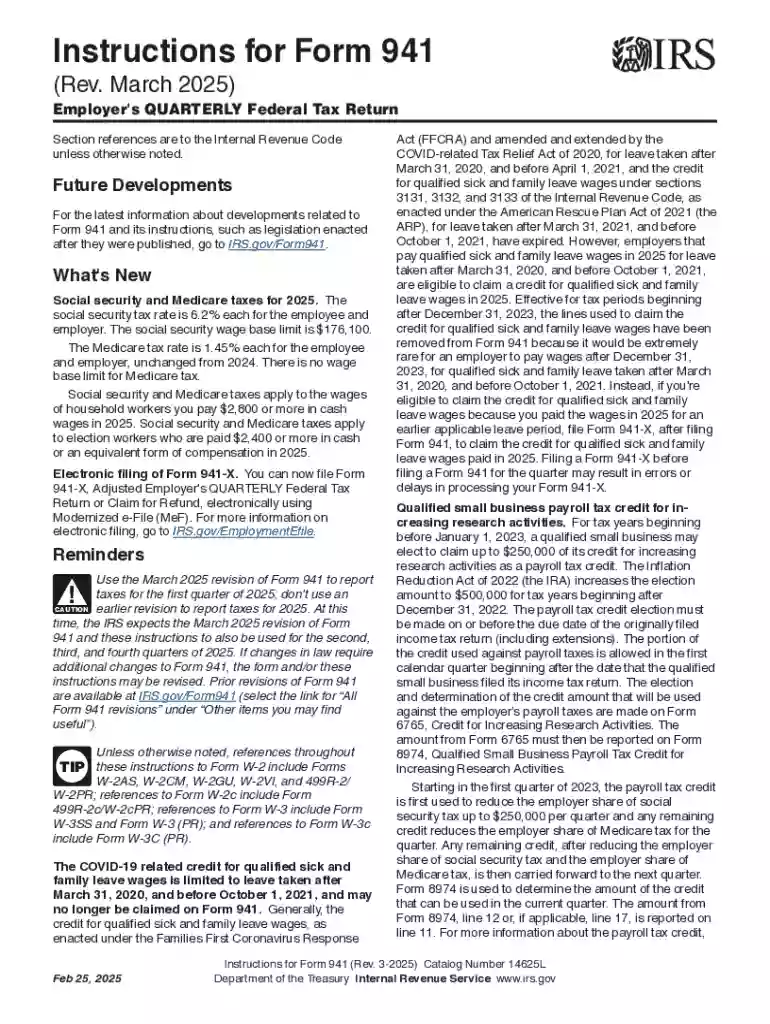
Form 941, known as the Employer's Quarterly Federal Tax Return, is a critical IRS document used by employers in the United States to report wages paid to employees, tips reported by employees, and the federal tax withheld from these wages. This form also includes information on social security and Medicare taxes. Employers must file it quarterly to ensure compliance with federal tax regulations. Its primary purpose is to provide the IRS with a comprehensive summary of payroll tax liabilities and payments made during the quarter.

Key Elements of Form 941

Form 941 captures several essential elements regarding employee compensation and employer tax responsibilities. These elements include:

  • Gross Wages Paid: Total wages paid to employees within the reporting quarter.
  • Taxes Withheld: Amount of federal income tax withheld from employee wages.
  • Social Security and Medicare Taxes: Combined employer and employee contributions.
  • Adjustments: Any corrections to taxes reported in previous quarters.
  • Credits: Available credits for sick leave or research activities.

Employers must accurately report these components to avoid discrepancies in tax reporting and potential penalties.

Steps to Complete Form 941

Completing Form 941 requires meticulous attention to detail to ensure all necessary information is accurately reported. The process involves:

  1. Gathering Payroll Records: Collect payroll data, including total wages paid and taxes withheld.
  2. Calculating Tax Liabilities: Determine the amounts for federal tax, Social Security, and Medicare contributions.
  3. Completing Form Sections: Accurately fill in each part of Form 941 with the gathered data.
  4. Double-Checking Entries: Review the form to correct any errors or omissions before submission.
  5. Submitting the Form: Choose either mail or electronic filing methods for form submission.

Common Mistakes and How to Avoid Them

  • Incorrect Payroll Totals: Ensure payroll data is accurate. Mistakes here can lead to incorrect tax calculations.
  • Wrong Identification Numbers: Double-check Employer Identification Numbers (EIN) on the form.

By following these steps and avoiding common pitfalls, employers can complete Form 941 efficiently and accurately.

Filing Deadlines and Important Dates

Employers are required to file Form 941 quarterly, with each due date tied to the end of a fiscal quarter:

  • First Quarter: April 30
  • Second Quarter: July 31
  • Third Quarter: October 31
  • Fourth Quarter: January 31

Late Filing and Extension Requests

  • Late Penalties: Failing to submit on time can result in penalties and interest.
  • Extension Options: Form 941 does not allow for extensions directly but communicating with the IRS may provide alternate solutions.

Timely submission is vital to prevent financial repercussions.

Penalties for Non-Compliance

The IRS imposes strict penalties for non-compliance related to Form 941. Understanding these can help employers avoid costly mistakes:

  • Late Filing Penalties: Accrued at a rate of 5% of the unpaid tax for each month the return is late, up to a maximum of 25%.
  • Failure to Pay: An additional penalty of 0.5% of the unpaid tax amount for each month.
  • Accuracy-Related Penalties: If filed with incorrect information, penalties may be applied unless due to reasonable cause.

Thorough and timely submission is necessary to minimize financial risk.

Who Typically Uses Form 941

Form 941 is mandatory for the majority of employers who withhold federal income taxes from their employees' wages. This includes:

  • Corporations: Large and small businesses that have employees on payroll.
  • Nonprofit Organizations: Those that employ staff subject to federal payroll taxes.
  • Government Entities: Federal, state, and local governments employing taxable workers.

Exceptions

Certain employers, such as seasonal businesses or those with no payroll during specific quarters, might have specific filing exceptions.

Employers should confirm their status to determine their filing obligations accurately.

Required Documents for Completing Form 941

Before beginning Form 941, ensure you have the following documents on hand:

  • Payroll Records: Detailed reports of wages and taxes withheld.
  • Previous Form 941 Reports: Use them as a reference to ensure consistent reporting.
  • Quarterly Financial Statements: These can provide additional context for the reported figures.

Supplementary Resources

Software tools like QuickBooks or TurboTax may also assist in gathering and organizing necessary data.

Having these documents ready helps streamline the completion process and reduces errors.

Form Submission Methods

Employers can submit Form 941 through multiple channels, ensuring flexibility and convenience:

  • Electronic Filing (e-file): Fast and secure; reduces the chance of errors through immediate validation.
  • Mail: Traditional paper filing, though slower and subject to postal delays.

Procedures for Electronic Submission

  • Register with an approved IRS e-file provider.
  • Use compatible payroll or tax software that supports e-filing.

Employers should choose a submission method that aligns with their operational capabilities and ensures compliance with IRS requirements.

IRS Guidelines for Form 941

The IRS provides detailed instructions for completing Form 941. Adhering to these guidelines is crucial:

  • Verification: Ensure all reported figures match financial records.
  • Compliance: Follow IRS updates regarding tax rate changes or additional credit eligibility.

Common IRS Updates

  • Tax Rates: Regular updates to social security and Medicare contribution limits.
  • Filing Instructions: Changes to procedures for electronic submissions or updates to penalties.

Staying informed on IRS guidelines helps maintain compliance and avoid potential audits or penalties.

be ready to get more

Complete this form in 5 minutes or less

Get form

Got questions?

We have answers to the most popular questions from our customers. If you can't find an answer to your question, please contact us.
Contact us
Form 940 is used to report FUTA taxes, while Form 941 is used to report federal income tax withheld, Social Security, and Medicare tax withholding.
Employers use Form 941 to: Report federal income, social security, and Medicare taxes withheld from employees paychecks, and. Report the employers share of social security and Medicare taxes.
Your business will incur a penalty of 5% of the total tax amount due. You will continue to be charged an additional 5% each month the return is not submitted to the IRS for up to 5 months. The penalty will max up to 25% of the unpaid taxes.
Your 940 tax form is due at the end of January, following the year wages were paid. For 2024, the Form 940 due date is January 31, 2025. This form is filed annually, even though tax payments may have to be made quarterly.
Form 941 is a common question that many business owners have, and in this article, we explained how they are different. Form 940 is used for filing FUTA tax while Form 941 is for reporting withheld federal income taxes and employers contributions to Medicare and Social Security Tax.

Security and compliance

At DocHub, your data security is our priority. We follow HIPAA, SOC2, GDPR, and other standards, so you can work on your documents with confidence.
Learn more
ccpa2
pci-dss
gdpr-compliance
hipaa
soc-compliance

People also ask

Understanding Form 940-PR, 941-PR, and 941-SS Form 941 is utilized to report income taxes, social security tax, and Medicare tax withheld from employee paychecks, also covering the employers portion of social security or Medicare tax. Employers in Puerto Rico traditionally used Form 941-PR to report withholdings.
Use Form 940 to report your annual Federal Unemployment Tax Act (FUTA) tax. Together with state unemployment tax systems, the FUTA tax provides funds for paying unemployment compensation to workers who have lost their jobs. Most employers pay both a federal and a state unemployment tax. Only employers pay FUTA tax.

Related links