DGR 61st edition Checklist for a Radioactive Shipment 2026

Get Form
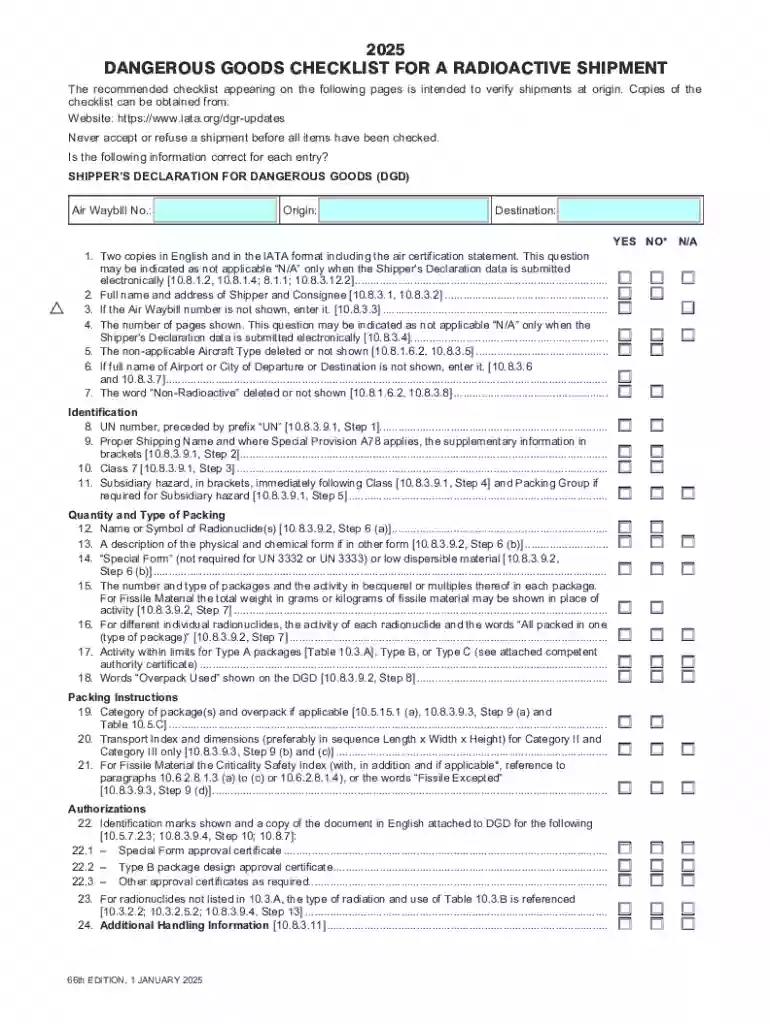
DGR 61st edition Checklist for a Radioactive Shipment Preview on Page 1

Here's how it works

01. Edit your form online
Type text, add images, blackout confidential details, add comments, highlights and more.

02. Sign it in a few clicks
Draw your signature, type it, upload its image, or use your mobile device as a signature pad.

03. Share your form with others
Send it via email, link, or fax. You can also download it, export it or print it out.

Definition and Meaning of the DGR 61st Edition Checklist for a Radioactive Shipment

The DGR 61st Edition Checklist for a Radioactive Shipment is an essential tool used to ensure that all safety protocols and required documentation are in place when transporting radioactive materials. This checklist plays a crucial role in verifying compliance with international and national regulations for handling dangerous goods, specifically focusing on radioactive shipments. It serves as a guide for shippers to systematically confirm each aspect of the shipment process, from its packing and labeling to the inclusion of necessary declarations and authorizations.

Key Components of the Checklist

  • Shipper's Declaration for Dangerous Goods (DGD): This form is mandatory to declare the nature of the dangerous goods in the shipment.
  • Packing Instructions: Detailed guidelines on how materials should be packed to prevent leaks and contamination.
  • Labeling Requirements: Specifications for labels indicating the presence of radioactive materials.
  • Transport Authorizations: Necessary permits and authorizations required for the shipment to proceed legally.

How to Use the DGR 61st Edition Checklist for a Radioactive Shipment

Using the DGR 61st Edition Checklist requires a methodical approach to ensure all regulatory and safety standards are met.

Steps to Implementing the Checklist

  1. Initial Assessment: Evaluate the type and classification of radioactive materials being shipped.
  2. Document Preparation: Compile all required documents, such as the Shipper's Declaration for Dangerous Goods and transport permits.
  3. Packing and Labeling: Follow the specific packing instructions and apply appropriate labels to indicate hazardous content.
  4. Verification Checks: Review the checklist to ensure all items are addressed before dispatching the shipment.

Important Considerations

  • Ensure that the personnel handling the checklist are trained in handling radioactive materials.
  • Regular audits and training sessions to keep personnel updated on changes in the regulations.

Steps to Complete the DGR 61st Edition Checklist for a Radioactive Shipment

Completing the DGR 61st Edition Checklist involves several detailed steps to ensure nothing is overlooked.

Step-by-Step Process

  1. Gather Documentation: Ensure you have the Shipper's Declaration for Dangerous Goods, packing instructions, and transport authorizations ready.
  2. Inspect Packaging: Verify that the packaging meets all safety and regulatory requirements.
  3. Label the Shipment: Ensure all labels are correct and clearly visible on the packaging.
  4. Complete the Checklist: Methodically check off each item as you verify it has been completed.
  5. Final Verification: Cross-check the completed checklist against the shipment to ensure full compliance.

Who Typically Uses the DGR 61st Edition Checklist for a Radioactive Shipment

The checklist is primarily used by professionals involved in the logistics of transporting radioactive materials.


decoration image ratings of Dochub

Typical Users

  • Logistics Managers: Oversee and ensure the proper execution of the checklist.
  • Compliance Officers: Verify adherence to legal standards.
  • Shipping Personnel: Directly interact with and manage the checklist during shipping preparation.
  • Training Personnel: Conduct training sessions for employees on using the checklist effectively.

Legal Use of the DGR 61st Edition Checklist for a Radioactive Shipment

Adherence to the DGR 61st Edition Checklist is not just a recommendation but a legal requirement for those transporting radioactive shipments.

Legal Implications

  • Failure to comply with the checklist can lead to legal penalties and fines for violations of transportation regulations.
  • Proper use ensures compliance with international regulations, such as those by the International Air Transport Association (IATA).

Consequences of Non-Compliance

  • Legal action and fines
  • Revocation of transport licenses
  • Increased scrutiny on future shipments

Key Elements of the DGR 61st Edition Checklist for a Radioactive Shipment

Different components are critical to the effectiveness of the checklist.

Essential Elements

  • Identification of Materials: Accurate categorization and classification of radioactive materials being shipped.
  • Safety Procedures: Step-by-step procedures to ensure the safety of handlers and transporters.
  • Documentation and Authorization: Prompt and accurate documentation, including all necessary approvals for transport.

State-Specific Rules for the DGR 61st Edition Checklist for a Radioactive Shipment

While the checklist follows international guidelines, variations can exist based on state-specific regulations in the U.S.

Variations by State

  • Certain states may have additional requirements or stricter enforcement policies concerning the transport of radioactive materials.
  • Ensuring compliance with both federal and state-specific laws is crucial to avoid legal issues.

Examples of Using the DGR 61st Edition Checklist for a Radioactive Shipment

The use of this checklist is seen across various industries that regularly handle radioactive materials.

Real-World Scenarios

  • Medical Industry: Transportation of isotopes for medical imaging.
  • Nuclear Power Plants: Shipments of spent nuclear fuel or other radioactive waste.
  • Research Institutions: Sending radioactive samples for analysis or study.

These examples demonstrate the checklist's vital role in ensuring safety and compliance in transporting sensitive and potentially hazardous materials.

be ready to get more

Complete this form in 5 minutes or less

Get form

Got questions?

We have answers to the most popular questions from our customers. If you can't find an answer to your question, please contact us.
Contact us
The checklist should contain information that identifies the person who checked during acceptance. The personnel accepting the dangerous cargo has the right to accept it for transportation only after it is convinced that the cargo: Correctly marked; No damage or leakage.
This section describes the documentation necessary for a consignment of dangerous goods. This includes the Shippers Declaration of Dangerous Goods and an Air Waybill.
Subsection 7.3 of the IATA DGR contains full-color examples of all hazard and handling labels. Two types of labels are addressed in Section 7: hazard labels, which are required for most dangerous goods in all classes; and. handling labels, which are required for some dangerous goods and indicate handling precautions.
Category 8 includes corrosive substances such as acids and alkalis. These substances can cause severe damage to skin and other materials if not handled properly. Category 10 includes miscellaneous dangerous goods such as dry ice, lithium batteries, and magnetized materials.
Hazard class 8: Corrosive substances The dangerous goods regulations define corrosive substances as a substance that by a chemical action, causes irreversible damage to the skin, or in the case of a leakage, will materially damage or even destroy other goods or the means of transport.

Security and compliance

At DocHub, your data security is our priority. We follow HIPAA, SOC2, GDPR, and other standards, so you can work on your documents with confidence.
Learn more
ccpa2
pci-dss
gdpr-compliance
hipaa
soc-compliance
be ready to get more

Complete this form in 5 minutes or less

Get form