Reporting abuse and neglectMass How to file a report of abuse or neglectMass How to file a report of 2026

Get Form
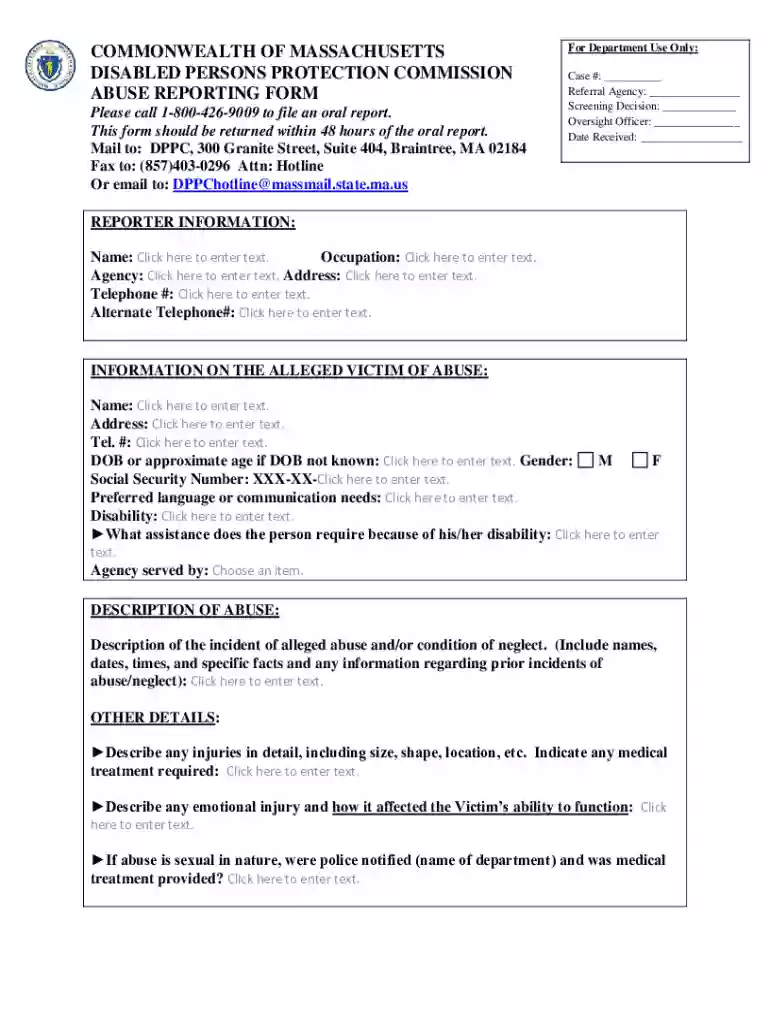
Reporting abuse and neglectMass How to file a report of abuse or neglectMass How to file a report of Preview on Page 1

Here's how it works

01. Edit your form online
Type text, add images, blackout confidential details, add comments, highlights and more.

02. Sign it in a few clicks
Draw your signature, type it, upload its image, or use your mobile device as a signature pad.

03. Share your form with others
Send it via email, link, or fax. You can also download it, export it or print it out.

Definition and Purpose of the Abuse Reporting Form

The Abuse Reporting Form from the Commonwealth of Massachusetts Disabled Persons Protection Commission is specifically designed for reporting incidents of abuse or neglect against disabled individuals. This form serves as an official document to detail incidents involving victims, alleged abusers, and specifics of the incident. Its primary purpose is to ensure proper documentation and timely intervention in cases of abuse or neglect, thereby safeguarding the well-being of disabled persons.

How to Use the Form for Reporting

Using the Abuse Reporting Form involves completing sections with detailed information about the incident. This includes inputting data about the victim, any injuries sustained, as well as the context and details of the alleged abuse. The form guides users through each part to ensure all necessary information is captured, facilitating an organized report that can be quickly processed by authorities for action.

Steps to Complete the Abuse Reporting Form

  1. Gather Required Information: Collect all available details, including the victim's information, specifics of the incident, and details about the alleged abuser.
  2. Section by Section Completion:
    • Reporter Information: Enter your contact details and relationship to the victim.
    • Victim Details: Fill in the victim's name, age, and any relevant medical history.
    • Incident Description: Provide a thorough account of what happened, including date, time, and location.
    • Risk Assessment: Assess and describe any immediate risks to the victim.
  3. Review and Submit: Double-check all entered details for accuracy before submission.

Key Elements of the Abuse Reporting Form

  • Reporter Information: This section captures details about the individual reporting the abuse, including their role in the situation.
  • Victim Identification: Important for recognizing and differentiating cases, allowing swift protection measures.
  • Alleged Abuser Details: Helps in identifying patterns and taking necessary legal actions.
  • Incident Narrative: Detailed accounts that support a better understanding and prompt intervention.
  • Injury and Risk Evaluation: Critical for prioritizing cases based on severity levels and urgent needs.

Legal Use and Compliance

Filing the Abuse Reporting Form is not merely a procedural step but a legal obligation in specific instances, particularly for mandated reporters. The form aligns with U.S. laws protecting disabled individuals, ensuring that all necessary details are relayed to authorities for appropriate actions. Compliance with this reporting process helps in safeguarding victims and upholding legal frameworks designed to minimize abuse.

Important Terms Related to the Form

  • Mandated Reporter: Individuals required by law to report cases of abuse, such as healthcare professionals, educators, and social workers.
  • Neglect: Failing to provide necessary care or protection to a disabled individual, resulting in potential harm.
  • Disabled Persons Protection Commission (DPPC): The state authority responsible for receiving and addressing reports of abuse.

State-Specific Rules and Procedures

Massachusetts has particular statutes that outline the responsibilities and procedural nuances associated with reporting abuse against disabled persons. The DPPC has established guidelines to facilitate the form's completion, ensuring coherence with state policies for the protection of disabled individuals.

Who Typically Uses This Form

The form is predominantly utilized by professionals who work with disabled individuals, such as healthcare workers, social service providers, and educators. However, it is also accessible to family members or acquaintances of the disabled individual who may witness or become aware of abuse situations.

Required Documents for Submission

When submitting the Abuse Reporting Form, it's vital to include any corroborating evidence or documentation that supports the report. This may encompass medical reports, witness statements, or photographs that provide additional context or evidence of the abuse.

Form Submission Methods

The completed form can be submitted through various means to ensure flexibility and accessibility:

  • Online Submission: Recommended for immediate and direct filing with the DPPC.
  • Mail-In Option: Traditional approach for those without internet access.
  • In-Person Delivery: Direct submission to ensure receipt.

Examples and Scenarios of Form Use

  • Healthcare Providers: Reporting instances of physical harm observed or disclosed during treatment.
  • Educators: Noticing signs of neglect such as malnutrition or untreated medical conditions in students.
  • Social Workers: Documenting and reporting information received during home visits or routine check-ins.

Penalties for Non-Compliance

Failing to report known or suspected abuse can result in penalties, particularly for mandated reporters. Consequences can include fines, legal action, and professional disciplinary measures. This underscores the responsibility to act when abuse is observed or suspected, enhancing protection for the vulnerable population.

be ready to get more

Complete this form in 5 minutes or less

Get form

Got questions?

We have answers to the most popular questions from our customers. If you can't find an answer to your question, please contact us.
Contact us
If you believe your civil rights, or someone elses, have been violated, submit a report using our online form. If you or someone else is in immediate danger, please call 911 or local police. If you are reporting misconduct by law enforcement or believe you have experienced a hate crime, please contact the FBI.
Get essential details: child or young persons details (name, address, DOB, details of siblings) incident details (date, type of risk, persons causing or contributing to harm) impact of the incident on the child or young person. network of support around the young person.
The best ways to get in touch call our non-emergency, 24/7 number: 101. visit a police station to speak to an officer in person. contact the NSPCC to speak to a professional practitioner. contact the childrens social care team at your local council. contact Fearless confidentially and anonymously.
In all other instances, when responding to abuse, take the steps outlined below. Step 1: Protect the person. Step 2: Preserve and record the evidence. Step 3: Report the incident immediately. Step 4: Support the abused person as well as the whistle-blower or complainant. Step 5: If necessary, take the matter further.
What Should a Mandated Reporter Do Before Reporting Any Allegations of Abuse or Neglect? Have a Reasonable Suspicion of Abuse or Neglect. Every child abuse report starts with a reasonable suspicion of a mandatory reporter that something isnt right. Conduct a Bias Check. You MUST Make a Report.

Security and compliance

At DocHub, your data security is our priority. We follow HIPAA, SOC2, GDPR, and other standards, so you can work on your documents with confidence.
Learn more
ccpa2
pci-dss
gdpr-compliance
hipaa
soc-compliance
be ready to get more

Complete this form in 5 minutes or less

Get form

People also ask

If you suspect that a child is being abused or neglected, or if you are a child who is being mistreated, call 800-422-4453 immediately. This ChildHelp National Child Abuse Hotline is available 24 hours a day, 7 days a week.
#1 Call the Child Abuse Hotline With a 24-hour on call hotline staff, you can guarantee that you will be able to get a hold of someone as soon as possible. Once the case is reported and risk is determined, a social worker will be assigned to further investigate the situation.

Related links