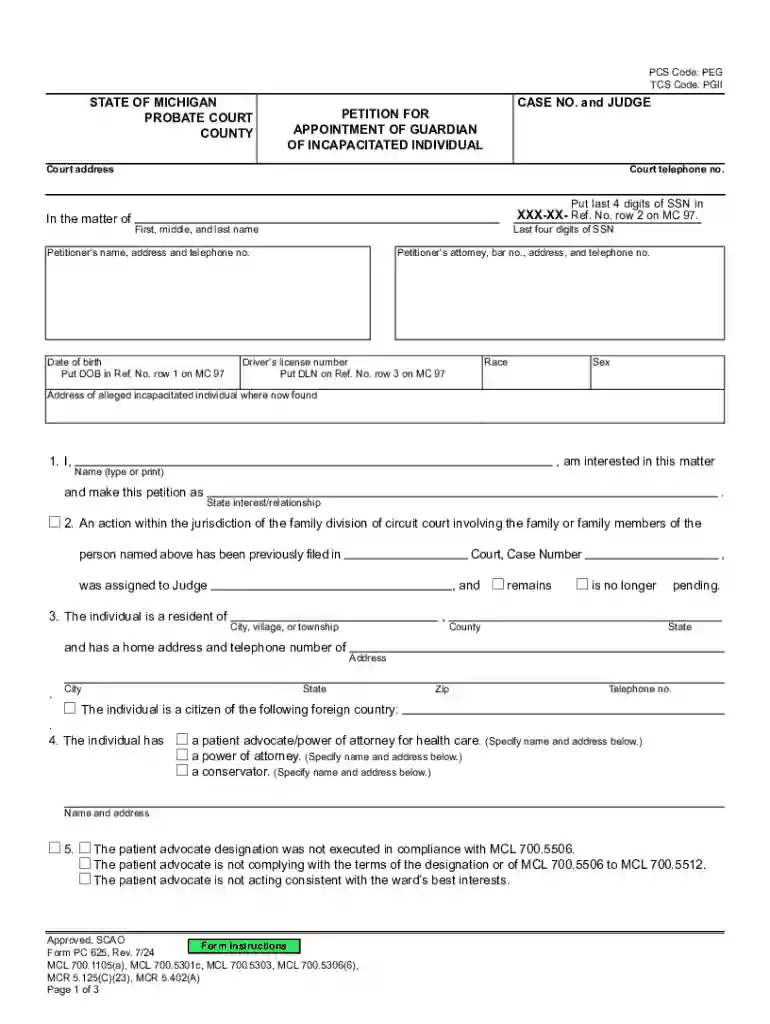
No 312 700 5306 Court appointment of guardian of-2026

Get Form
No 312 700 5306 Court appointment of guardian of Preview on Page 1

Here's how it works

01. Edit your form online
Type text, add images, blackout confidential details, add comments, highlights and more.

02. Sign it in a few clicks
Draw your signature, type it, upload its image, or use your mobile device as a signature pad.

03. Share your form with others
Send it via email, link, or fax. You can also download it, export it or print it out.

Definition and Meaning

The "No Court Appointment of Guardian of" is a legal document used to petition a court for the appointment of a guardian for an incapacitated individual. It is essential in situations where an individual cannot manage their person or property due to a mental or physical condition. The form serves to protect the interests of the incapacitated person by designating a responsible party to act on their behalf. This legal mechanism ensures the well-being and proper management of an individual's affairs, preserving their rights and dignity.

How to Use the No Court Appointment of Guardian of

To use the form, you must complete it with accurate and detailed information about the alleged incapacitated individual, the petitioner, and the proposed guardian. This includes providing evidence of the individual's incapacity, detailing any existing legal arrangements, and justifying the need for guardianship. The completed form should then be submitted to the relevant court for review. If approved, a court hearing will be scheduled to determine the necessity and appropriateness of the guardianship.

  • Identify the need for guardianship.
  • Gather necessary information about all parties involved.
  • Complete the form with precise details.
  • Submit the form to initiate the court process.

Steps to Complete the No Court Appointment of Guardian of

  1. Gather Required Information: Collect information about the incapacitated person, including their medical condition, existing legal documents, and other relevant details.
  2. Fill in the Form: Provide comprehensive information on the form regarding the petitioner, the incapacitated person, and the proposed guardian.
  3. Include Supporting Documentation: Attach evidence such as medical reports, power of attorney documents, or any other legal papers supporting the need for guardianship.
  4. Review for Accuracy: Double-check all entered information to ensure accuracy and completeness.
  5. Submit the Form: File the form with the appropriate court jurisdiction, along with any required filing fees.

Legal Use of the No Court Appointment of Guardian of

This form is employed to legally request the appointment of a guardian, enabling responsible individuals to manage the personal and property affairs of someone who is incapacitated. It is particularly relevant in legal contexts where the rights and protections of the incapacitated individual are considered paramount. The court evaluates the petition to ensure that the guardianship is in the individual’s best interest, adhering to legal standards to safeguard their well-being.

Key Elements of the No Court Appointment of Guardian of

  • Petitioner Information: Details about the individual requesting the guardianship.
  • Incapacitated Individual Details: Information about the alleged incapacitated person.
  • Guardian Nominee: Proposed guardian's details and qualifications.
  • Supporting Evidence: Medical and legal documents substantiating the incapacity.
  • Declaration of Intent: A statement explaining why guardianship is necessary.

Who Typically Uses the No Court Appointment of Guardian of

This form is typically used by family members, friends, or legal representatives of an individual who is no longer able to make informed decisions for themselves. It is used by those seeking legal authority to provide care and manage the affairs of a loved one, ensuring they receive proper support and protection.


decoration image ratings of Dochub

Important Terms Related to No Court Appointment of Guardian of

  • Incapacitated Individual: A person unable to make decisions due to physical or mental limitations.
  • Guardian: An individual lawfully appointed to manage the affairs of an incapacitated person.
  • Petitioner: The person or entity requesting the court for guardianship.
  • Legal Hearing: A court session where the necessity of guardianship is evaluated.

State-Specific Rules for the No Court Appointment of Guardian of

Different states in the U.S. may have specific rules and requirements regarding the appointment of guardianships. It's essential to understand local laws and regulations, which can affect aspects such as filing procedures, necessary documentation, and the judicial process. Consulting a legal expert familiar with the jurisdiction where the guardianship is sought can provide guidance tailored to the state's requirements.

Examples of Using the No Court Appointment of Guardian of

  • Scenario One: A family member petitions for guardianship of an elderly parent diagnosed with dementia. The form is used to initiate the legal process, ensuring the parent receives necessary care and protection.
  • Scenario Two: A court appoints a responsible guardian to manage the financial and personal affairs of a young adult with severe cognitive disabilities, ensuring their well-being and financial stability.
be ready to get more

Complete this form in 5 minutes or less

Get form

Got questions?

We have answers to the most popular questions from our customers. If you can't find an answer to your question, please contact us.
Contact us
Supreme Court Rule 40A gives the Court discretion to appoint a Guardian ad Litem in custody proceedings when the court finds that the childs best interests are not adequately protected by the parties and that separate representation of the childs best interests is necessary. Guardians are not automatically
Guardians are legal representatives appointed by a court to take care of individuals who are unable to take care of themselves. The person for whom a guardian is appointed is referred to as the ward. Wards can be either minor children or adults who are considered incapacitated.
A guardian ad litem (GAL) is a neutral person the court appoints to investigate what solutions would be in the best interests of a child. Here, we are talking about a GAL in a divorce or parental rights and responsibilities case.
A guardian is appointed by the court to make the personal decisions for the person subject to guardianship. The guardian has authority to make decisions on behalf of the protected person about such things as where to live, medical decisions, training and education, etc.
Guardians are appointed when a court determines that an individual is at risk because they cannot make decisions for themselves and there is no less restrictive way to meet the individuals needs. Guardianship may remove a broad spectrum of rights from the individual.

Security and compliance

At DocHub, your data security is our priority. We follow HIPAA, SOC2, GDPR, and other standards, so you can work on your documents with confidence.


Learn more
ccpa2
pci-dss
gdpr-compliance
hipaa
soc-compliance
be ready to get more

Complete this form in 5 minutes or less

Get form