







Definition and Meaning of "How Puerto Rico Became White"
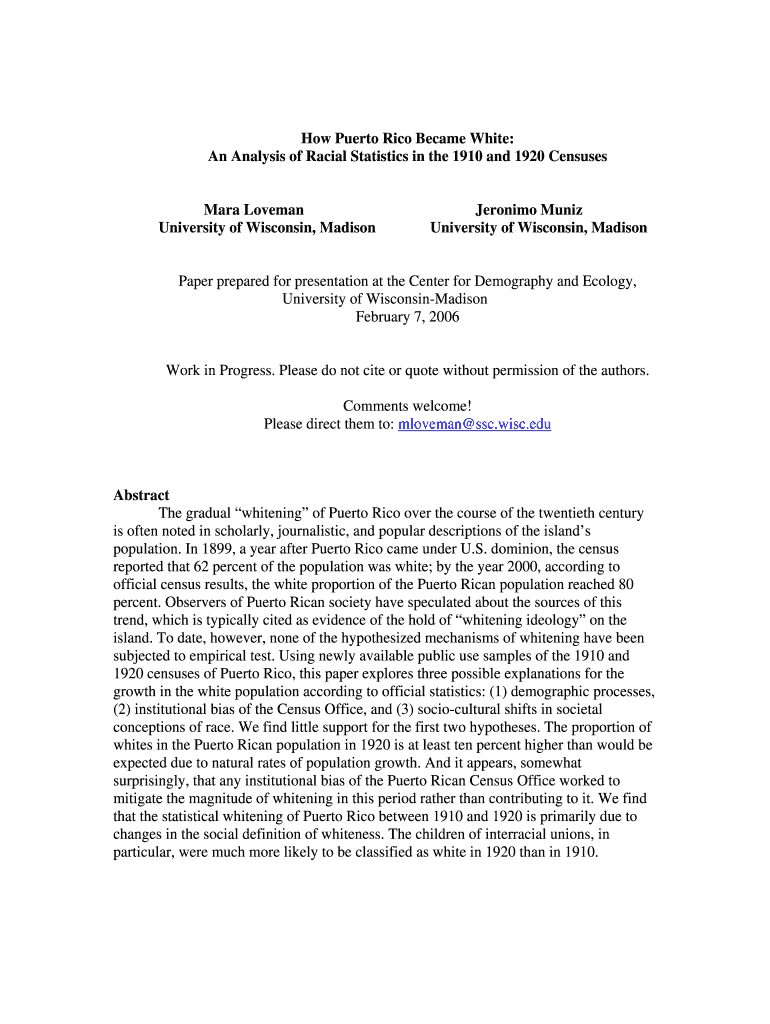
The concept of "How Puerto Rico Became White" explores the socio-cultural and demographic transitions within Puerto Rico during the early 20th century that led to a significant increase in the population classified as white. This term primarily examines changes recorded in the racial statistics of the 1910 and 1920 censuses. During this time, the percentage of individuals identified as white rose from 65.5% to 73%, a shift attributed largely to evolving societal definitions of race rather than demographic changes or institutional biases. Understanding this transformation involves acknowledging the fluid nature of racial classification, particularly as it relates to children of interracial unions, who were increasingly categorized as white by the 1920 census.
Key Elements of the "How Puerto Rico Became White" Study
The study examining the transformation of racial identity in Puerto Rico identifies three main hypotheses: demographic processes, institutional biases in census reporting, and socio-cultural shifts in racial definitions. While the demographic and institutional explanations provide little evidence, the socio-cultural shifts play a crucial role in explaining how racial definitions, especially regarding children of interracial unions, influenced census classifications.
Socio-Cultural Influences
- Interracial Unions: Increased likelihood of children from these unions to be classified as white.
- Societal Perceptions: Evolving views on race impacted how individuals self-identified and were classified.
- Racial Fluidity: Demonstrates the socially constructed nature of race.
Steps to Complete a Study of "How Puerto Rico Became White"
- Gather Historical Census Data: Analyze census data from 1910 and 1920 for racial classifications.
- Examine Demographic Trends: Investigate birth, death, and migration rates during the relevant periods.
- Analyze Societal Narratives: Study literature, newspaper articles, and other historical accounts that reflect societal views on race.
- Review Census Methodologies: Understand the methods used for racial classification and any changes in criteria over the years.
- Formulate Hypotheses: Develop theories regarding the shifts in racial identity and test these against the historical data.
Examples of Using "How Puerto Rico Became White"
This study provides various examples of how racial identity in Puerto Rico evolved. For instance, children born to interracial couples became more likely to be classified as white over time. This trend is reflective of a broader societal acceptance and redefinition of what it meant to be white, influenced by both internal societal changes and external pressures.
Legal Implications of Racial Reclassification
Racial reclassification in the context of the census can have significant legal implications, influencing everything from voting rights to civil rights legislation and the allocation of resources. Understanding this historical context helps in examining equity in representation and the distribution of government aid based on racial demographics.
Who Typically Conducts Research on "How Puerto Rico Became White"
This study appeals to sociologists, historians, and other social scientists interested in racial identity formation and demographic studies. It also attracts policymakers and educators who seek to understand the historical context of racial dynamics in Puerto Rico and its contemporary implications.
Important Terms Related to "How Puerto Rico Became White"
- Racial Whitening: The process by which racial identity becomes more closely aligned with whiteness in census records.
- Demographic Processes: Natural population changes through birth, death, and migration.
- Institutional Bias: Potential systemic influences in census taking that influence racial classifications.
- Socio-Cultural Shift: Changes in societal norms and definitions regarding race.
Practical Scenarios for Using the Study
Utilizing the findings from the "How Puerto Rico Became White" study can aid in educational settings to illustrate the complexity of racial identity. It also serves as a case study in discussions about the fluid nature of race and the impact of policies on racial classifications.
Versions or Alternatives to "How Puerto Rico Became White" Study
Similar studies on racial identity shifts can be found in other regions and periods, such as the "passing" narratives in postbellum America or the mestizaje concept in Latin American countries. These comparisons can provide a broader understanding of racial identity transformations globally.
Software Compatibility for Analyzing Census Data
For those analyzing census data, software such as SPSS, SAS, or R can be used to manage and interpret complex datasets efficiently. Understanding software compatibility helps researchers perform comprehensive analyses of historical and contemporary census records.




