
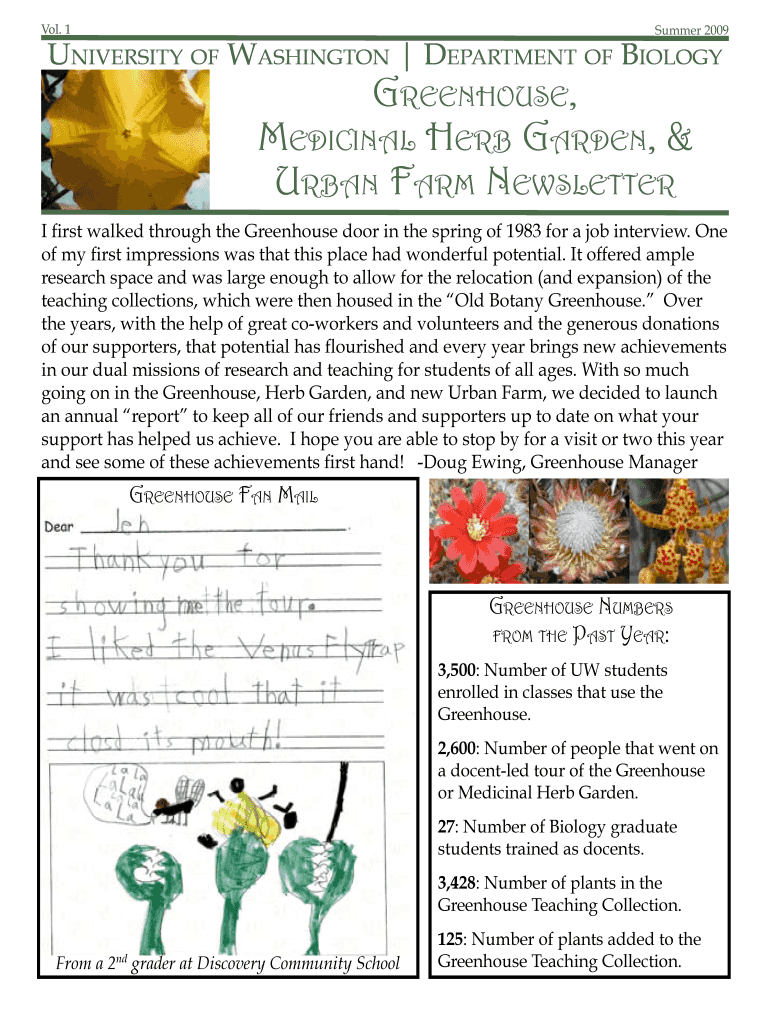







Key Elements of the Greenhouse, Medicinal Herb Garden, and Urban Farm Newsletter - Biology Washington
The Greenhouse, Medicinal Herb Garden, and Urban Farm Newsletter from the University of Washington's Department of Biology is a crucial resource detailing the activities, achievements, and ongoing projects within these facilities. The newsletter serves as a bridge connecting the University with the community, showcasing how these initiatives contribute to education, research, and environmental stewardship.
Statistics on Student Engagement
- The newsletter highlights the active involvement of students in conducting research and participating in educational programs.
- Engagement statistics are included to demonstrate the extent of student participation, emphasizing its educational impact.
- Examples of such statistics might include the number of students involved in research projects or internships related to the garden or farm.
Plant Collections and Educational Programs
- Detailed descriptions of plant species cultivated in the greenhouse and medicinal herb garden, showcasing their diversity and role in academic research.
- Educational programs are outlined to illustrate how these facilities enhance learning opportunities for students in fields such as botany, ecology, and agriculture.
Importance for Research and Teaching
- The facilities play a critical role in facilitating hands-on learning experiences, which are vital for students pursuing sciences.
- Faculty can conduct research that requires controlled environments, surrounded by diverse plant species for experimental and observational studies.
How to Use the Greenhouse, Medicinal Herb Garden, and Urban Farm Newsletter - Biology Washington
The newsletter is designed to be informative and engaging, catering to a varied audience comprising faculty, students, donors, and the wider community. Here's how it can be used effectively:
Engaging Donors and Sponsors
- Highlight opportunities for public support and sponsorships, with specific calls to action for donations.
- Share success stories to inspire contributions and ongoing support.
Enhancing Curriculum
- Educators can integrate information from the newsletter into coursework, using it as a reference for assignments and projects.
- Practical examples and case studies provided in the newsletter can enrich lectures and classroom discussions.
Promoting Community Involvement
- Encourage local community members to visit and participate in workshops or events organized by the greenhouse and garden.
- Spread awareness about sustainable practices and environmental conservation efforts undertaken by the University.
Steps to Complete the Greenhouse, Medicinal Herb Garden, and Urban Farm Newsletter - Biology Washington
For faculty or students involved in compiling the newsletter, following a structured process ensures comprehensive and accurate reporting.
Gathering Content
- Research Recent Projects: Collect details on any recent research projects or events conducted in the past quarter.
- Conduct Interviews: Interview faculty members and students involved in headline projects to gather firsthand insights and testimonials.
Compiling and Editing
- Organize by Theme: Structure the newsletter based on themes like research, student activities, and community outreach.
- Edit for Clarity: Use concise language, ensuring technical terms are explained to cater to a broader audience.
Final Review and Distribution
- Peer Review: Have multiple team members review the newsletter for factual accuracy and clarity.
- Distribute: Utilize both digital platforms and printed copies to reach the widest audience possible.
Who Typically Uses the Greenhouse, Medicinal Herb Garden, and Urban Farm Newsletter - Biology Washington
The newsletter's readership is diverse, encompassing various stakeholders invested in the University's environmental and biological initiatives.


University Students and Faculty
- Students use it to discover research projects they might be interested in joining.
- Faculty members use it to stay informed about departmental developments and potential collaborative opportunities.
Local Community and Alumni
- Community members interested in agriculture or gardening gain insights into the practical applications of these fields.
- Alumni can reconnect with the University’s initiatives, potentially leading to increased alumni engagement and support.
Examples of Using the Greenhouse, Medicinal Herb Garden, and Urban Farm Newsletter - Biology Washington
The newsletter can serve numerous practical purposes, illustrating its versatility and broad appeal.
Educational Tool
- Professors may refer to specific articles or case studies within the newsletter to emphasize concepts taught in biology courses.
- The newsletter acts as a current event resource in sustainability courses, prompting discussions on innovative agricultural practices.
Fundraising and Development
- Development teams within the University utilize the newsletter to pitch for funding, showcasing previous successes to secure future investments.
- Highlighting specific needs of the greenhouse or farm in the newsletter can lead to targeted fundraising efforts.
Legal Use of the Greenhouse, Medicinal Herb Garden, and Urban Farm Newsletter - Biology Washington
Understanding the legal and copyright considerations is essential for the distribution and content use of the newsletter.
Copyright and Content Rights
- Articles and images within the newsletter should respect copyright laws, with permissions secured for any external contributions.
- Any medical or scientific claims must be backed by research, following legal guidelines to prevent misinformation.
Privacy Considerations
- Ensure that all personal data, such as interviews or student contributions, is used with consent.
- Follow privacy laws and University guidelines for sharing personal or sensitive information.
Versions or Alternatives to the Greenhouse, Medicinal Herb Garden, and Urban Farm Newsletter - Biology Washington
While this newsletter provides essential updates, other resources complement its offerings.
Alternative Publications
- Departmental journals or other newsletters within the University may offer more comprehensive research articles or specialized content.
- Online blogs or platforms dedicated to sustainable farming or urban agriculture can provide more industry-specific insights.
Digital Access
- A digital version of the newsletter might offer interactive elements, such as videos or hyperlinks to related research, enhancing reader engagement.
- Subscribing to email updates ensures readers receive the latest issues promptly, increasing the reach and accessibility of content.




