Fm-divb-201 Final Decree of Divorce set B 2026

Get Form
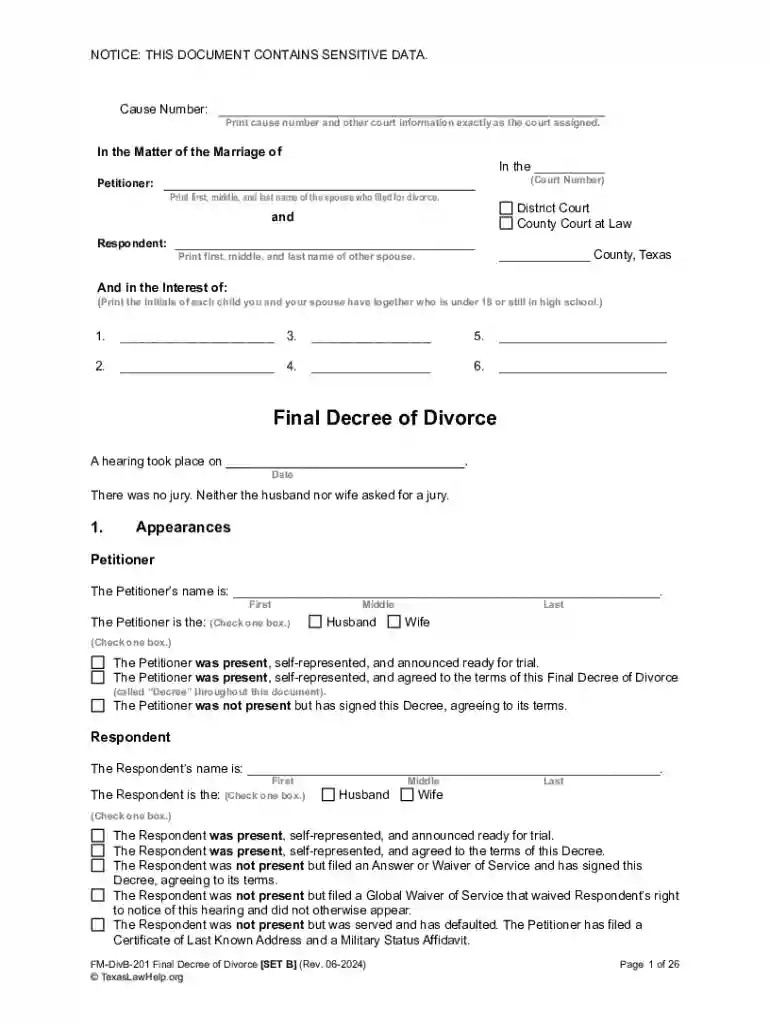
Fm-divb-201 Final Decree of Divorce set B Preview on Page 1

Here's how it works

01. Edit your form online
Type text, add images, blackout confidential details, add comments, highlights and more.

02. Sign it in a few clicks
Draw your signature, type it, upload its image, or use your mobile device as a signature pad.

03. Share your form with others
Send it via email, link, or fax. You can also download it, export it or print it out.

Definition & Meaning

The "Fm-divb-201 Final Decree of Divorce set B" is a legal document issued by a court in Texas, concluding the legal proceedings of a divorce case. This decree serves as a comprehensive legal record detailing the terms of the divorce, including arrangements related to child custody, spousal support, division of property, and other essential elements. It formalizes the end of the marriage, establishing the rights and responsibilities of each party involved.

Key Elements of the Fm-divb-201 Final Decree of Divorce set B

The final decree includes several crucial components that outline the legal obligations and rights of both parties:

  • Jurisdiction and Appearances: Details the court's authority over the case and records the appearances of the parties involved.
  • Child Custody and Support: Specifies arrangements for the custody and care of any children from the marriage, including visitation schedules, child support obligations, and provisions for medical and dental care.
  • Division of Property and Debts: Details how marital assets and liabilities will be divided between the parties.
  • Spousal Support: Outlines any alimony or spousal maintenance, including duration and amount if applicable.

These elements ensure a clear understanding of post-divorce responsibilities and entitlements.

Steps to Complete the Fm-divb-201 Final Decree of Divorce set B

Completing this form involves several steps:

  1. Fill Out Personal Details: Both parties must provide personal information including names and contact details.
  2. Child Custody Arrangements: Specify any agreements related to the care of children, ensuring all necessary fields are completed.
  3. Financial Arrangements: Detail the division of assets and debts, and note any spousal or child support terms.
  4. Review for Accuracy: Verify all entered details before submission to avoid discrepancies and legal issues.
  5. Submit to Court: Once completed, the form must be submitted to the relevant court for processing and approval.

Who Typically Uses the Fm-divb-201 Final Decree of Divorce set B

This document is primarily used by:

  • Divorcing Couples: Couples who are legally ending their marriage and need to establish the terms of their separation.
  • Attorneys: Legal representatives assisting clients through divorce proceedings.
  • Judicial Officials: Court personnel executing and ensuring the legal process of divorce is followed.

These users ensure the decree accurately reflects the agreed-upon terms of divorce.

decoration image ratings of Dochub

State-Specific Rules for the Fm-divb-201 Final Decree of Divorce set B

While this form is generally applicable within Texas, various state-specific rules may apply:

  • Filing Requirements: The form must be submitted within the jurisdiction where the divorce is filed.
  • Residency Requirements: At least one party must meet specific residency requirements for divorce proceedings to be initiated.
  • Child Custody Laws: Texas laws around custody and visitation may influence the terms documented in the decree.

It is important to consult with a legal professional familiar with Texas law to ensure compliance with all relevant legal standards.

How to Obtain the Fm-divb-201 Final Decree of Divorce set B

Obtaining this form can be done through several channels:

  • Online: Access and download from Texas state judicial websites or other legal resource websites.
  • Through Legal Counsel: Attorneys can provide clients with the necessary forms as part of their legal services.
  • Court Clerk's Office: Visit the clerk's office in the applicable county courthouse to request a physical copy.

Each method ensures that applicants can easily acquire the necessary documentation to proceed with their divorce filing.

Legal Use of the Fm-divb-201 Final Decree of Divorce set B

This decree is legally binding and serves as an enforceable agreement between the parties involved. It is:

  • Admissible in Court: As a legal record of the divorce settlement.
  • Required for Financial Institutions: When making changes regarding shared financial accounts or assets.
  • Necessary for Remarriages: Individuals must have a final decree before legally remarrying.

Adhering to the conditions set in the decree is critical, as failure to do so could result in legal consequences.

Important Terms Related to Fm-divb-201 Final Decree of Divorce set B

Understanding the terminology used in this decree is crucial:

  • Petitioner and Respondent: The individuals filing for divorce and responding to the filing, respectively.
  • Conservatorship: Refers to the custody arrangement of any children involved.
  • Community Property: Assets and debts acquired during marriage that must be divided equitably.
  • Possession and Access: Terms related to visitation and parenting time with children.

A clear understanding of these terms ensures all parties are informed and compliant with the decree's stipulations.

Examples of Using the Fm-divb-201 Final Decree of Divorce set B

Consider scenarios where the form plays an essential role:

  • Dispute Resolution: Helps in resolving disputes related to custody or property division post-divorce.
  • Documenting Agreements: Formalizes verbal agreements made during mediation into a legally binding document.
  • Employment and Benefits Changes: Provides the necessary documentation for updating marital status with employers or benefit providers.

Such examples highlight the decree's importance in ensuring a smooth transition post-divorce.

be ready to get more

Complete this form in 5 minutes or less

Get form

Got questions?

We have answers to the most popular questions from our customers. If you can't find an answer to your question, please contact us.
Contact us
In Texas, there needs to be a final divorce decree filed and signed by a judge in order for your divorce to be final. It is important to note that a divorce cannot be finalized until 60 days from the filing of the Original Petition for Divorce is filed and accepted by the court.
Your divorce is final in Texas once the judge signs the final divorce decree. You will receive a copy of the signed decree from the court, typically through your attorney or directly from the court clerk. This signed decree is the official document that legally ends your marriage.
In Texas, there needs to be a final divorce decree filed and signed by a judge in order for your divorce to be final.
Your divorce will officially become final once a judge signs your divorce decree. It will be sent to your attorney and he or she will send you a copy. The date on your decree is the date of your divorce.
Certified copies of divorce decrees are only available from the district clerk. Certified copies of marriage/divorce records must be obtained in the county or district in which they were originally filed.

Security and compliance

At DocHub, your data security is our priority. We follow HIPAA, SOC2, GDPR, and other standards, so you can work on your documents with confidence.
Learn more
ccpa2
pci-dss
gdpr-compliance
hipaa
soc-compliance

People also ask

Although the exact format varies, a standard divorce decree will include the courts name, the case number, the spouses names, and, at the end, the judges signature. Although not shown in this picture, important provisions like parental rights, visitation, and child support will also appear.
Default means you have your spouse served with the initial divorce papers and your spouse does not file an answer with the court. If your spouse is served and defaults (does not file an answer with the court), you can finish your divorce without your spouse.
See why moving out is the biggest mistake in a divorce. You May Give a Divorce Judge the Impression Youve Abandoned Your Spouse. You Could Affect the Decisions a Divorce Judge Makes Regarding Child Custody. You Will Negatively Impact Your Financial Situation and the Equitable Distribution of Marital Assets.

Related links