




01. Edit your form online
Type text, add images, blackout confidential details, add comments, highlights and more.

Type text, add images, blackout confidential details, add comments, highlights and more.

Draw your signature, type it, upload its image, or use your mobile device as a signature pad.

Send it via email, link, or fax. You can also download it, export it or print it out.
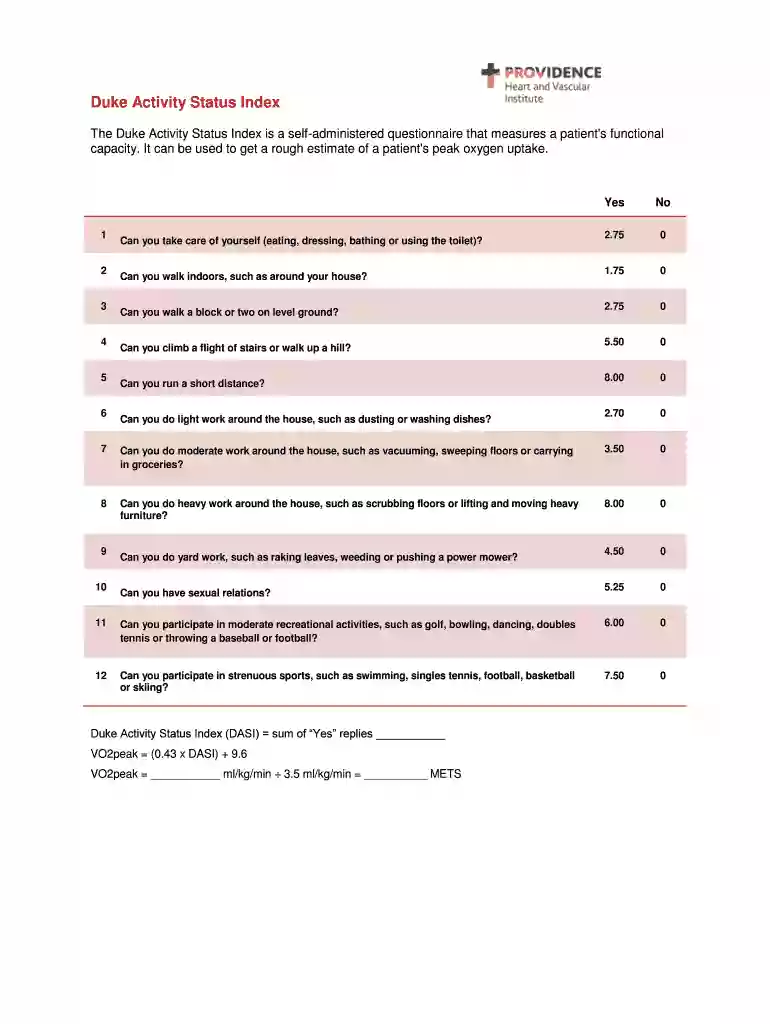
The Duke Activity Status Index (DASI) is a self-administered questionnaire aimed at evaluating a patient's functional capacity. It helps estimate peak oxygen uptake through a series of questions about everyday activities and physical abilities. Responses to these questions generate a score that aids in the calculation of VO2peak, providing insights into an individual's cardiovascular health and fitness level.
To effectively use the DASI, follow these steps:
This process assists healthcare providers in assessing cardiovascular fitness and planning appropriate interventions or treatments.
The DASI can be obtained from medical professionals, hospitals, or trusted health information sources. Typically, clinics use this questionnaire as part of a routine assessment for patients experiencing cardiovascular issues. Patients may also download and complete the form if available online through healthcare providers or medical research websites.
Completing the DASI involves the following:
These steps ensure that the assessment accurately reflects your functional status.
The DASI is crucial for several reasons:
These factors highlight the DASI's role in comprehensive patient care and health management.
The DASI comprises several components:
These elements are designed to offer a complete picture of a patient's activity status.
The DASI is predominantly used by:
This broad usage underscores the tool's versatility in clinical and personal health settings.


In the U.S., adherence to legal and ethical standards is vital when using the DASI:
These considerations help maintain patient rights and confidentiality while using the DASI for medical assessments.
We've got more versions of the The Duke Activity Status Index is a self-administered questionnaire that measures a patient's functi form. Select the right The Duke Activity Status Index is a self-administered questionnaire that measures a patient's functi version from the list and start editing it straight away!
| Versions | Form popularity | Fillable & printable |
|---|---|---|
| 2011 | 4.5 Satisfied (53 Votes) |
At DocHub, your data security is our priority. We follow HIPAA, SOC2, GDPR, and other standards, so you can work on your documents with confidence.




by X Fan 2015 Cited by 64 The Duke Activity Status Index (DASI) is a 12-item, self-administered questionnaire to measure functional status.
Mar 2, 2026 Supercritical water oxidation (SCWO) is a single step wet oxidation process that transforms organic matter into water, carbon dioxide and,Read more


