







Definition & Meaning
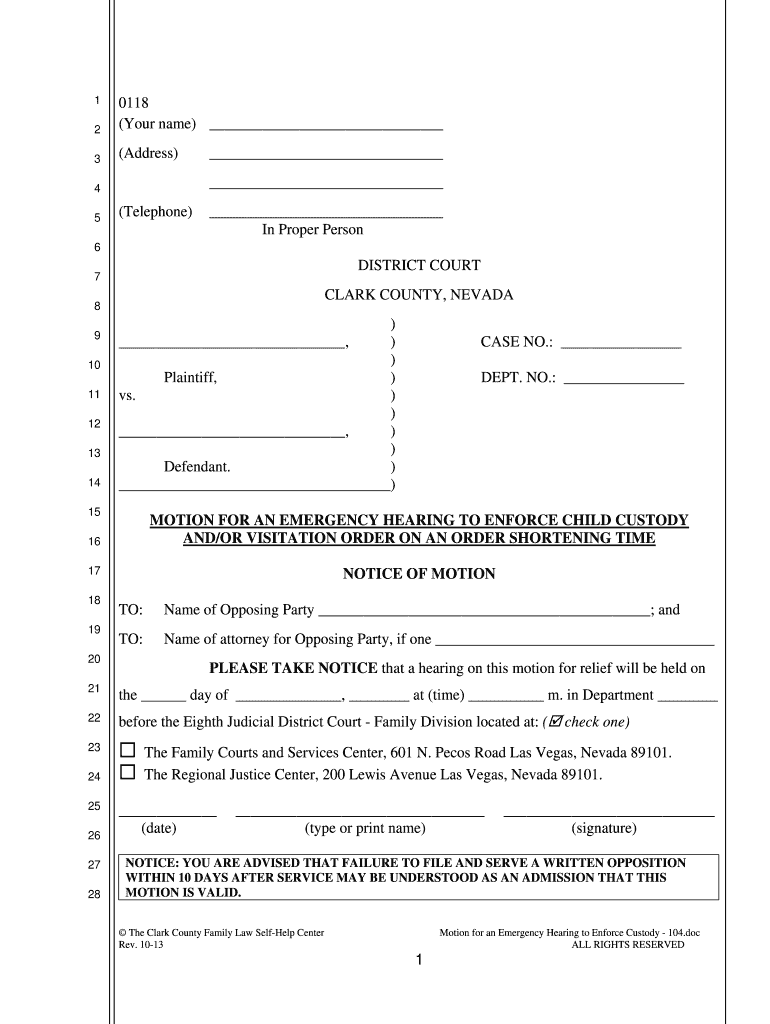
The "Motion for an Emergency Hearing to Enforce Custody - 104doc" is a legal document used in family court proceedings, specifically in the context of child custody disputes. This form requests an immediate court hearing to address urgent issues regarding the enforcement of a child custody arrangement. It is aimed at resolving situations where existing custody or visitation agreements are not being adhered to, posing a significant and immediate concern for the child's welfare. This motion is typically filed when a parent believes that complying with the original custody agreement is critical to protecting the child's best interests.
How to Obtain the Motion for an Emergency Hearing to Enforce Custody - 104doc
To obtain the "Motion for an Emergency Hearing to Enforce Custody - 104doc," parties involved in a child custody case usually need to access it through the local family court where their case is filed. This form can often be found on the court's official website for downloadable access. In some cases, individuals can obtain physical copies from the courthouse. It is crucial to ensure that you have the correct form version specific to your jurisdiction, as legal requirements can vary by state.
Steps to Complete the Motion for an Emergency Hearing to Enforce Custody - 104doc
- Gather Information: Compile all relevant details about the custody arrangement, including dates, any breaches of the agreement, and incidents that demonstrate the need for urgent intervention.
- Complete the Form: Fill out the sections that require the petitioner’s and respondent's information, details of the children involved, and the reasons for requesting an emergency hearing.
- Attachment of Evidence: Attach supporting documents such as previous court orders, communication logs, and any evidence that substantiates the claims made in the motion.
- Review Legal Standards: Ensure that the motion aligns with legal standards and highlights how the request serves the child's best interests.
- Submission: File the completed form at the family division of the local courthouse and pay any applicable filing fees. Confirm appropriate procedures for serving the motion to the other party involved.
Key Elements of the Motion for an Emergency Hearing to Enforce Custody - 104doc
- Parties' Information: Details about the petitioner and respondent, including contact information and relationship to the child.
- Current Order: References to the existing custody or visitation order that is allegedly being violated.
- Grounds for Emergency: Justification for the emergency status, emphasizing immediate risks to the child's well-being.
- Proposed Solution: Suggestions for how the court should address the situation to enforce the custody order.
- Prior Involvement: Any history of law enforcement or Child Protective Services' involvement related to the custody issues at hand.
Legal Use of the Motion for an Emergency Hearing to Enforce Custody - 104doc
The legal use of this motion is strictly to address immediate and significant violations of custody agreements. It is commonly employed when one parent denies access to the other parent, relocates without consent, or when there are concerns involving the child's safety. Legal counsel is often recommended when drafting and submitting this motion due to complex regulations and potential for significant impact on custody arrangements.
State-Specific Rules for the Motion for an Emergency Hearing to Enforce Custody - 104doc
State-specific legal frameworks govern the filing and adjudication of the motion. These rules can include specific stipulations about what constitutes an emergency and the evidence required. For instance, Nevada law emphasizes the best interest of the child as a critical factor in such cases. Understanding the procedural nuances and legal standards unique to your state is essential for effectively navigating the filing process and achieving the desired outcome.
Important Terms Related to Motion for an Emergency Hearing to Enforce Custody - 104doc
- Custody Order: A legal document outlining the responsibilities and rights of each parent regarding their child’s upbringing.
- Petitioner: The individual who initiates the motion.
- Respondent: The individual against whom the motion is filed.
- Best Interest of the Child: Legal standard used to decide custody based on what is most beneficial for the child's well-being.
- Visitation Rights: The non-custodial parent's legal right to spend time with their child as outlined in the custody order.
Examples of Using the Motion for an Emergency Hearing to Enforce Custody - 104doc
- Denied Visitation: A parent has repeatedly denied the other parent's scheduled visitations, warranting immediate court intervention to restore rights.
- Unapproved Relocation: One parent relocates the child to another state without obtaining consent or modifying the court order.
- Immediate Safety Concerns: Evidence suggests that the child is in an environment detrimental to their health or safety, prompting urgent court action.
Required Documents
When submitting the motion, certain documents are typically required to support the case:
- Existing Court Orders: The original custody agreement or any modifications that have been officially recorded.
- Evidence of Violation: Communication records, affidavits, or witness statements illustrating the infraction.
- Additional Documentation: Reports from Child Protective Services or law enforcement, if relevant to the case.




