




01. Edit your form online
Type text, add images, blackout confidential details, add comments, highlights and more.

Type text, add images, blackout confidential details, add comments, highlights and more.

Draw your signature, type it, upload its image, or use your mobile device as a signature pad.

Send it via email, link, or fax. You can also download it, export it or print it out.
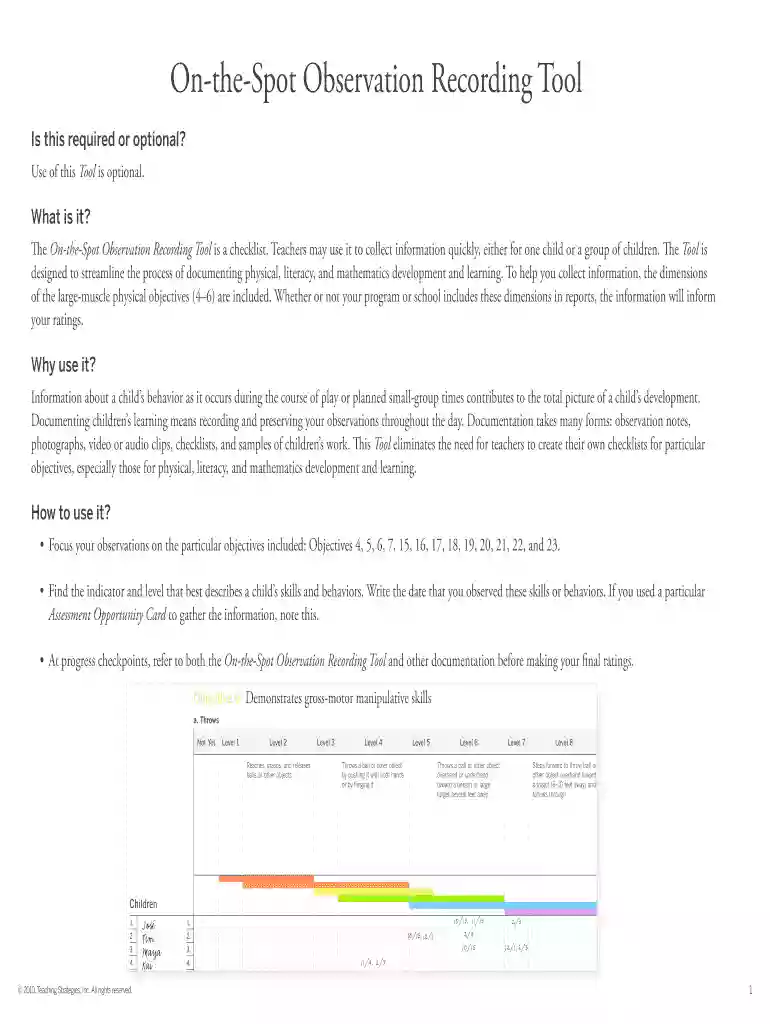
The On-the-Spot Observation Recording Tool is a resource designed primarily for teachers to document children's development in real-time. It serves as a checklist to capture aspects of physical, literacy, and mathematics development, particularly during play or small-group activities. This tool aids educators by providing specific objectives and indicators that help in assessing children's skills and behaviors without interrupting their flow. Ultimately, it enhances the understanding of a child's overall developmental progress and ensures that important learning milestones are recorded efficiently.
To effectively use the On-the-Spot Observation Recording Tool, educators should familiarize themselves with its components and objectives. Steps include:
Select the Developmental Area: Decide whether the focus is on physical, literacy, or mathematics development.
Identify Key Objectives: Before observing, review the specific objectives and indicators listed on the tool.
Observe and Record: As children engage in activities, document their behaviors and skills using notes, photographs, or checklists. Ensure observations are detailed and clear.
Utilize Varied Documentation: Include different types of documentation, such as notes for detailed behaviors, photographs for visual reference, and checklists for quick assessments.
These steps help in maintaining a structured approach, enabling educators to capture comprehensive developmental data.
Completing the tool involves several key steps that ensure detailed documentation:
Preparation: Familiarize with the tool's format and prepare any necessary materials, such as a camera for capturing photographs or a tablet for digital notes.
Observation Period: Choose a suitable time and setting that allows for unobtrusive observation, such as during free play or structured activities.
Documentation: Record observations systematically, ensuring each entry is time-stamped and linked to the correct developmental area.
Review and Reflect: After observations, review the recorded data to ensure completeness and accuracy. Reflect on any patterns or areas needing further attention.
Integration with Planning: Use the collected data to inform lesson planning and individual learning plans, guiding educational approaches.
These steps ensure that the tool is used effectively to monitor and enhance children's learning experiences.
The tool comprises several key elements that facilitate its use:
By utilizing these elements, the tool serves as an adaptable and comprehensive framework for recording children's development.
Consider a classroom setting where children are engaged in a block-building activity. An educator might use the tool to document:
Physical Development: How children use their fine motor skills to manipulate blocks, observing precision in placement and hand-eye coordination.
Literacy Development: Noting any vocabulary used by children while interacting, such as naming shapes or using terms like "balance" and "stability."
Mathematics Development: Observing counting activities, measuring the height of structures, or noting problem-solving strategies used when the structure topples.
Such examples showcase the tool's versatility in capturing diverse aspects of learning.
The tool is primarily designed for:
Each user type benefits from the tool's ability to provide structured insights into child development.


The tool can be used with various software for enhanced functionality:
Utilizing software compatibility, educators can maintain organized and accessible records.
Legal compliance and ethical considerations are critical when using the tool:
Following these guidelines ensures that the tool is used responsibly and ethically.
At DocHub, your data security is our priority. We follow HIPAA, SOC2, GDPR, and other standards, so you can work on your documents with confidence.



Jul 13, 2015 using as a tool the systematic observation and recording of the childrens needs, interests and development in terms of learning
by SA Md-Yunus 2014 The on-the-spot observation recording tool streamlines the overall process of recording information about physical development, literacy, and


