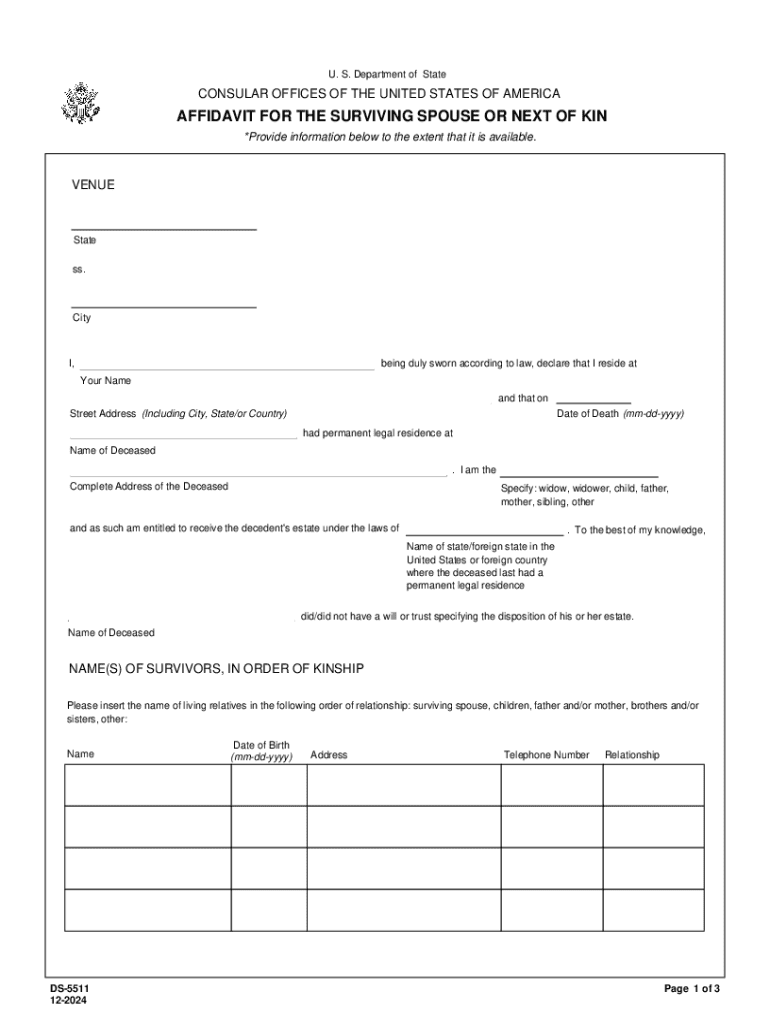







Definition and Meaning
The DS-5511, Affidavit for the Surviving Spouse or Next of Kin, is a form issued by the U.S. Department of State. It is specifically designed for the surviving spouse or next of kin of a deceased American citizen who passed away outside the United States. This affidavit captures essential information about the affiant's relationship with the deceased, the deceased's legal residence, and pertinent details about the decedent's estate. It plays a crucial role in assisting U.S. Consular Officers in managing the personal effects of deceased citizens, ensuring that the possessions of the decedent are appropriately handled and distributed according to legal and familial considerations. By documenting this information, the DS-5511 also emphasizes the voluntary nature of participation, yet highlights that failure to submit this form may necessitate alternative documentation.
How to Use the DS-5511 Affidavit for the Surviving Spouse or Next of Kin
Utilizing the DS-5511 involves several critical steps to ensure that all required information is accurately captured and submitted. This process generally starts with acquiring the form, which can typically be obtained through the U.S. Department of State’s website or from a U.S. Consulate abroad. The primary purpose of the affidavit is to provide comprehensive details regarding the relationship between the affiant and the deceased, including contact information, legal standing, and a declaration of intent concerning the decedent’s estate. Once completed, the form must be submitted to the appropriate U.S. Consular Office, allowing them to initiate the necessary actions related to the deceased’s estate and personal effects.
Detailed Instructions
- Acquire the form: Download from the U.S. Department of State’s official site or request a physical copy from a U.S. Consulate.
- Complete the personal information sections: This includes your full name, the deceased's full name, your relationship to the decedent, and contact details.
- Declare estate intentions: Clearly outline any claims or intentions regarding the deceased’s estate.
- Review for accuracy: Ensure all information is correct and complete before submission.
- Submit to the relevant consulate: Depending on your location and the consulate's requirements, submission may be in person or by mail.
Steps to Complete the DS-5511 Affidavit for the Surviving Spouse or Next of Kin
Completing the DS-5511 affidavit involves a structured process to ensure all necessary details are accurately documented. Here is a step-by-step guide to filling out this form:
- Download the Form: Access the form via the U.S. Department of State’s website to ensure you have the most current version.
- Fill in Personal Details: Enter your full name, address, and contact information in the designated fields.
- Provide Deceased's Information: Accurately enter the deceased’s name, date of birth, and last known residence.
- Declare Relationship: Specify your exact relationship to the deceased, whether as a spouse, child, or another form of legal kinship.
- Detail Estate Information: Indicate any known details about the deceased’s estate, including any executorship or financial claims.
- Sign and Date: Confirm the information is accurate to the best of your knowledge, then sign and date the form.
- Submission: Submit the completed affidavit to the appropriate U.S. Consulate office, adhering to any specific submission guidelines provided.
Key Elements of the DS-5511 Affidavit for the Surviving Spouse or Next of Kin
The DS-5511 form comprises several critical sections that capture necessary information for processing. These elements include:
- Personal Information: Basic details about both the affiant and the deceased, serving as the foundation for the affidavit.
- Relationship Confirmation: A critical section that requires elaboration on the affiant’s relationship to the deceased.
- Estate Declaration: Outlining intentions or claims relative to the decedent’s estate encourages accurate and fair handling by U.S. Consular Officers.
- Affirmation and Signature: Affirming the accuracy of the information with a signed declaration ensures legal compliance and accountability.
Importance of Each Element
- Personal Information aids in verifying identities and contact points.
- Relationship Confirmation assists in prioritizing legal rights and responsibilities.
- Estate Declaration supports the management and distribution of the deceased’s assets.
- Affirmation of details upholds the truthfulness and legal standing of the affidavit.
Why Use the DS-5511 Affidavit for the Surviving Spouse or Next of Kin
Utilizing the DS-5511 form is crucial for several reasons. It systematically addresses the need for organized and legally compliant management of the deceased’s effects abroad. By consolidating necessary information into a standardized document, the form ensures that the U.S. Consular Officers efficiently process the deceased’s estate in alignment with U.S. legal standards.
Benefits
- Streamlines processing of the decedent's estate.
- Legalizes the affiant’s relationship and claims.
- Facilitates communication with relevant authorities.
- Minimizes the need for additional documentation or hassle.
Who Typically Uses the DS-5511 Affidavit for the Surviving Spouse or Next of Kin
The DS-5511 is generally used by those closely connected to a deceased American citizen who has died abroad. This typically includes:
- Surviving spouses seeking to manage and repatriate the decedent’s possessions.
- Next of kin, such as children or parents, who have a close familial relationship with the deceased.
- Legal representatives or executors appointed to manage the deceased’s estate.


Legal Use of the DS-5511 Affidavit for the Surviving Spouse or Next of Kin
The DS-5511 affidavit serves a legal purpose by ensuring the proper handling of the deceased’s personal effects according to U.S. and international legal standards. It provides a legally recognized mechanism for the affiant to communicate their relationship and any claims to the deceased’s property.
Functions
- Legal Proof: Establishes legal rights to manage and claim the deceased's assets.
- Affidavit Authenticity: Serves as a sworn statement that can be used in legal proceedings if necessary.
- Regulatory Compliance: Ensures that all international and U.S. laws regarding estate management abroad are adhered to.
State-Specific Rules for the DS-5511 Affidavit for the Surviving Spouse or Next of Kin
While the DS-5511 is a federal form commonly used across various states, certain state-specific nuances might affect the way the information is processed or the legal implications thereof. It’s essential that users understand any unique state regulations that might intersect with federal guidelines when managing an estate or claiming kinship rights through the DS-5511.
Considerations
- State Requirements: Check for unique state laws related to probate or estate handling that may apply.
- Integration with State Systems: Understand how the federal form might be utilized in tandem with state-level legal proceedings.
- State Variations: Be aware that different states may have distinct procedures or requirements in recognizing international estate claims.
Understanding these details will ensure comprehensive compliance and facilitate smoother legal processes when using the DS-5511.