
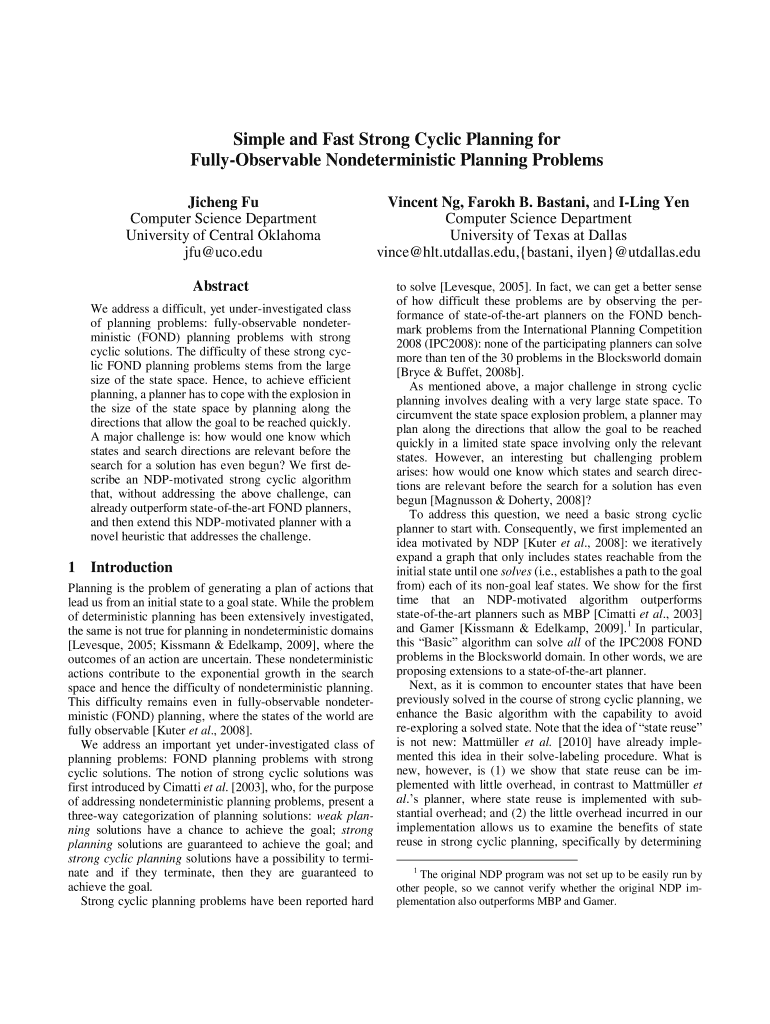







Understanding Strong Cyclic Planning
Strong cyclic planning is a form of planning used in artificial intelligence to find solutions within fully-observable nondeterministic environments. It involves creating strategies allowing for cycles in the plan, ensuring the goals are eventually achieved despite uncertainties. This planning approach is particularly useful when dealing with complex scenarios where the outcome of certain actions cannot be precisely predicted, allowing for flexible and robust decision-making. The key objective is to efficiently cover large state spaces while ensuring plan effectiveness.
Practical Applications of Strong Cyclic Planning
Strong cyclic planning is used in scenarios that require robust solutions in uncertain environments. It finds applications in robotics, where a robot must complete tasks in dynamic settings, and in logistics, where planners need to ensure goods are delivered despite potential disruptions. This type of planning is crucial for autonomous systems that need to adapt to changing conditions without human intervention, ensuring they can achieve their goals by adapting their strategies as new information becomes available.
Steps to Implement Strong Cyclic Planning
-
Problem Definition: Begin by clearly understanding the problem, identifying the goals, and recognizing the potential uncertainties within the environment.
-
Model Creation: Develop a model representing the various states and actions possible within the environment. This model will serve as the basis for planning.
-
Algorithm Selection: Choose a strong cyclic planning algorithm that is best suited for the specific problem. Algorithms like the Fast Incremental Planner (FIP) are useful for efficiently navigating large state spaces.
-
Plan Development: Use the algorithm to generate a plan that ensures goals are achieved despite uncertain outcomes. The plan should accommodate cycles to revisit states as needed.
-
Testing and Iteration: Test the plan in simulated or real environments, adjusting as necessary to address any unforeseen challenges and to enhance efficiency.
Key Elements of Simple and Fast Strong Cyclic Planning
Strong cyclic planning involves several critical components:
-
State Space Representation: A comprehensive model of all possible states the system can encounter. The efficiency of the plan depends on how well this space is covered.
-
Action Set: A list of all feasible actions that can transition the system from one state to another. The actions must accommodate potential uncertainties.
-
Goal Recognition: Clearly defined goals that the plan must achieve, ensuring that multiple paths can still lead to successful outcomes.
-
Cyclic Strategies: Techniques that allow the revisitation of states to handle nondeterminism, ensuring plan robustness.
software compatibility and tools
Strong cyclic planning can be implemented using various software tools and platforms. Tools like TurboTax and QuickBooks may offer capabilities compatible with implementing or simulating planning processes. These tools can support the creation, testing, and deployment of planning strategies. Integration with existing systems, such as DocHub for document management and workflow, enhances the overall planning process by streamlining document handling related to planning activities.
Legal and ethical considerations in strong cyclic planning
When implementing strong cyclic planning, particularly in sensitive environments, it’s crucial to consider the legal and ethical implications. For example, automated decision-making processes must comply with applicable data protection regulations, such as the GDPR or the CCPA. Ethical considerations include transparency in decision-making processes and ensuring that the use of AI in planning does not result in unintended biases or inequalities.
Examples of strong cyclic planning in action
Real-world scenarios of strong cyclic planning include autonomous vehicle navigation, where vehicles must adhere to routes that account for changing traffic conditions and potential detours. In healthcare, this planning method can be used to manage patient treatment pathways, adjusting for possible variations in patient responses to treatment. Another example is in manufacturing, where production lines can be optimized to handle equipment downtimes or supply chain disruptions while maintaining overall productivity.
Challenges and Considerations in Strong Cyclic Planning
Implementing strong cyclic planning poses several challenges, including:
-
Scalability: As state spaces grow, the complexity of developing efficient plans increases.
-
Computational Resources: High computational power may be required to test and deploy plans within large and complex environments.
-
Dynamic Adaptation: Plans must be flexible enough to adapt to real-time changes without requiring complete redevelopment.
Addressing these challenges involves using advanced planning algorithms, efficient computational strategies, and continuous testing and refinement.




