




01. Edit your form online
Type text, add images, blackout confidential details, add comments, highlights and more.

Type text, add images, blackout confidential details, add comments, highlights and more.

Draw your signature, type it, upload its image, or use your mobile device as a signature pad.

Send it via email, link, or fax. You can also download it, export it or print it out.
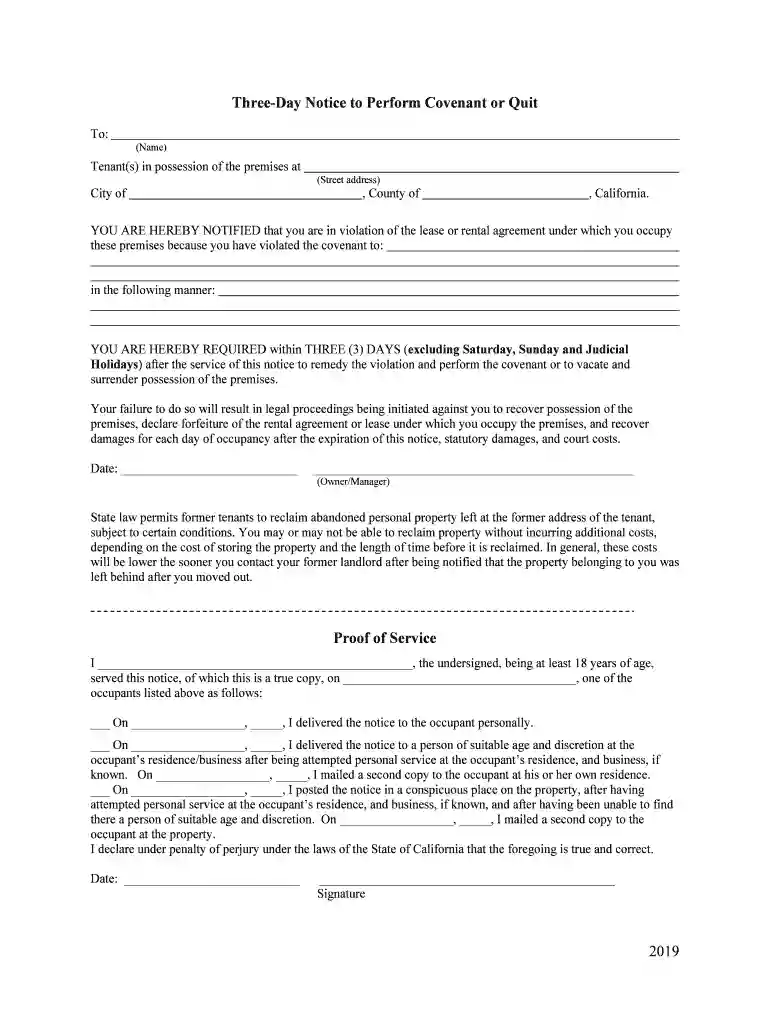
The "Three-Day Notice to Perform Covenant or Quit" is a legal document used primarily in the United States to address lease violations by tenants. This notice is issued by landlords or property managers to tenants who have breached specific terms of their lease agreement. The notice gives the tenant three days to correct the violation, known as performing the covenant, or vacate the premises, hence the term "quit." Common lease violations could include failing to maintain the property, unauthorized subletting, or having pets when they are prohibited by the lease.
When a lease violation occurs, the landlord should first document the breach to create a clear record. The next step is to fill out the Three-Day Notice to Perform Covenant or Quit form, ensuring that it includes specific information about the breach and the steps the tenant must take to rectify it. Importantly, landlords must clearly state the deadline for compliance. This notice should be delivered to the tenant either in person or by certified mail with return receipt, ensuring proof of service.
Comprehensive completion of these steps ensures legal enforceability and enhances the clarity of the message communicated to the tenant.
These elements are crucial for the legality and clarity of the notice, to prevent disputes between tenant and landlord.
This form is aligned with legal procedures for managing lease violations, providing landlords with a tool to enforce compliance. It’s a prelude to eviction proceedings, ensuring landlords give tenants a fair opportunity to correct their actions. Landlords must follow state-specific laws governing notice requirements to avoid legal pitfalls during potential eviction processes.
Various states in the U.S. have unique specifications for issuing this notice. For example, in California, extra care must be taken to list all the allegations in the lease breach, ensuring it covers the legal grounds for eviction. Some states might require additional notification procedures or offer longer periods for tenants with particular circumstances, like disabilities or health issues.
Understanding these terms facilitates better communication between tenants and landlords, easing the resolution process of lease violations.
Consider a tenant who has a pet in a unit where the lease prohibits animals. The landlord issues a Three-Day Notice to Perform Covenant or Quit, detailing the lease clause prohibiting pets and requiring the tenant to either remove the pet within three days or face potential eviction proceedings. Another example might involve unauthorized alterations to a property, such as painting walls without consent. Here, the landlord would specify the original wall color as part of the restoration requirement in the notice.
We've got more versions of the Three-Day Notice to Perform Covenant or Quit form. Select the right Three-Day Notice to Perform Covenant or Quit version from the list and start editing it straight away!
At DocHub, your data security is our priority. We follow HIPAA, SOC2, GDPR, and other standards, so you can work on your documents with confidence.



3-day Notice to Perform Covenants or Quit. You must do something (like remove a pet if pets arent allowed) or move out in 3 days. Move out by a deadline. 3Read more
Dec 8, 2004 Three-Day Notices to Perform Covenant or Quit are served for delinquent balances that have occurred after March 31, 2023.


