




01. Edit your appraisal district residence homestead exemption online
Type text, add images, blackout confidential details, add comments, highlights and more.

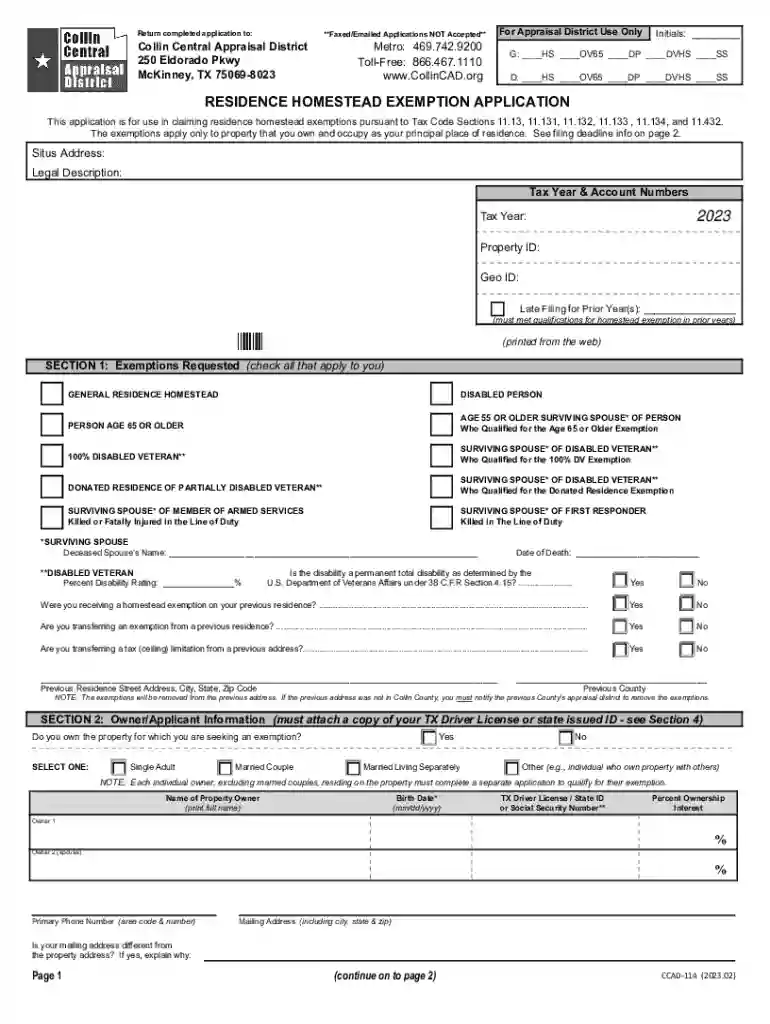
Type text, add images, blackout confidential details, add comments, highlights and more.

Draw your signature, type it, upload its image, or use your mobile device as a signature pad.

Send collin homestead exemption via email, link, or fax. You can also download it, export it or print it out.
The Application for Residence Homestead Exemption is a form used by homeowners in the United States to claim a reduction in property taxes on their primary residence. This exemption significantly reduces the taxable value of a home, thereby lowering the amount of property taxes owed. Different variations of the exemption exist, catering to specific categories such as disabled persons, seniors aged 65 or older, and surviving spouses of veterans. Collectively, these exemptions can lead to substantial savings on property taxes, proving essential for qualifying individuals.
Obtain the Form: Start by acquiring the form from your local appraisal district's website or office.
Fill Out Personal Information: Provide your full name, address of the property, and contact information.
Select the Appropriate Exemption Type: Make sure to indicate which exemption applies to you, such as for disabled individuals or seniors.
Attach Required Documentation: Attach documentation like proof of age, disability, or veteran status, if needed for the exemption type.
Sign and Date the Application: Ensure all information is accurate, then sign and date the form for validity.
Submit the Form: Mail or deliver the application to your local appraisal district by the deadline to ensure timely processing.
Eligibility for a residence homestead exemption requires that the applicant owns and occupies the property as their primary residence. Furthermore, specific exemptions based on circumstances such as age, disability, or military service require additional documentation. Senior exemptions typically require proof of age, such as a birth certificate or driver's license. Disabled individuals may need to present a certification, while surviving spouses of veterans might require military discharge papers. Ensuring all criteria are met is critical for application approval.


Submitting the application necessitates providing various documents. Homeowners must usually offer proof of ownership, such as a property deed, and identification verifying residency, like a driver's license. Specific exemptions require additional documentation:
In Texas, and many other states, the filing deadline for a residence homestead exemption is April 30 of the tax year. Submissions must be received by this date, not merely postmarked. Missing the deadline generally results in ineligibility for exemption benefits for that tax year. It is important to confirm the deadline with the local appraisal district, as variations may occur based on location or specific circumstances. Mark these dates on your calendar to avoid potential penalties.
Acquiring the Application for Residence Homestead Exemption typically involves contacting the local appraisal district in your county. Many appraisal districts provide downloadable forms on their websites, streamlining access to necessary documents. Additionally, forms can often be obtained in person at the district office. If online access is unavailable, deliver applications in hard copy to ensure completeness and validity.
Homeowners have multiple options for submitting their completed exemption applications. Many local appraisal districts offer online portals for electronic submission, offering a convenient and quick method. Alternatively, applications can be mailed directly to the appraisal district's address; ensure adequate postage and use a reliable mailing service. While less common, in-person submission is still an option for individuals preferring direct handoff. Verify with your local district to confirm acceptable methods.
The application contains several critical components that must be accurately completed to ensure eligibility and processing:
By addressing each of these elements thoroughly, applicants can optimize the chance of receiving desired exemptions.
We've got more versions of the appraisal district residence homestead exemption form. Select the right appraisal district residence homestead exemption version from the list and start editing it straight away!
At DocHub, your data security is our priority. We follow HIPAA, SOC2, GDPR, and other standards, so you can work on your documents with confidence.


Jul 3, 2026 The SVAMITVA property card is a government-issued record of rights for your house and plot in the inhabited (abadi) area of your village.
Mar 29, 2022 The completed application and required documentation are due no later than April 30 of the tax year for which you are applying. A late homesteadRead more


