




01. Edit your texas ez computation report online
Type text, add images, blackout confidential details, add comments, highlights and more.

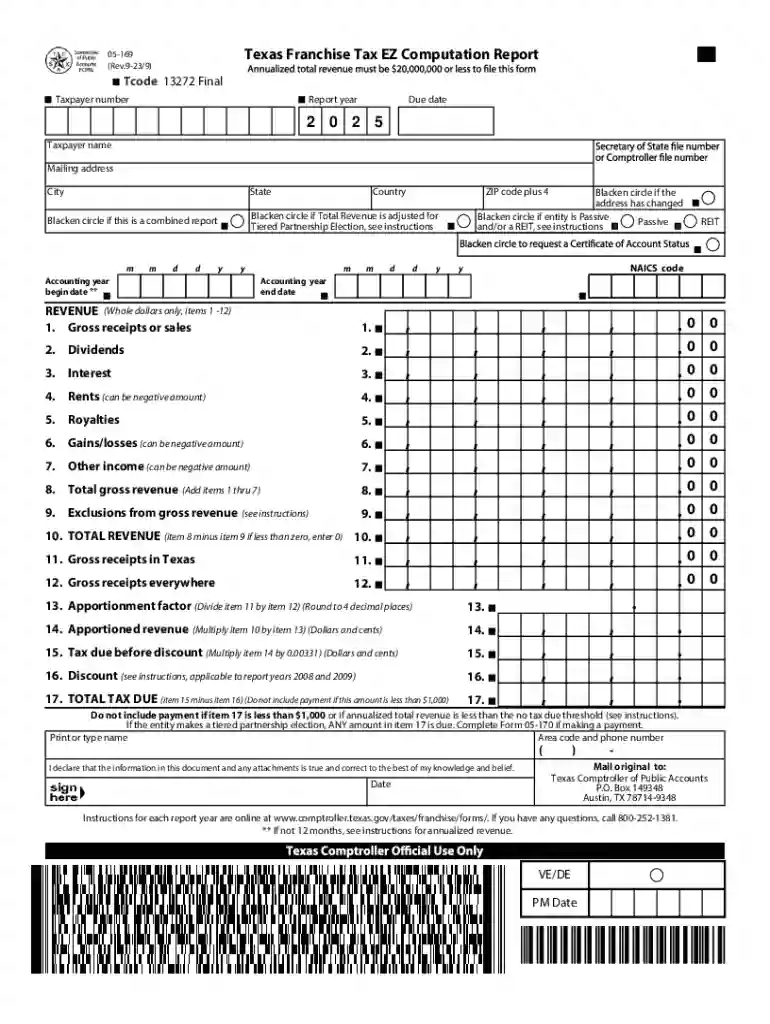
Type text, add images, blackout confidential details, add comments, highlights and more.

Draw your signature, type it, upload its image, or use your mobile device as a signature pad.

Send texas form 05 169 via email, link, or fax. You can also download it, export it or print it out.
Form 05-169, Texas Franchise Tax 2025 E-Z Computation Final, is a specialized document used by businesses operating in Texas to report franchise tax obligations. The form is designed to simplify the process for small businesses by providing an "E-Z" computation method for calculating franchise taxes due. It captures essential taxpayer information, revenue items, apportionment factors, and the total tax owed. The goal is to streamline the tax filing process, ensuring compliance with Texas state laws.
Completing the Form 05-169 requires attention to detail and accuracy. Follow these steps to ensure compliance:
Download or Obtain the Form: Start by acquiring the latest version of the Form 05-169 directly from the Texas Comptroller's website.
Provide Taxpayer Information: Fill out the necessary taxpayer details, including the name of the business, address, and tax identification number.
Report Revenue Items: Carefully document total revenue and various income categories, ensuring all amounts align with your records.
Calculate Tax Due: Use the E-Z computation method provided to accurately calculate the franchise tax due based on your reported revenues.
Review and Sign: Double-check all entries for accuracy and completeness. Sign the form to certify the information provided.
Submit Form: Send the completed document through your preferred method - either online via the Texas Comptroller’s website, by mail, or in person.
Understanding key terms within Form 05-169 ensures accurate completion:
Businesses operating in Texas and subject to franchise taxes typically use Form 05-169. This includes:
Form 05-169 contains several critical sections necessary for accurate filing:
Form 05-169 offers several submission options to accommodate different preferences and resources:
Timely filing of Form 05-169 is crucial to avoid penalties. Key dates include:
Non-compliance with filing requirements for Form 05-169 can result in significant penalties:
By understanding and utilizing these sections, taxpayers can navigate and complete Form 05-169, Texas Franchise Tax 2025 E-Z Computation Final, effectively.
We've got more versions of the texas ez computation report form. Select the right texas ez computation report version from the list and start editing it straight away!
| Versions | Form popularity | Fillable & printable |
|---|---|---|
| 2025 | 4.5 Satisfied (32 Votes) | |
| 2024 | 4.8 Satisfied (23 Votes) | |
| 2022 | 4.8 Satisfied (60 Votes) | |
| 2021 | 4.4 Satisfied (268 Votes) | |
| 2020 | 4.4 Satisfied (184 Votes) | |
| 2019 | 4.4 Satisfied (38 Votes) | |
| 2018 | 4 Satisfied (57 Votes) | |
| 2016 | 4.4 Satisfied (160 Votes) | |
| 2013 | 4.2 Satisfied (120 Votes) | |
| 2011 | 4.4 Satisfied (349 Votes) |
At DocHub, your data security is our priority. We follow HIPAA, SOC2, GDPR, and other standards, so you can work on your documents with confidence.






EZ Computation if it has annualized total revenue of $20 million or less. 05-169, EZ Computation Report - ANNUAL (PDF) or FINAL (PDF)
Eligibility for no tax due, discounts and the E-Z Computation. The no tax due thresholds, discounts and the E-Z Computation do not apply to an upper or lower


