01. Edit your form online
Type text, add images, blackout confidential details, add comments, highlights and more.

Type text, add images, blackout confidential details, add comments, highlights and more.

Draw your signature, type it, upload its image, or use your mobile device as a signature pad.

Send it via email, link, or fax. You can also download it, export it or print it out.
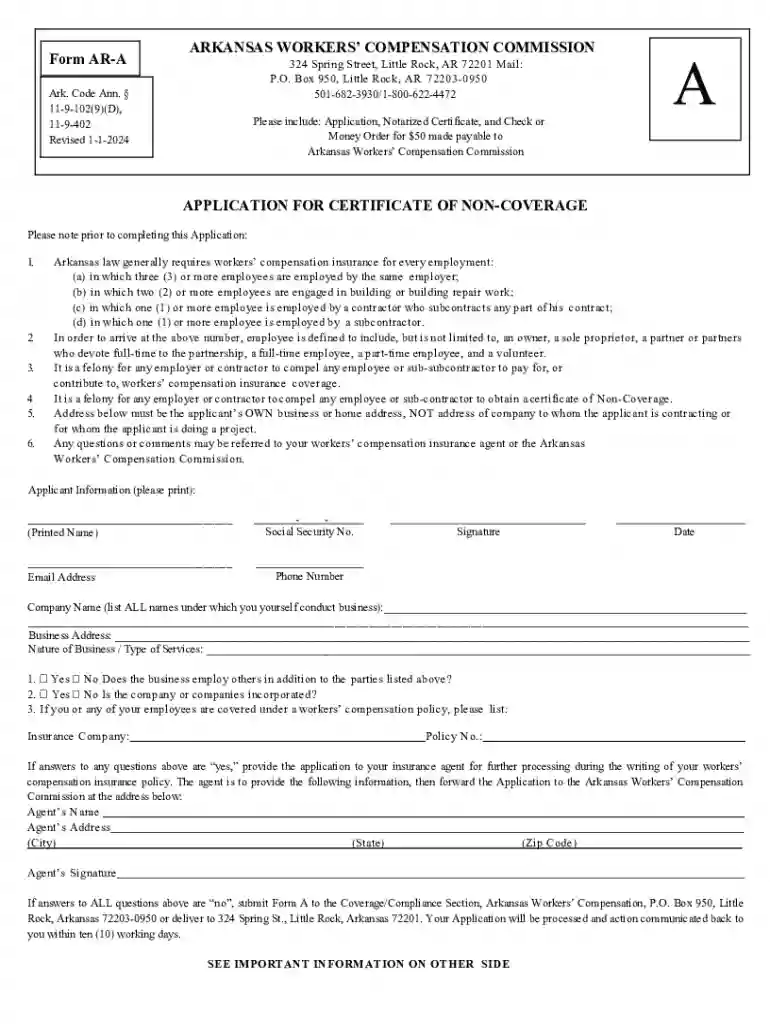
The Arkansas Workers' Compensation Commission forms are essential documents required by the Arkansas Workers' Compensation Commission for various purposes, including obtaining a Certificate of Non-Coverage. These forms ensure that employers and workers comply with state laws related to workers' compensation insurance. The forms help standardize the process of applying for exemptions or reporting, making it easier to manage workers' compensation issues within the state. Understanding these forms is crucial for businesses and individuals involved in labor and employment within Arkansas.
To acquire the necessary forms from the Arkansas Workers' Compensation Commission, individuals can visit the official Arkansas Workers' Compensation Commission website. The site offers downloadable versions of each form, including instructions on filling them out. Alternatively, you can request physical copies by contacting the commission's office directly. Forms may also be available through legal aid organizations or business associations that operate within the state. It's essential to ensure you have the latest version by checking for updates on the commission's website.
Identify the Required Form: Determine which form you need based on your purpose, such as applying for a Certificate of Non-Coverage.
Download or Request the Form: Obtain the form from the Arkansas Workers' Compensation Commission's website or office.
Fill Out the Required Sections: Complete all mandatory fields, ensuring accuracy to avoid processing delays. Include information such as business details and personal identification information as necessary.
Attach Necessary Documents: If required, attach supporting documents, such as a notarized certificate or payment confirmation for the requisite fee.
Review for Accuracy: Double-check all entered information to ensure it is correct.
Submit the Form: Send the completed form to the Arkansas Workers' Compensation Commission via the specified submission method, which could include online, mail, or in-person submission.
These forms are primarily used by business owners, employers, and workers within the state of Arkansas. Employers seeking to apply for non-coverage certificates or report on compensation issues are typical users of these forms. Additionally, individuals working as independent contractors may need to use these forms to confirm their exemption from workers' compensation insurance coverage. Legal advisors and HR professionals also frequently use these forms to assist their clients in compliance matters.


Compliance with Arkansas Workers' Compensation Commission forms is legally mandated for businesses and individuals seeking specific exemptions or coverage. The forms include legal warnings about the consequences of providing false information, underscoring their importance. Non-compliance, such as failing to submit required documentation or submitting inaccurate information, can result in penalties or legal action. It's critical to adhere to all guidelines to avoid these potential issues, ensuring all data submitted is truthful and complete.
These elements collectively facilitate the proper processing and approval of submissions.
Understanding these terms is vital for correctly completing and submitting items to the commission.
Adhering to filing deadlines is crucial when dealing with the Arkansas Workers' Compensation Commission forms to ensure compliance and avoid penalties. While specific deadlines can vary based on the form's purpose, most applications require timely submission following specific work or contract events. It is advisable to check with the Arkansas Workers' Compensation Commission or consult with a legal advisor to ascertain precise deadlines relevant to your situation.
Submissions of these forms can typically be made through several methods:
Choosing the appropriate method can depend on convenience, speed, and the specific requirements of the form in question.
Failure to comply with the guidelines and submission requirements can result in various penalties. These may include fines, denial of non-coverage certificates, or even potential legal action against the entity or individual at fault. Ensuring all forms are filled out accurately and submitted on time is essential to avoid these repercussions. Legal consultations can also provide further guidance on compliance to mitigate risks.
We've got more versions of the Arkansas Worker's Compensation CommissionForms form. Select the right Arkansas Worker's Compensation CommissionForms version from the list and start editing it straight away!
| Versions | Form popularity | Fillable & printable |
|---|---|---|
| 2024 | 4.2 Satisfied (59 Votes) |
At DocHub, your data security is our priority. We follow HIPAA, SOC2, GDPR, and other standards, so you can work on your documents with confidence.