




01. Edit your form online
Type text, add images, blackout confidential details, add comments, highlights and more.

Type text, add images, blackout confidential details, add comments, highlights and more.

Draw your signature, type it, upload its image, or use your mobile device as a signature pad.

Send it via email, link, or fax. You can also download it, export it or print it out.
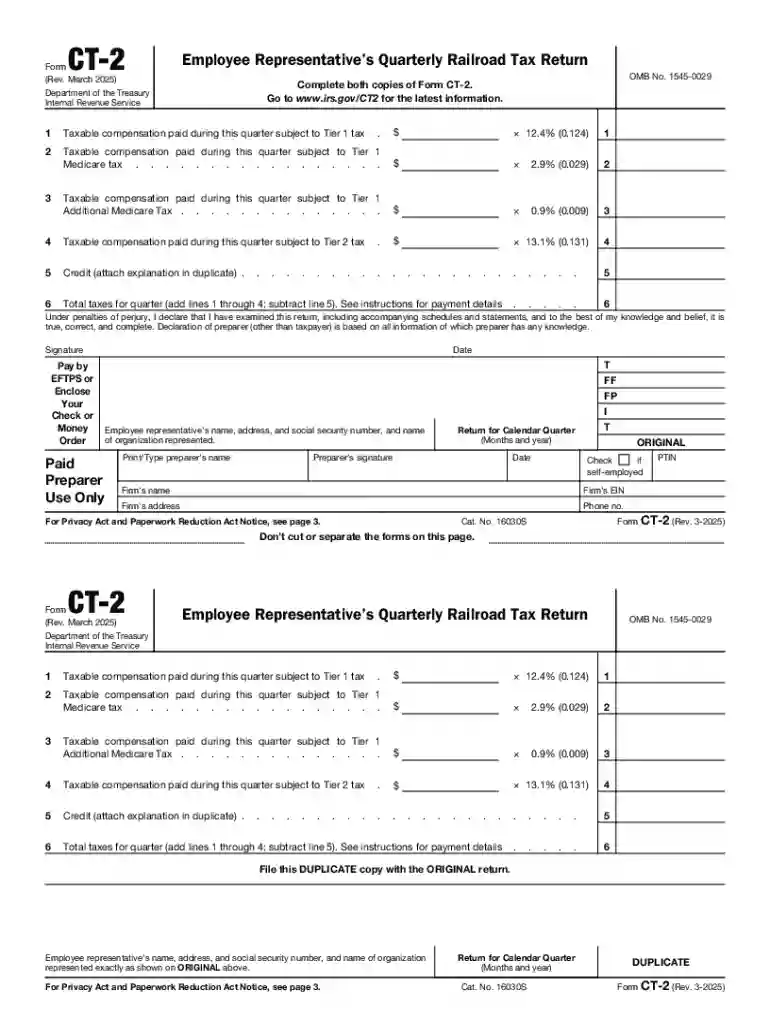
The Form CT-2, officially known as the Employee Representative’s Quarterly Railroad Tax Return, is a document issued by the IRS for the purpose of reporting railroad retirement taxes on compensation received by employee representatives. This tax form ensures compliance with regulations associated with railroad-related employment and taxation, helping to outline the specific tax rates applicable for Tier 1 and Tier 2 taxes, including Medicare taxes. The document is a critical component for tracking and fulfilling tax obligations in the railroad industry within the United States.
Using the CT-2 form involves reporting your taxable compensation accurately each quarter. First, collect detailed records of the compensation received in your role as an employee representative. Begin filling out the form by entering your personal identification details, such as your name, address, and social security number. Follow this by detailing your earnings subject to Tier 1 and Tier 2 tax rates. Ensure all sections are completed in alignment with IRS instructions, which can help avoid potential penalties for inaccurate reporting.
Acquiring the CT-2 form can be accomplished through multiple channels. The most direct method is to download it from the official IRS website, ensuring you have the most current version of the form. Alternatively, you can request a paper copy by contacting the IRS via mail or telephone. Using authorized tax software also provides access to Form CT-2 as part of their tax filing services, streamlining the process for electronic submissions.
Completing the CT-2 form requires diligence and accuracy. Begin by following detailed IRS guidelines that outline each step necessary for correct form submission:
To stay compliant with IRS regulations, it is crucial to meet the filing deadlines for the CT-2 form, which must be filed quarterly. The due dates are the last day of the month following the close of the quarter:
Properly tracking these dates ensures timely submissions and helps in avoiding penalties associated with late filings.
The IRS provides comprehensive guidelines for the completion and submission of Form CT-2, which include detailed instructions on defining which compensation categories fall under taxable income for railroad retirement taxes. Carefully adhering to these guidelines ensures that the form is completed correctly, mitigating the risks of financial and legal repercussions. Familiarize yourself with updates or changes in the guidelines to maintain compliance.
Failure to submit the CT-2 form accurately and within the stipulated deadlines can result in penalties. These penalties include fines for late filing or inaccuracies in reported compensation. In severe cases, non-compliance may lead to further legal actions. Hence, it's important to understand the repercussions of failing to file or filing incorrectly, which highlight the need for precision and timely submission.
The CT-2 form includes several crucial elements necessary for proper filing. Key elements include:
Understanding these components is crucial for accurately fulfilling your filing obligations with the CT-2 form.
We've got more versions of the Ct-2 form. Select the right Ct-2 version from the list and start editing it straight away!
At DocHub, your data security is our priority. We follow HIPAA, SOC2, GDPR, and other standards, so you can work on your documents with confidence.




You must file Form CT-2 for the first quarter in which youre paid taxable compensation for services you performed as an employee representative. ContinueRead more
Cass County power station is an operating power station of at least 346-megawatts (MW) in Plattsmouth, Cass, Nebraska, United States with multiple units,
The Clemson Thinks2 (CT2) program, now in its 11th year, was initially developed by Clemson University as the Quality Enhancement Plan for the universitysRead more


