







Definition & Meaning
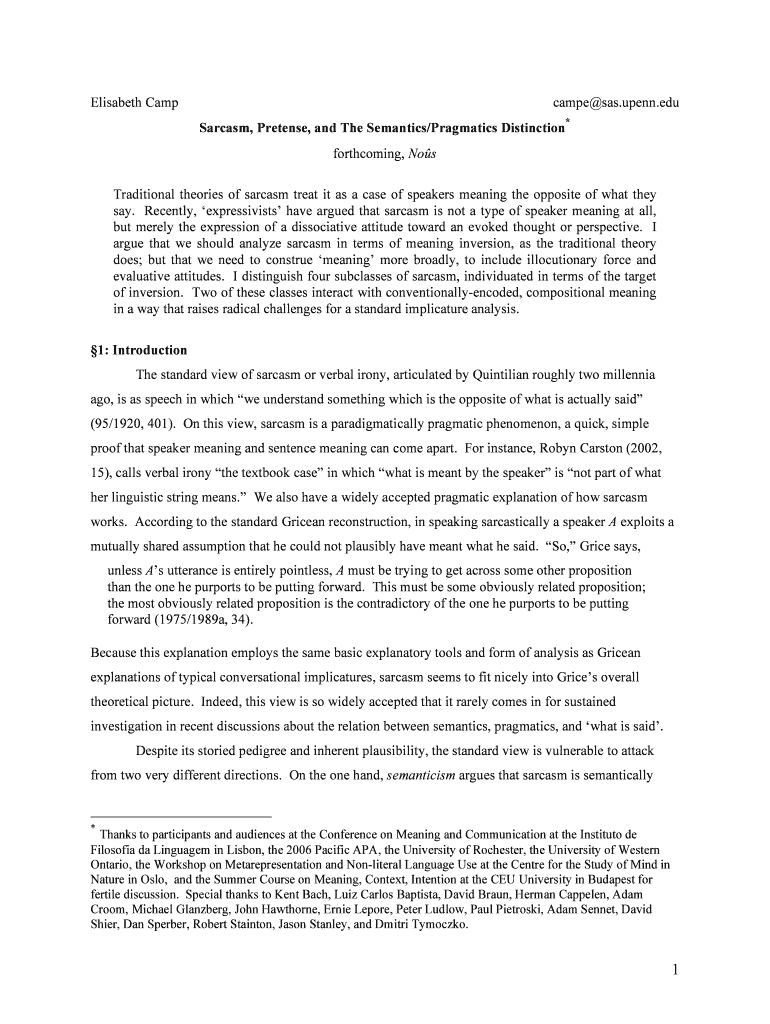
The work of Elisabeth Camp delves into the semantics and pragmatics behind sarcasm. Her insights aim to refine traditional definitions, challenging the notion that sarcasm merely involves meaning inversion. By critiquing semanticist and expressivist perspectives, Camp presents a wider understanding of meaning that harmonizes illocutionary force and evaluative attitudes. Her conceptual framework broadens the conventional boundaries of sarcasm, recognizing it as a nuanced amalgamation of content and context, capable of expressing complex emotional and critical subtleties.
Key Elements of the Elisabeth Camp Work
Camp identifies four subclasses of sarcasm, each serving distinct communicative purposes. These are:
- Perlocutionary Sarcasm: Focuses on the effect of the utterance on the audience, often used to provoke a specific reaction.
- Propositional Sarcasm: Centers around the content, using contradiction to convey criticism or disbelief.
- 'Like'-Prefixed Sarcasm: Employs the prefix "like" to introduce sarcastic comments, highlighting the disconnect between the literal and intended meanings.
- Lexical Sarcasm: Involves the use of specific words or phrases that inherently carry sarcastic overtones, often understood through context and tone.
How to Use Insights from Elisabeth Camp
To effectively utilize Camp's insights in communication, consider:
- Audience Awareness: Understand the listener's background and disposition, as sarcasm can be easily misunderstood or lost, if cultural or contextual hints are missed.
- Contextual Alignment: Align your sarcastic expressions with the ongoing conversation to ensure clarity and emphasize the intended critique or humor.
- Tone and Delivery: Use appropriate vocal inflections and facial expressions to aid in conveying the correct sarcastic message, acknowledging the subtle nuances that Camp emphasizes.
Steps to Implement Elisabeth Camp’s Framework
- Identifying the Form of Sarcasm: Determine which of Camp’s four subclasses is most relevant to your context or message.
- Crafting the Message: Frame your sarcasm in a way that aligns with Camp’s characterization of evaluative attitudes and illocutionary force.
- Delivering with Nuance: Implement the tone, context, and delivery methods that Camp's framework highlights as crucial for effective communication.
- Observing Reactions: Note the audience's response to refine future uses of sarcasm based on real-world feedback and adapt your approach accordingly.
Why Study Elisabeth Camp’s Work on Sarcasm
Studying Camp's work provides a comprehensive understanding that exceeds basic sarcasm. It equips communicators with tools to effectively incorporate sarcasm into language, enhancing expressive nuance in both personal and professional settings. By understanding the intricacies of sarcasm, one can avoid miscommunication and amplify the desired emotive and evaluative effects in dialogue.
Who Typically Engages with Elisabeth Camp’s Framework?
- Linguists and Communication Experts: Those interested in the complexities of human language and communication benefit significantly from Camp’s nuanced perspective.
- Educators: Camp's insights are beneficial for educators teaching language and literature, as they present a refined lens through which to analyze and understand sarcasm in texts.
- Psychologists: Given its focus on evaluative attitudes and illocutionary force, Camp’s work is also relevant to those studying human interactions and expressions.
Examples of Using Elisabeth Camp’s Framework
For instance, in a conversation where someone claims to have completed an overwhelming amount of work in a short time, a speaker might say, "Oh, like you’ve really done that all by yourself," employing 'like'-prefixed sarcasm to express skepticism. Another scenario could involve propositional sarcasm, where a person comments, "Sure, because that's never been done before," to critique the originality of an idea.
Important Terms Related to Elisabeth Camp’s Semantics
- Illocutionary Force: The intended force behind an utterance that defines its function in communication. In sarcasm, it often deviates from the literal meaning.
- Evaluative Attitude: The perspective or stance conveyed through language, which in sarcastic contexts, is often critical.
- Contextual Exploitation: The strategic use of context to shape the meanings of words and phrases beyond their conventional use, crucial for understanding and implementing sarcasm.
State-Specific Variances in Sarcasm Understanding
While sarcasm is universally used, its interpretation often varies by locale within the U.S. Regional dialects, cultural norms, and local expressions affect how sarcasm is both perceived and understood, necessitating a flexible approach when applying Camp's insights across different state populations.




