






Definition & Meaning
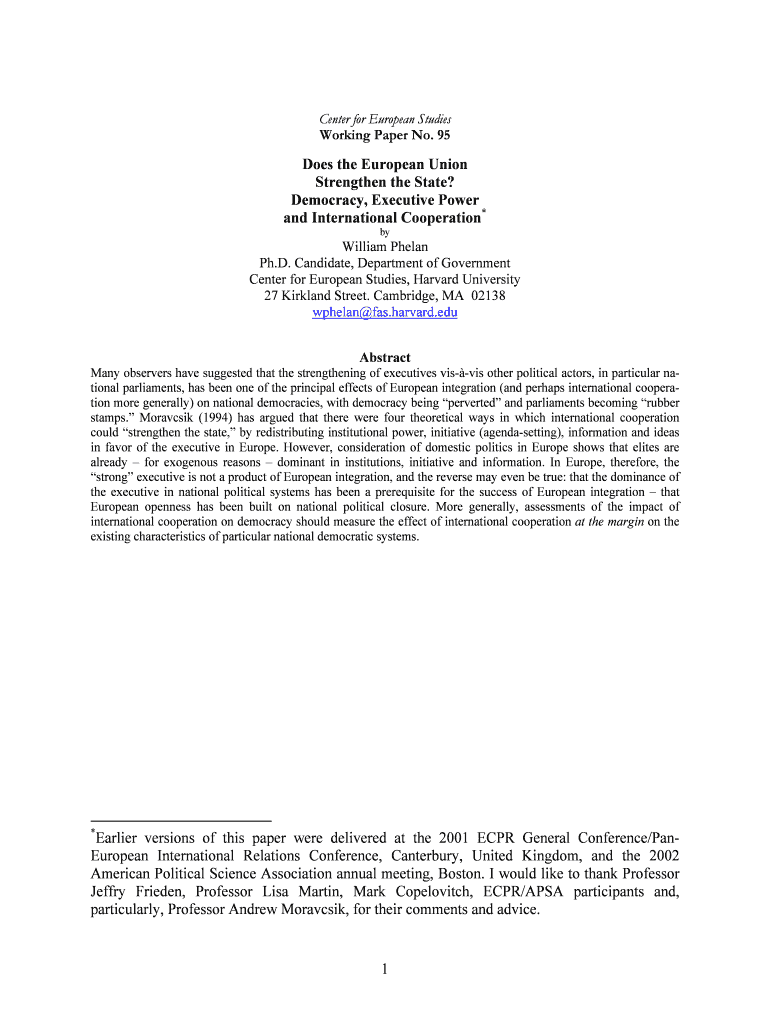
The concept of "Does the European Union Strengthen the State? Democracy, Executive Power and International Cooperation" addresses the impact of European integration on national states, particularly concerning how democratic processes and executive powers are influenced. It explores whether the EU enhances the power of state leadership and how international collaboration shapes internal governmental dynamics.
How to Use the Concept
The question of whether the EU strengthens national states is primarily analyzed in academic and policy-making contexts. Researchers and political analysts study this concept to understand the broader implications of EU policies on member states' sovereignty. By examining legislative changes, shifts in executive authority, and broader democratic practices, stakeholders can assess the EU's role in reinforcing or undermining the authority of member states.
Steps to Complete the Analysis
- Identify Key Players: Understand the roles of EU institutions, such as the European Commission and European Parliament, in influencing member states.
- Gather Data: Collect information on legislative changes and democratically elected national bodies post-EU integration.
- Analyze Outcomes: Compare executive versus legislative power dynamics pre- and post-EU influence.
- Review Case Studies: Examine specific examples from EU member states to identify trends and variations in the distribution of power.
- Conclude Findings: Determine whether EU involvement generally enhances or diminishes state sovereignty.
Key Elements of the Concept
- Executive Power: Analyzes shifts in national executive authority resulting from EU integration.
- Legislative Influence: Studies changes and adaptations in national legislatures due to EU directives.
- Democratic Processes: Reviews the impact on democratic practices and citizen representation within member states.
- International Cooperation: Considers the role of treaties and alliances that influence national policy decisions.
Why the Concept Matters
Understanding the relationship between the European Union and member states' governance offers insights into how supranational organizations can affect national sovereignty. This analysis is critical for policymakers, citizens, and scholars seeking to comprehend the broader implications of EU membership on state control and democratic practices.
Who Typically Uses This Analysis
- Policy Makers: Government officials use this concept to guide national policy in response to EU mandates.
- Academics: Researchers analyze these dynamics to contribute to scholarly debates about state sovereignty and international governance.
- Political Scientists: Study the impact of integration on political systems and institutions within EU member states.
Important Terms Related to the Concept
- Sovereignty: The authority of a state to govern itself or another state.
- Supranationalism: The notion of transcending national boundaries for collaborative governance, often attributed to the EU.
- Integration: The process of unifying different states and economies under a common framework or system.
Examples of Analyzing the Concept
- Case Study: Germany: Examines how EU policies have influenced German legislative processes and executive decisions.
- Case Study: France: Investigates the balance of power between French national institutions and EU directives.
- Case Study: Poland: Analyzes Poland's approach to EU integration and its effects on national policy and autonomy.
Business Types that Benefit from the Analysis
- Consulting Firms: Offer strategic advice to businesses and governments on navigating EU regulations.
- Think Tanks: Conduct in-depth analysis to provide insights and recommendations for policy adjustments.
- Legal Practitioners: Assist in interpreting and adapting to EU legislation for national application.
State-Specific Rules and Considerations
While the EU implements overarching policies, each member state retains unique legislative frameworks and traditions. The analysis of how the EU impacts individual states can vary significantly, contingent upon pre-existing legal systems, economic conditions, and political structures.