This document gives my treatment choices and 2026

Get Form
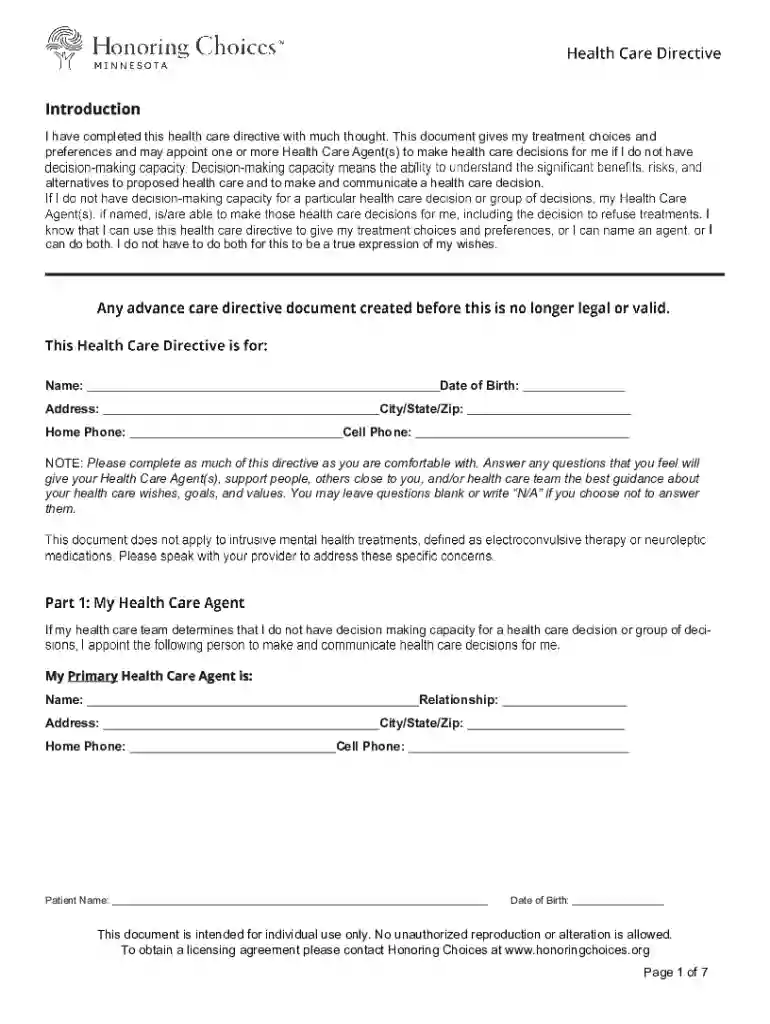
This document gives my treatment choices and Preview on Page 1

Here's how it works

01. Edit your form online
Type text, add images, blackout confidential details, add comments, highlights and more.

02. Sign it in a few clicks
Draw your signature, type it, upload its image, or use your mobile device as a signature pad.

03. Share your form with others
Send it via email, link, or fax. You can also download it, export it or print it out.

Definition & Meaning

A health care directive, notably titled "This document gives my treatment choices and," serves as a formal record of an individual's preferences regarding medical care decisions. This document enables the appointment of Health Care Agents who can make medical decisions on behalf of the person if they are unable to do so. It addresses various critical treatment options, including but not limited to, CPR, life-prolonging treatments, and pain management, ensuring that the directives align with the individual's values and personal wishes.

Key Elements of the Health Care Directive

The directive outlines several crucial components aimed at encompassing the diverse aspects of medical decision-making:

  • Appointment of Health Care Agents: Identifying individuals authorized to make healthcare decisions on one's behalf.
  • Treatment Preferences: Specifying choices concerning life-sustaining measures like CPR and artificial nutrition.
  • Pain Management: Instructions regarding the management of pain and comfort care.
  • Organ Donation: Preferences on organ and tissue donation posthumously.
  • Funeral Arrangements: Detailed wishes regarding burial or cremation, if any.

These components ensure that all necessary medical decisions adhere to the individual's values and explicit desires.

Who Typically Uses the Document

"This document gives my treatment choices and" is generally used by adults in the United States who wish to have a say in their medical treatment should they become incapacitated. It is particularly relevant for:


  • Elderly individuals: Who may face imminent health issues.
  • Patients with chronic illnesses: Who need specific instructions for their ongoing care.
  • Individuals undergoing major surgery: As part of pre-operative planning.
  • Persons without immediate family: Who may require external agents to make medical decisions.
decoration image ratings of Dochub

Steps to Complete the Directive

Completing a health care directive requires careful attention and consideration to accurately reflect the individual's wishes:

  1. Review the Form: Understand each section and what it covers.
  2. Appoint Health Care Agents: Choose trusted individuals who will act as agents.
  3. Detail Treatment Preferences: Specify choices regarding different medical interventions.
  4. Discuss with Healthcare Providers: Ensure clarity on medical preferences.
  5. Legalize the Document: Some states require notarization or witnesses.
  6. Distribute Copies: Provide verified copies to agents, healthcare providers, and family members.

This step-by-step process ensures comprehensive documentation of one's medical care choices.

Legal Use of the Directive

In the United States, the directive is legally binding, provided it meets specific state laws’ criteria relating to execution and content. Legality requires it to:

  • Be in written form with clear instructions.
  • Be signed and dated by the individual.
  • Include witnesses or a notary where applicable.

Adherence to these criteria ensures the directive is upheld in medical situations.

Important Terms Related to the Document

Understanding specific terms can enhance clarity:

  • Health Care Agent: A designated person authorized to make medical decisions.
  • CPR: Cardiopulmonary resuscitation, a lifesaving technique.
  • Life-Prolonging Treatment: Medical interventions intended to extend life, such as ventilators.
  • Do Not Resuscitate (DNR): Instructions to avoid CPR if the heart stops.
  • Palliative Care: Specialized medical care focused on providing relief from pain.

These terms are critical in grasping the full scope of the directive.

Examples of Using the Directive

Illustrative scenarios demonstrate its relevance:

  • Chronic Condition Management: An individual with a degenerative disease outlines treatment refusal preferences.
  • End-Stage Cancer: Specifies the choice to forgo extensive life-prolonging measures.
  • Surgical Complications: Details comfort care options if surgical recovery becomes improbable.

Such examples highlight how the directive caters to diverse situations.

State-Specific Rules for the Directive

Each U.S. state may have distinct rules regarding health care directives. Variations can include:

  • Witness Requirements: Some states require two witnesses, others only one.
  • Notarization: A few states mandate notarization instead of or in addition to witnesses.
  • Agent Eligibility: States may have different rules about who can be an agent, often excluding treating physicians.

Reviewing state-specific guidelines is essential for validity and compliance.

Software Compatibility & Digital Management

With advancements in technology, managing such documents digitally is now possible. Platforms like DocHub provide:

  • Secure Online Editing: Allows for digital completion and distribution.
  • Electronic Signatures: Ensures legal compliance with electronic authenticity.
  • Cloud Integration: Facilitates storage and easy sharing with healthcare agents and providers.

These digital tools enhance the accessibility and management of health care directives, ensuring seamless integration into one's healthcare planning.

This comprehensive coverage explores every relevant aspect of the directive titled "This document gives my treatment choices and," providing essential guidelines, practical scenarios, and detailed insights necessary for understanding and implementing this significant document.

be ready to get more

Complete this form in 5 minutes or less

Get form

Got questions?

We have answers to the most popular questions from our customers. If you can't find an answer to your question, please contact us.
Contact us
An advance care directive is an important part of your end-of-life care. An advance care directive formalises your advance care plan. The directive can contain all your needs, values and preferences for your future care and details of a substitute decision-maker.
Completing the SR1 form It may be appropriate to complete an SR1 form: if you think the patient may meet the Special Rules for end of life eligibility criteria. following a conversation about advance care planning.
A living will is one of the most common and necessary end-of-life documents. It is an advance directive that details your desires regarding medical treatment if you are no longer able to communicate your own wishes. A living will would spell out what medical care a person would or wouldnt want such as: Palliative care.
Living wills and other advance directives include written, legal instructions that state the treatment you want for medical conditions when youre unable to make decisions for yourself. Advance directives guide choices for healthcare professionals and caregivers in certain situations.
Health Care Agent (Medical Power of Attorney) An Advance Directive may name another person to act as a Health Care Agent to carry out the patients wishes. The Health Care Agent can also be named in a separate document called a Health Care Power of Attorney.

Security and compliance

At DocHub, your data security is our priority. We follow HIPAA, SOC2, GDPR, and other standards, so you can work on your documents with confidence.
Learn more
ccpa2
pci-dss
gdpr-compliance
hipaa
soc-compliance
be ready to get more

Complete this form in 5 minutes or less

Get form

People also ask

An advance directive is a legal document that provides instructions for medical care and only goes into effect if you cannot communicate. It allows you to name one or more persons as health care agents or proxies to make decisions based on your wishes.
Advanced care planning refers to all documents that pertain to end-of-life care. These include advance directives and medical orders. Advance directives include documents that mention a health care agent and living wills. These are initiated by the patient.
End-of-life planning checklist: A guide to the 12 documents you should consider Last will and testament. Revocable living trust. Beneficiary designations for non-probate assets. Durable financial power of attorney. Pet Trust. Durable medical power of attorney. Living will. Life insurance.

Related links