






Definition and Meaning of the Brief in Opposition for Respondent Florida Democratic - Election 2000
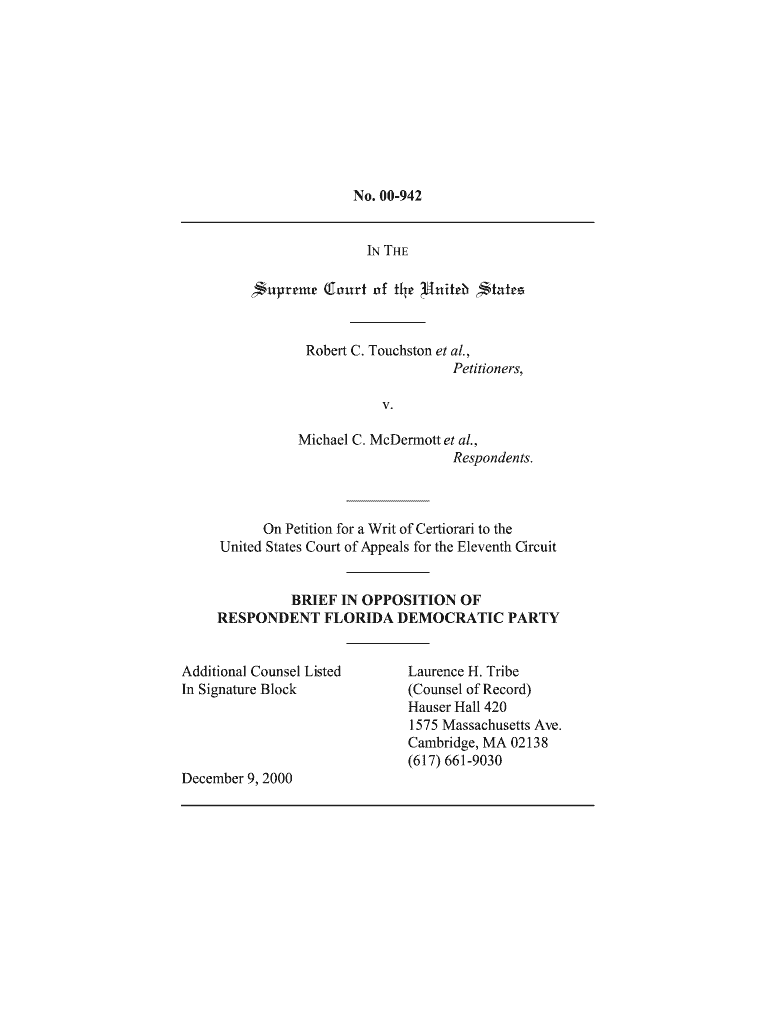
The Brief in Opposition for Respondent Florida Democratic during the Election 2000 refers to a legal document submitted to a higher court to counter a petition for a writ of certiorari. This specific document responded against claims made by Robert C. Touchston and others regarding the handling of manual recounts in the Florida presidential election. The responding brief argued against the need for judicial intervention, emphasizing the decision of the Florida Supreme Court in Gore v. Harris, which mandated manual counts of undervotes as standard procedure. This document plays a crucial role in influencing the court's decision to review or deny the petition, thus maintaining the lower court's ruling when manual recounts were contested.
Key Elements of the Brief in Opposition for Respondent Florida Democratic - Election 2000
Several critical elements are present within this brief that establish the foundational arguments opposing the petition.
- Manual Recount Justification: The brief strongly associates the necessity of manual recounts with electoral fairness, leveraging the precedent set by the Florida Supreme Court.
- Lack of Irreparable Harm: An essential argument is that the petitioners failed to illustrate concrete irreparable harm from the manual recount process.
- Constitutional Claims: The brief scrutinizes claims regarding equal protection and due process, arguing that they fall short of merit.
- Judicial Discretion: Emphasizing the district court’s discretion, the document underscores its sound judgment in denying the preliminary injunction.
Each of these components plays an integral role in disputing the need for higher court intervention, with comprehensive counter-arguments designed to reinforce electoral integrity.
Legal Use of the Brief in Opposition for Respondent Florida Democratic - Election 2000
The legal use of this brief is paramount in defending election procedures and outcomes from unwarranted judicial interruption.
- Support of Judicial Decisions: It serves as a robust safeguard promoting the consistency and reliability of electoral decisions as determined by the judiciary.
- Counteraction of Certiorari Petitions: By articulating the limitations and inappropriateness of the petitioners' claims, this brief effectively minimizes unnecessary legal escalations.
- Preservation of Precedents: By invoking pivotal decisions like Gore v. Harris, the brief seeks to uphold legal precedents critical to democratic processes.
Through these uses, the brief secures the integrity of election results and legal proceedings by deterring unfounded judicial reviews.
Steps to Complete the Brief in Opposition for Respondent Florida Democratic - Election 2000
Completing such a brief involves a series of precise legal steps to ensure a compelling opposition.
- Analyze the Certiorari Petition: Thoroughly review the claims and implications of the writ petition to form a robust understanding.
- Research Applicable Precedents: Gather precedents and legal principles relevant to the case to support the opposition.
- Construct Core Arguments: Develop clear arguments addressing each point raised by the petitioners while reinforcing the legal grounds of the current decision.
- Draft the Document: Carefully draft the brief, integrating all necessary arguments and referencing legal standards.
- Review and Revise: Ensure thorough proofreading and revising for clarity, precision, and legal accuracy.
These steps are vital in crafting a legally sound document that effectively counters the writ petition.
Why the Brief in Opposition for Respondent Florida Democratic - Election 2000 is Important
This brief holds notable importance in upholding electoral processes and legal judgments.
- Protection of Electoral Integrity: The brief strives to maintain the integrity of election outcomes by supporting lawful recounts.
- Judicial Efficiency: By opposing unwarranted certiorari, the brief assists in preventing potential backlogs and inefficiencies within the judicial system.
- Public Confidence: Upholding fair and transparent electoral and judicial practices through such briefs fosters public trust in these systems.
These factors elucidate why briefs in opposition are crucial components of maintaining sound legal and electoral frameworks.
Examples of Using the Brief in Opposition for Respondent Florida Democratic - Election 2000
This brief has historical significance, evident through its practical applications in challenging election-related petitions.
- Election Dispute Resolution: The 2000 election recount serves as a primary example where the brief functioned to counteract disruption from legal disputes.
- Judicial Precedent Application: The brief leveraged established court decisions like Gore v. Harris to nullify claims made by petitioners.
- Judgment Reinforcement: By reinforcing the foundational court decisions surrounding manual recounts, the document exemplified its role in thwarting unnecessary higher court reviews.
These examples highlight the practical utility of opposition briefs in mitigating legal challenges that threaten electoral fairness.
State-Specific Rules for the Brief in Opposition
Florida's unique legal landscape during the 2000 election necessitated specific adherence to state laws and precedents.
- Supreme Court Precedence: The decision in Gore v. Harris was pivotal, rendering state election procedures non-negotiable.
- Recount Regulations: State-specific statutes governed the recount processes, underscoring the acceptance criteria outlined in the brief.
- Legal Procedural Standards: Florida law defined the procedural context in which the brief was constructed, establishing essential legal benchmarks.
A clear understanding of these state-specific rules ensures the brief's alignment with local electoral law and procedural norms.
Penalties for Non-Compliance with the Brief in Opposition's Rulings
Non-compliance with established legal rulings as defended by the brief can lead to significant repercussions.
- Legal Ramifications: Ignoring judicial decisions protected by the brief can result in contempt of court and potential penalties.
- Electoral Challenges: Failure to adhere to court-sanctioned recount procedures could result in electoral outcomes being invalidated or contested.
- Judicial Escalation: Persistent non-compliance might necessitate further judicial review, inadvertently complicating and prolonging legal proceedings.
Understanding these potential penalties underlines the importance of abiding by the decisions reinforced within opposition briefs.