
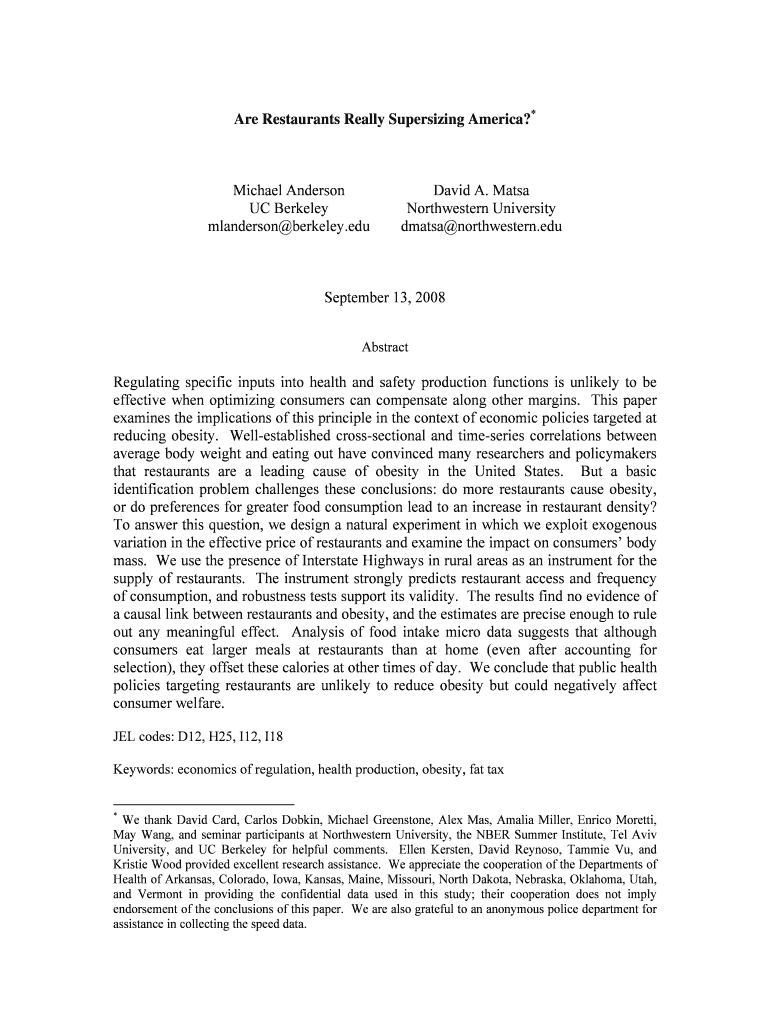







Overview of "Are Restaurants Really Supersizing America? - Stanford Graduate - GSB Stanford"
The study titled "Are Restaurants Really Supersizing America? - Stanford Graduate - GSB Stanford" investigates the link between restaurant density and obesity rates in the United States. It challenges traditional beliefs that increased access to restaurants correlates directly with higher obesity rates. Researchers utilized a natural experiment involving proximity to Interstate Highways to analyze the relationship between restaurant availability, body mass index (BMI), and obesity prevalence. The findings indicate no direct causal relationship, suggesting that public health policies targeting restaurant access may not effectively address obesity issues.
Key Findings and Insights
Restaurant Access and Calorie Consumption
- Although individuals consume more calories when dining at restaurants, the study found that these excess calories are often offset by reduced intake at other times.
- This suggests that people might adjust their overall calorie consumption subconsciously to maintain balance.
Public Health Policy Implications
- The research argues that policies focusing on decreasing restaurant density might not yield significant health benefits.
- Economic impacts of such policies could be substantial without leading to the desired reduction in obesity rates.
Methodology and Data Analysis
Use of Natural Experiments
- The study leveraged a natural experiment framework, benefiting from variations in restaurant density near Interstate Highways.
- This approach provided a unique perspective on how accessibility influences eating habits and obesity indicators.
Analysis Techniques
- Detailed statistical analyses were conducted to investigate correlations between restaurant density, BMI, and obesity rates.
- The study accounted for variables such as geographic, demographic, and socioeconomic factors to ensure comprehensive results.
Importance of the Research
Challenging Assumptions
- By demonstrating the lack of a direct causal link, the study invites policymakers to reconsider strategies that exclusively target external food environment factors.
Broader Implications for Obesity Research
- This research emphasizes the complexity of obesity, suggesting that solutions require multifaceted approaches beyond limiting restaurant access.
Legal and Cultural Considerations
- The study assumes its primary audience is based in the United States, aligning its references and analysis with U.S.-centric cultural and legal contexts.
- It considers the cultural significance of dining out as part of the American lifestyle and how this influences eating behaviors.
Application Process & Approval Time
- The study emphasizes swift dissemination of its findings to inform ongoing policy debates and health initiatives.
- Any related policy changes based on the study would require a clear implementation strategy and timeline for political and social acceptance.
Versions or Alternatives to the Study
Further Research Directions
- Future studies could include longitudinal data to observe changes over time following shifts in restaurant density.
- Comparative analyses involving different countries or dietary cultures could enrich the understanding of restaurant density and obesity.
Key Takeaways
- The research highlights the need for comprehensive strategies in tackling obesity, considering multiple influencing factors beyond just restaurant access.
- Policymakers are encouraged to consider economic, cultural, and behavioral dimensions when designing interventions to address public health challenges related to obesity.




