







Definition and Scope of the Retail Competition Analysis
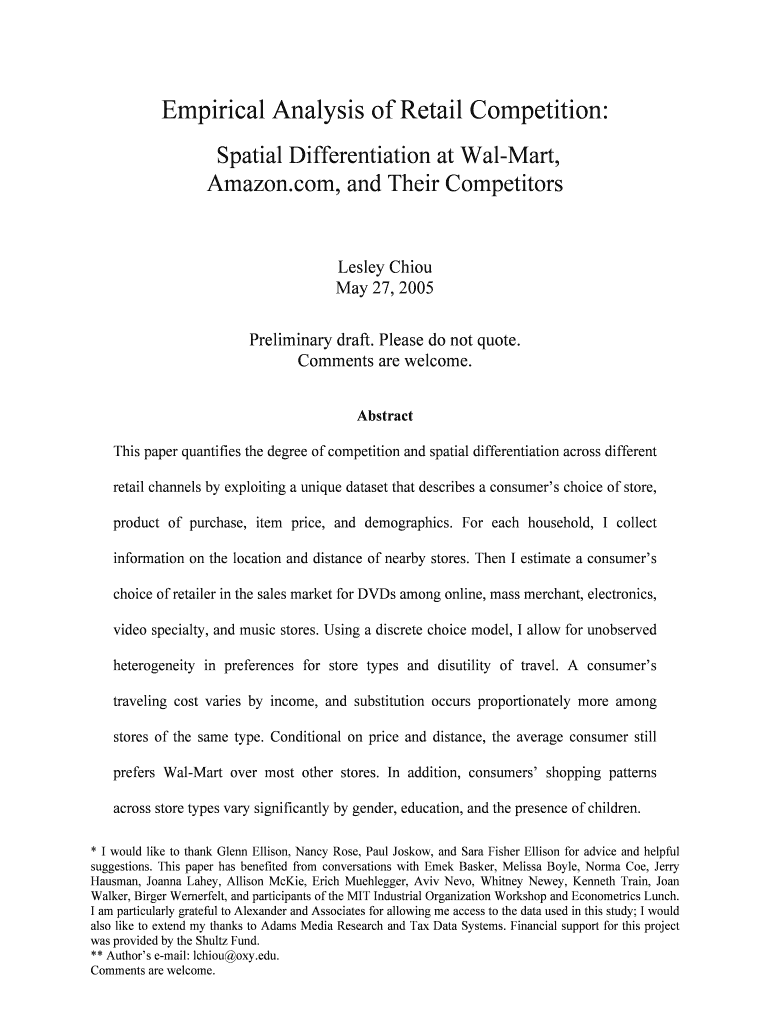
The "Empirical Analysis of Retail Competition: - Stanford Graduate School" examines the competitive dynamics among major retailers, such as Wal-Mart and Amazon.com, focusing on spatial differentiation among store types. It utilizes a unique dataset to explore consumer preferences, taking into account factors like price sensitivity and travel costs by different demographic segments. This analysis provides insights into how consumers prioritize store characteristics over pricing and distance, challenging traditional assumptions about retail competition.
Utilizing the Empirical Analysis for Retail Competition
Engaging with this analysis involves a detailed understanding of its findings on consumer behavior and retail strategies. Academics, business analysts, and retail strategists can leverage the insights to refine marketing strategies or develop competitive advantages in their operations. Specifically, the recognition of store characteristics can inform location strategies and enhance customer targeting.
Obtaining Access to the Research
Those interested in accessing the "Empirical Analysis of Retail Competition: - Stanford Graduate School" should explore academic journals, university databases, or contact the Stanford Graduate School directly for access. Institutional subscriptions or collaborations might provide direct access, while individuals could potentially find a summary or discussion of its findings in professional retail analytics forums or conferences.
Completing a Detailed Review of the Analysis
- Initial Study: Begin by reading the summary and objectives to grasp the scope and intent.
- Data Examination: Analyze the dataset used, focusing on variables like price sensitivity and consumer demographics.
- Findings Exploration: Delve into the results to understand consumer preferences and spatial factors.
- Strategic Implications: Consider the strategic recommendations and implications for various retail operations.
Motivations for Studying Retail Competition Analysis
Understanding retail competition analysis is critical for retailers seeking to optimize their business strategies in a highly competitive market. This analysis provides a data-driven foundation to make decisions on store locations, marketing tactics, and product assortments, ultimately aimed at maximizing consumer engagement and sales.
Typical Users of the Analysis
- Retail Executives: To align business strategies with market trends.
- Academics and Researchers: For studying market dynamics and consumer behavior.
- Marketing Professionals: To tailor promotional strategies based on consumer preferences.
- Urban Planners: To understand the impact of retail locations on urban development.
Key Concepts and Terminology
- Spatial Differentiation: Referring to how retail locations and store types impact consumer preferences.
- Price Sensitivity: The degree to which the cost of products influences consumer choices.
- Consumer Demographics: The segmentation of consumers based on income, age, and geographic location.
Core Elements of the Analysis
- Data Utilization: Leveraging an innovative dataset focuses on the DVD retail market.
- Methodology: Empirical methods to quantify consumer preferences.
- Impact Assessment: Evaluating e-commerce effects on physical retail competition.
Diverse Applications and Examples
Real-world examples include retail chains applying these findings to select optimal new store locations or using them to enhance in-store customer experiences. For instance, the prominence of characteristics like customer service or in-store ambiance might sway a consumer's choice, as suggested by the study.
Variants and Alternatives for the Analysis
There may be alternative studies or versions that explore similar themes with different focus areas, such as the effects of digital marketplaces on specific retail sectors or international variations in consumer behavior. Engaging with multiple analyses provides a more comprehensive understanding of the retail landscape.
By examining these components, professionals can extract meaningful insights to drive effective decision-making and strategic planning within the retail industry. Each block contributes to a nuanced understanding of retail competition and consumer decision-making processes.




