




01. Edit your eeo usps form online
Type text, add images, blackout confidential details, add comments, highlights and more.

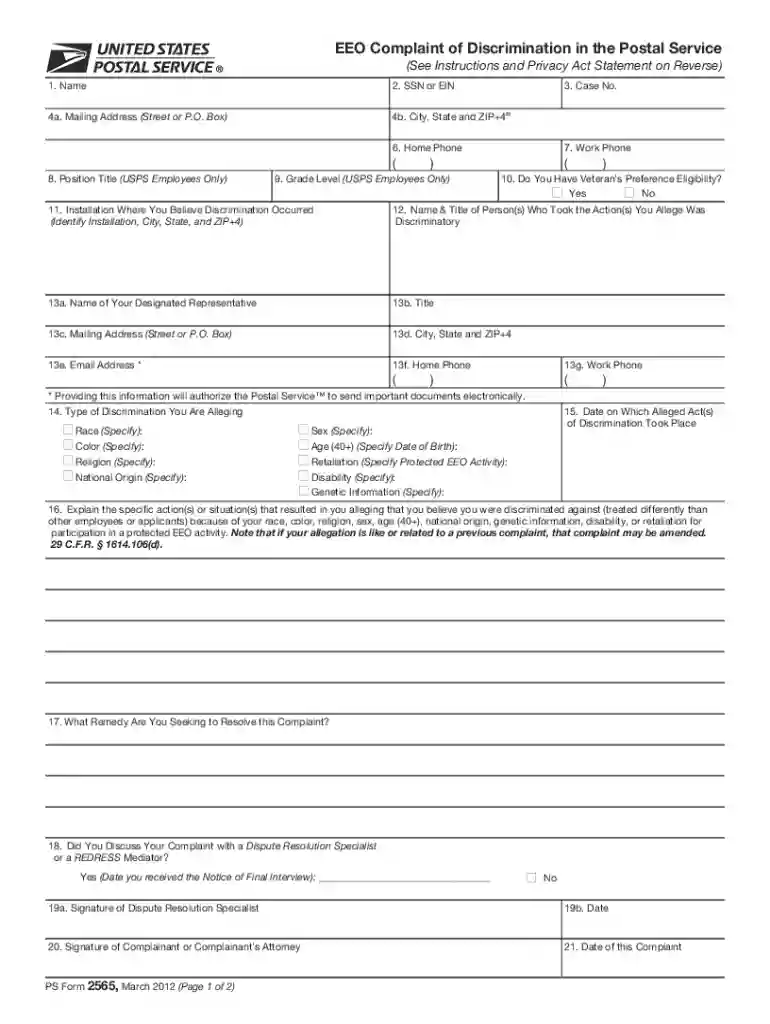
Type text, add images, blackout confidential details, add comments, highlights and more.

Draw your signature, type it, upload its image, or use your mobile device as a signature pad.

Send ps form 2565 via email, link, or fax. You can also download it, export it or print it out.
The Equal Employment Opportunity (EEO) complaint of discrimination in the postal service is a formal process through which employees or applicants of the U.S. Postal Service can address instances of discrimination. This includes actions perceived as discriminatory based on race, color, religion, sex, age, national origin, genetic information, disability, or retaliation for involved in protected EEO activities. The complaint form serves as a detailed record of the allegations, outlining personal details, specific incidences of discrimination, and the desired resolution. Understanding this form is crucial for those seeking to address workplace fairness issues within the postal service.
To effectively utilize the EEO complaint form, individuals must first identify the discriminatory action they have experienced. After recognizing such an event, they need to collect evidence and documentation that supports their claim. The form should be filled meticulously, ensuring clarity and completeness. Submission of the form can be done through several methods, including online or via mail. It's important to retain a copy of the completed form for personal records.
When filing an EEO complaint of discrimination, it's vital to include supporting documentation that substantiates the claim. Examples of necessary documents might include:
These documents ensure that the complaint process begins with a comprehensive foundation, which can aid in substantiating the claims presented.
The legal backbone of an EEO complaint arises from federal laws that protect employees from workplace discrimination. The form must adhere to established procedures to ensure compliance and validity. Legal counsel can often help interpret the laws applicable to specific cases and lead procedural guidance. Employees can apply these laws to achieve resolutions such as reinstatement, back pay, or policy changes within the organization.
Several core elements are essential for completing the discrimination complaint form:
These elements help create a clear and robust representation of the complaint's basis.
Not everyone within the postal service environment is eligible to file an EEO complaint. Eligibility primarily covers:
Eligibility determination ensures that the complaint aligns with statutory protections provided under federal employment laws.


Timeliness is critical in the filing process, with the following dates being essential:
Missing these key dates can result in the dismissal of a claim, making it vital to adhere to all stipulated deadlines.
The EEO complaint form allows for flexible submission methods:
Choosing a submission method should reflect the urgency and convenience needed for the claim, with online methods often providing the fastest acknowledgment.
Privacy considerations are critical due to the sensitive nature of these complaints:
Understanding these privacy safeguards helps reassure complainants about the integrity and confidentiality of the process.
We've got more versions of the eeo usps form form. Select the right eeo usps form version from the list and start editing it straight away!
At DocHub, your data security is our priority. We follow HIPAA, SOC2, GDPR, and other standards, so you can work on your documents with confidence.


After her request was denied, Gomez-Perez, then forty-five years old, filed an equal employment opportunity (EEO) complaint with the USPS alleging age
To begin the pre-complaint process, OIG employees must contact the Postal Service EEO Office: Online at ; or; By writing to: NEEOISO - EEORead more


