




01. Edit your form online
Type text, add images, blackout confidential details, add comments, highlights and more.

Type text, add images, blackout confidential details, add comments, highlights and more.

Draw your signature, type it, upload its image, or use your mobile device as a signature pad.

Send it via email, link, or fax. You can also download it, export it or print it out.
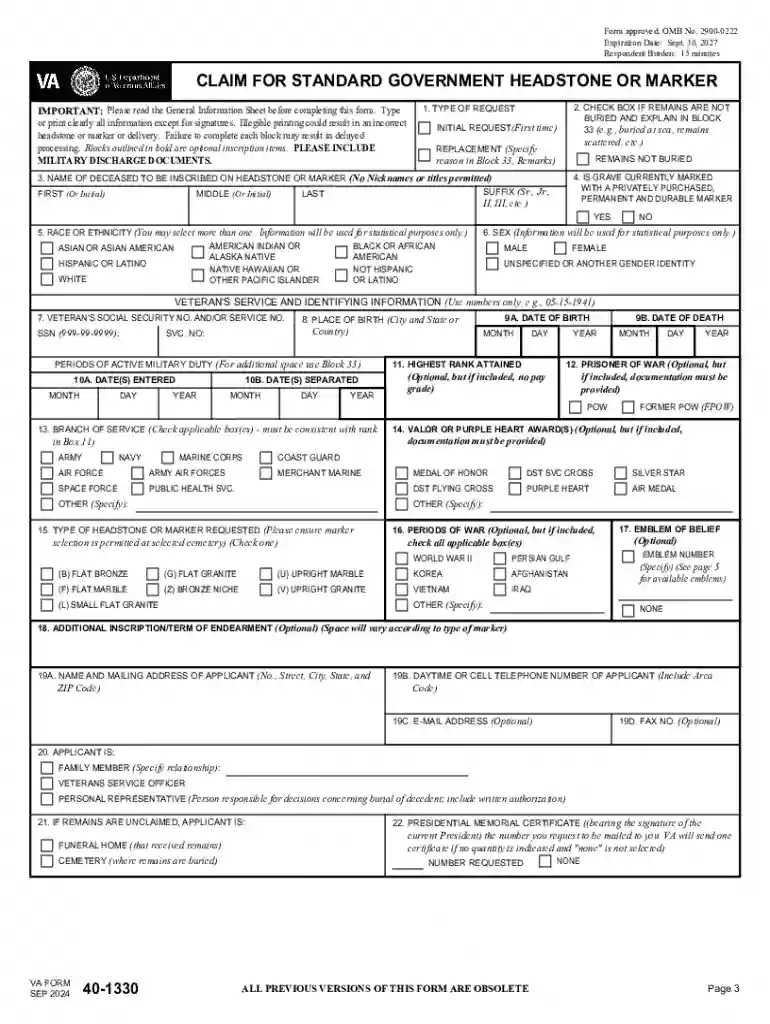
The VA Form 40-1330, also known as the Claim for Standard Government Headstone or Marker, is a document used by eligible individuals to apply for a government-issued headstone or marker. This form provides eligible deceased veterans with a formal acknowledgment of their service to the country through a standard government-issued grave marker. The form is integral for ensuring that veterans receive the appropriate recognition at their final resting place, celebrating their military service and honoring their sacrifices.
To qualify for a government-issued headstone or marker, certain eligibility criteria must be met. Primarily, the deceased must be a veteran who was discharged under conditions other than dishonorable. Additionally, any service member who died on active duty is eligible. Spouses and dependents of veterans may also qualify in certain circumstances if they are buried in a national, military, or state veterans cemetery. It's essential for applicants to verify eligibility before proceeding to avoid delays and ensure a smooth application process.


The VA Form 40-1330 can be obtained through several methods to accommodate various needs and preferences. Applicants can download the form directly from the Department of Veterans Affairs website, ensuring they have the most up-to-date version. Alternatively, they may request a physical copy by contacting their local VA office. In some cases, funeral directors or veteran service organizations may assist in acquiring and completing the form as part of their services for veteran families.
Gather Necessary Documentation: Before filling out the form, collect all required documents such as discharge papers (DD Form 214) to verify the veteran's service information.
Complete Personal Information: Enter the deceased veteran's and applicant's personal details, including full names, dates of birth and death, and social security numbers.
Select Headstone or Marker Type: Choose the type of headstone or marker desired, such as upright granite or marble headstones, flat markers, or niche markers.
Provide Inscription Details: Submit the text for the headstone or marker, including the veteran's name, rank, branch of service, dates of birth and death, and any other approved inscriptions or emblems.
Sign and Submit: Review all information for accuracy, sign the form, and submit it to the appropriate VA office, either by mail or through electronic means, if available.
Submitting the VA Form 40-1330 can be done either online, by mail, or in person at a VA office. For online submissions, applicants may use the VA's electronic portal, which often speeds up processing times. If choosing to mail, ensure all documents are in a sealed envelope addressed to the Veterans Affairs National Cemetery Administration, with all required supporting documentation included. In-person submissions provide an opportunity to speak directly with VA staff, which can be beneficial for answering any questions or clarifying uncertainties about the form or process.
The VA Form 40-1330 includes several essential components that applicants must carefully complete:
Using the VA Form 40-1330 carries legal implications, as providing false information is subject to penalties under federal law. Applicants must provide truthful and accurate information to avoid any legal issues that could hinder the process. Misrepresentation concerning the veteran's service details or eligibility may result in denial of a headstone or marker. Therefore, ensuring all submitted data and documents are accurate and verifiable is essential to uphold the integrity of the form and honor the veteran appropriately.
The application process involves submitting the completed form along with all required documentation to the VA. Once received, the VA reviews the application to confirm eligibility and accuracy before processing the request. The average approval time can vary, generally taking between four to six weeks. However, circumstances such as missing documentation or additional verification requirements may extend this period. Families are encouraged to follow up with the VA if a response is not received within the anticipated timeframe, ensuring any outstanding issues are quickly resolved.
We've got more versions of the VA Form 40-1330, CLAIM FOR STANDARD GOVERNMENT HEADSTONE OR MARKER CLAIM FOR STANDARD GOVERNMENT HEA form. Select the right VA Form 40-1330, CLAIM FOR STANDARD GOVERNMENT HEADSTONE OR MARKER CLAIM FOR STANDARD GOVERNMENT HEA version from the list and start editing it straight away!
At DocHub, your data security is our priority. We follow HIPAA, SOC2, GDPR, and other standards, so you can work on your documents with confidence.


Dec 19, 2025 Find out how to apply for grave markers, headstones, Presidential Memorial Certificates, and other memorial items to honor a Veterans service.Read more
(iii) VA Forms 40-1330 and 40-1330M include application and submission instructions as well as additional information related to emblems of belief, and areRead more


