01. Edit your form online
Type text, add images, blackout confidential details, add comments, highlights and more.

Type text, add images, blackout confidential details, add comments, highlights and more.

Draw your signature, type it, upload its image, or use your mobile device as a signature pad.

Send it via email, link, or fax. You can also download it, export it or print it out.
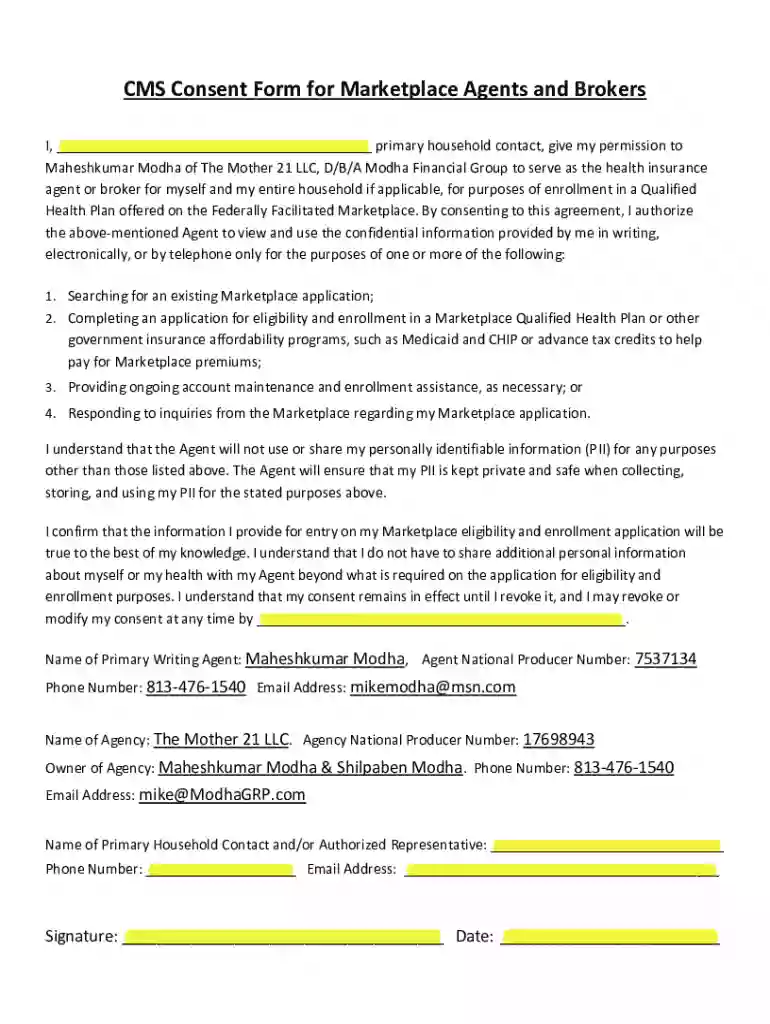
The CMS Consent Form for Marketplace Agents and Brokers is a legal document granting authorized health insurance agents the ability to act on behalf of an individual or primary household contact. It allows these agents to access personal information necessary for enrolling individuals in Qualified Health Plans through the Federally Facilitated Marketplace. This consent ensures protection and confidentiality of personally identifiable information (PII), which is crucial for maintaining the privacy and rights of individuals seeking health insurance.
To utilize the CMS Consent Form effectively, individuals must first understand the scope of permissions they are granting. This includes:
Agents typically walk clients through the form, explaining each section and its implications. The form should be completed in accordance with federal and state regulations, ensuring all required fields are accurately filled out before submission.
Double-check for accuracy and completeness before submitting the form to avoid delays in processing.
Using the CMS Consent Form serves several purposes:
Consent forms are especially beneficial for those unfamiliar with health insurance marketplaces or those who prefer guided assistance.
Critical aspects of the CMS Consent Form include:
Understanding these components is vital for both agents and clients to ensure clarity and mutual understanding of responsibilities and limitations.
The use of the CMS Consent Form is guided by legal standards that include:
Clearly defined legal use fosters trust between clients and agents, facilitating smoother interactions.
Understanding terminology is crucial for effective form use:
Familiarity with these terms helps clients and agents to better navigate the consent process.
The execution and requirements of the CMS Consent Form can vary by state:
Agents and clients should consult state-specific guidelines to ensure compliance and smooth processing of consent forms.
At DocHub, your data security is our priority. We follow HIPAA, SOC2, GDPR, and other standards, so you can work on your documents with confidence.