Chapter 16 Haircutting 2026

Get Form
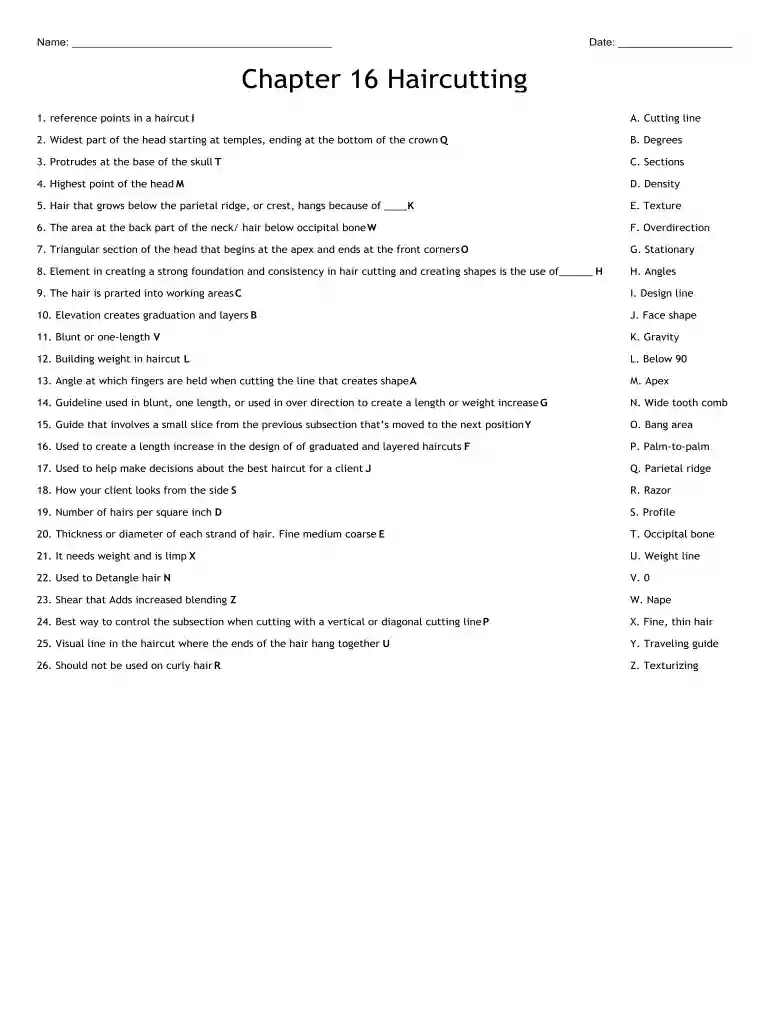
Chapter 16 Haircutting Preview on Page 1

Here's how it works

01. Edit your form online
Type text, add images, blackout confidential details, add comments, highlights and more.

02. Sign it in a few clicks
Draw your signature, type it, upload its image, or use your mobile device as a signature pad.

03. Share your form with others
Send it via email, link, or fax. You can also download it, export it or print it out.

Definition and Meaning of Chapter 16 Haircutting

Chapter 16 Haircutting is a comprehensive educational section found within cosmetology training materials that elucidates the essential principles and technical skills necessary for effective hair cutting. It serves as an instructional guide for both novice and experienced stylists, focusing on the foundational aspects required to execute various haircuts proficiently. This chapter typically covers fundamental terminology and concept explanations that are critical to understanding the haircutting process.

Key Elements of Chapter 16 Haircutting

Chapter 16 Haircutting includes several core elements crucial for mastering the craft of haircutting. These elements cover:

  • Reference Points: Understanding reference points on the head is essential for creating balance and proportion in haircuts.
  • Cutting Techniques: Techniques such as blunt cutting, point cutting, and texturizing are explored to give stylists a range of options.
  • Hair Characteristics: Texture, density, and growth patterns are pivotal characteristics affecting how a haircut will look and behave.

Important Terms Related to Chapter 16 Haircutting

To navigate Chapter 16 effectively, it is essential to be familiar with specific haircutting terminology:

  • Cutting Line: The angle at which the hair is held and cut.
  • Sections and Subsections: Dividing the hair into manageable parts for precision cutting.
  • Degrees: Often used to describe the angle of a haircut, crucial in determining the overall style.

Steps to Complete the Chapter 16 Haircutting

Chapter 16 involves a series of carefully orchestrated steps to yield the desired haircut. These typically include:

  1. Consultation: Analyzing hair type and client preferences.
  2. Preparation: Shampooing and arranging the hair with clips into sections.
  3. Cutting Process: Using chosen techniques to cut each section as per the style blueprint.
  4. Finalizing: Checking symmetry, making adjustments, and styling.

Who Typically Uses the Chapter 16 Haircutting

This chapter is a reference tool predominantly utilized by cosmetology students and educators in beauty schools to ensure that learners gain a robust understanding of haircutting fundamentals. Furthermore, professional stylists frequently refer to this chapter to refresh their skills or when teaching apprentices the mechanics of including various cuts.


decoration image ratings of Dochub

Important Terms Related to Chapter 16 Haircutting

Knowing the specific language of haircutting aids in mastering the skills outlined in the chapter:

  • Texture: The thickness or diameter of an individual hair strand.
  • Density: The number of hair strands per square inch on the scalp.
  • Elevation: The degree at which the hair is lifted away from the scalp, affecting the haircut’s structure.

Legal Use of the Chapter 16 Haircutting

While Chapter 16 itself does not govern legal stipulations, it plays a crucial role in meeting the educational requirements for obtaining a cosmetology license in many states. Passing exams that test knowledge from such educational chapters is mandatory for legal practice as a haircutter.

Examples of Using the Chapter 16 Haircutting

Practical application scenarios found in Chapter 16 display the transformation of theoretical knowledge into practical skills:

  • A stylist uses elevation and degrees to cut a layered bob, adjusting the angle based on the client's head shape.
  • Implementing texturizing techniques to thin out thick hair while maintaining length ensures a style that is lighter and easier to manage.

Understanding and leveraging the information in Chapter 16 empowers stylists to deliver consistent, professional-level results.

be ready to get more

Complete this form in 5 minutes or less

Get form

Got questions?

We have answers to the most popular questions from our customers. If you can't find an answer to your question, please contact us.
Contact us
Over direction creates length and width in the opposite direction. If hair is directed from the front to the back, hair is longer in the front. If hair is directed from back to front, hair is longer in the back.
0:35 6:09 And im going to cut it. Off. Now this is directly up from where it. Lives haul out from the headMoreAnd im going to cut it. Off. Now this is directly up from where it. Lives haul out from the head thats as short as it can be using that as my guide. Now anywhere on the head.
Stationary When a guide is set and all new sections are over directed to that stationary point. This builds the most weight. Traveling When a piece of the previously cut section is used as the guide for the next section being cut. This builds minimal weight.
Expert-Verified Answer. The shear-over-comb technique is used in haircutting to place the hair in position for shaping by rolling the comb out. This method helps in achieving a precise cut while allowing the hair to be lifted and held correctly during the trimming process.
: to direct the activities, performance, or course of (someone or something) in an excessive or overbearing manner. The manager is overdirecting the project.

Security and compliance

At DocHub, your data security is our priority. We follow HIPAA, SOC2, GDPR, and other standards, so you can work on your documents with confidence.
Learn more
ccpa2
pci-dss
gdpr-compliance
hipaa
soc-compliance
be ready to get more

Complete this form in 5 minutes or less

Get form

People also ask

A clipper cut is an electric or batery operated tools that cut hair by using two moving blades held in place by a metal plate with teeth.
Cowlicks, whorls, and other growth patterns affect where the hair ends up once it is dry. You may need to use less tension when cutting these areas to compensate for hair being pushed up when it dries, especially in the nape, or to avoid getting a hole around the ear in aone-length haircut.
OVER DIRECTION Over direction creates length and width in the opposite direction. If hair is directed from the front to the back, hair is longer in the front. If hair is directed from back to front, hair is longer in the back.

Related links