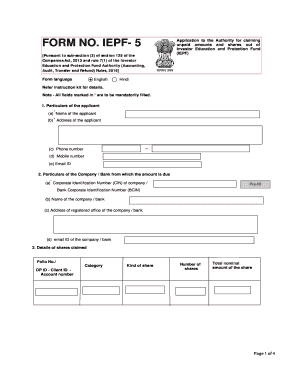
01. Edit your 15g form online
Type text, add images, blackout confidential details, add comments, highlights and more.

Type text, add images, blackout confidential details, add comments, highlights and more.

Draw your signature, type it, upload its image, or use your mobile device as a signature pad.

Send it via email, link, or fax. You can also download it, export it or print it out.
Form 15G is a self-declaration form used under the Income-tax Act, 1961, by individuals or Hindu Undivided Families (HUFs) residing in India to ensure that their income falls below the taxable threshold. The primary objective of this form is to prevent banks from deducting Tax Deducted at Source (TDS) on their interest income. Typically, individuals with a total income below the exemption limit use this form. It comprises personal details of the declarant, estimated total income, and verification statements. Form 15G is primarily targeted at residents who are below the age of sixty.
To download Form 15G, you can visit financial institutions' websites that offer the document or directly obtain it from the official income tax portal of the Government of India. Once there, you can easily find the form in the designated section for taxpayer services. If a digital format is preferred, it is typically available in PDF form, which ensures compatibility and easy access across various devices. Financial institutions also might provide printed copies directly at their branches upon request.
Fill Personal Details: Begin by entering basic personal information such as the name, PAN, address, and the status of the applicant.
Provide Estimated Income: Input the estimated income details for the current financial year to declare that it is not liable for tax deductions.
Declaration of Previous Year Income: Complete the section regarding previous years' income if applicable, to provide the full context of the tax situation.
Verification and Signature: After completing the form, verify all entries for accuracy before signing. The declarant's signature is mandatory to validate the declaration.
Submission to Financial Institutions: Submit the completed form to the respective financial institution to prevent any TDS deductions on interest income.
Form 15G is pivotal for individuals who rely on interest income but do not fall under the taxable income bracket. By submitting this form, individuals can avoid premature or unnecessary TDS deductions, ensuring liquidity and preventing any impact on their cash flow. It also assists in ensuring compliance with tax laws, eliminating any possible legal disputes over tax deductions on non-taxable incomes.
Typically, young individuals or those not earning incomes beyond the exemption limit, such as students, homemakers with interest income, or part-time workers, use Form 15G. It is not applicable for companies or firms, as this form caters to individuals and HUFs, saving them from tax deductibility when their income is genuinely below taxable limits.
Layout: The form comprises two parts. Part I must be filled by the individual/holder, and Part II is reserved for verification by the institution.
Sections: It includes sections on personal details, income estimation, and declaration of past income.
Mandatory Fields: Certain fields such as PAN and estimated income must be completed carefully to ensure validity.
Declaration: A vital part is the verification and declaration section, which legally binds the declarant to the statement provided.
It's crucial to understand that Form 15G should only be used when the conditions stipulated under the Income-tax Act are genuinely met, as misrepresentation or false declarations can result in penalties or legal proceedings. The form supports legal tax avoidance for those it genuinely applies to, making honest declarations necessary.
Failure to submit Form 15G when you are eligible might result in unnecessary TDS deductions, complicating the matter with refunds and increased paperwork. On the other hand, falsifying information to reduce liabilities can incur strict penalties, including fines and prosecution. Therefore, it is essential to ensure that all information is accurate and compliant with rules under the Income-tax Act.
While Form 15G is a central government form, certain banks and financial institutions might have different procedural requirements based on state regulations. It's advisable to consult with the local branch of the bank or financial institution to ensure compliance with any state-specific requirements before submission.
We've got more versions of the 15g form form. Select the right 15g form version from the list and start editing it straight away!
At DocHub, your data security is our priority. We follow HIPAA, SOC2, GDPR, and other standards, so you can work on your documents with confidence.