






Definition and Meaning
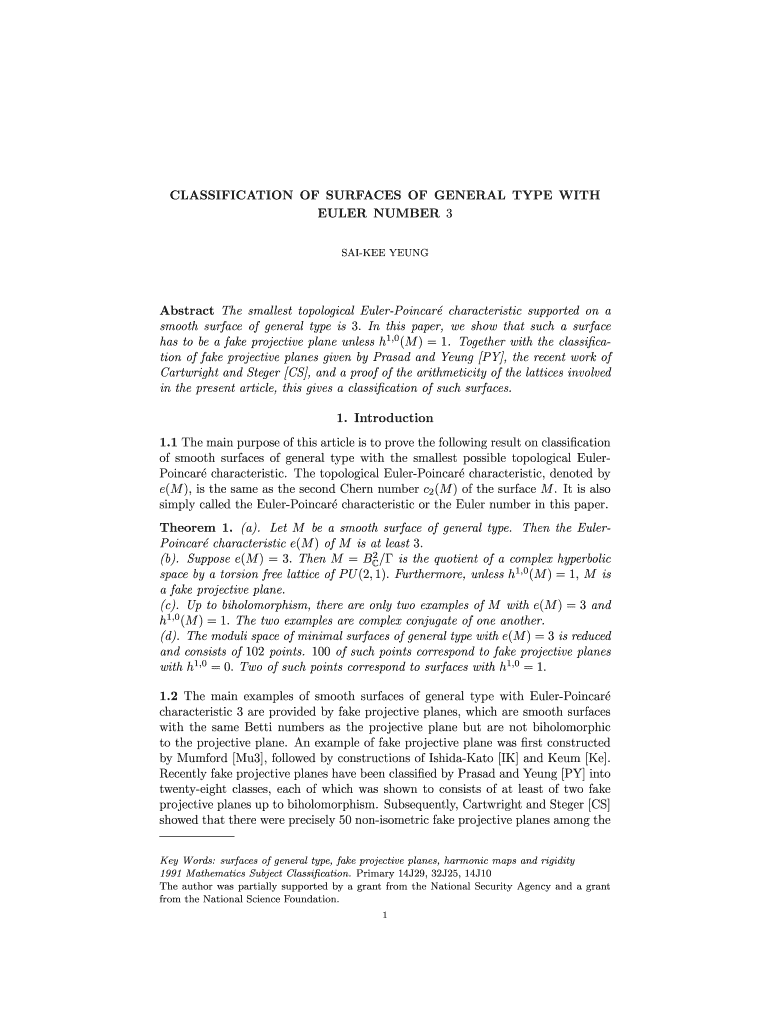
The "Classification of Surfaces of General Type With" explores the categorization of mathematical surfaces that exhibit a certain level of complexity. These surfaces are distinguished by specific properties which are critical in fields such as algebraic geometry. Understanding this classification involves recognizing particular characteristics like the Euler-Poincaré characteristic, which helps in identifying the mathematical behavior and inherent attributes of such surfaces. Researchers and mathematicians utilize these classifications to advance theories and solve complex equations.
Key Elements of Classification
Certain elements are pivotal in classifying surfaces of general type. These include:
- Topology: Focuses on the properties of a surface that remain unchanged under continuous deformations.
- Algebraic Features: Examines the polynomial equations defining these surfaces.
- Euler Characteristic: A fundamental topological invariant used for classifying surfaces, indicating the ‘shape’ or structural essence.
- Canonical Class: It relates to the dualizing sheaf, essential for the classification in algebraic geometry.
How to Use the Classification
Using the classification involves several steps and insights, primarily aimed at students, mathematicians, or researchers.
- Data Gathering: Collect data on the surface, including its algebraic equations and topological features.
- Determine Invariants: Calculate invariants such as the Euler characteristic.
- Apply Theoretical Models: Use algebraic models to predict and classify based on gathered data.
- Analyze Outcomes: Compare the results against known classifications to understand the surface's type.
Examples of Using the Classification
Real-world applications of this classification provide a useful framework to explore:
- Mathematical Research: Deepening the understanding of complex geometrical structures in research settings.
- Theoretical Physics: Utilized in string theory where surfaces of general type help model extra dimensions.
- Engineering Solutions: Assisting in solving complex mechanical simulations through geometric modeling.
Steps to Complete the Classification
- Identify Surface Properties: Collect all possible data about the surface properties you are dealing with.
- Calculate Numerical Invariants: Use mathematical formulas to determine key numerical invariants, such as the Euler-Poincaré characteristic.
- Compare with Known Classes: Match the obtained data with existing literature to classify.
- Document Findings: Ensure all observations and categorizations are documented for reference and further study.
Who Typically Uses the Classification
The classification is predominantly used by:
- Mathematicians: To expand understanding in fields like topology and algebraic geometry.
- Researchers: For advanced studies in mathematical structures and their applications.
- Higher Education Institutions: In academic courses involving complex mathematical and geometrical concepts.
- Theoretical Physicists: When models require understanding complex surface types and characteristics.


Important Terms Related to Classification
- Curvature: Influences how a surface bends in space.
- Genus: Refers to the number of 'holes' in a surface, crucial in topological classification.
- Minimal Model: A surface model devoid of redundancies.
- Bicanonical Map: A tool used to study surfaces, providing a map related to their geometry.
State-Specific Rules and Variances
While this classification typically adheres to universal mathematical principles, certain educational institutions or research facilities might have specific protocols or methodologies when studying or applying these classifications. These rules ensure adherence to regional academic standards and can provide unique insights into applied mathematics research.
Legal Use of the Classification
In academia, the classification of surfaces of general type is generally understood as part of mathematical research and study. While it does not typically involve legal issues, intellectual property rights or copyright laws might apply regarding the documentation and publication of new findings related to this classification.
Filing Deadlines / Important Dates
For academic purposes, deadlines might be imposed based on the academic calendar or research grant timelines. It is essential to adhere to these timelines for presentations at conferences or submission for peer-reviewed journals.
Form Submission Methods (Online / Mail / In-Person)
While not typically a form in the conventional sense, submitting research or findings related to this classification often occurs through:
- Online Platforms: Many academic journals and conferences require electronic submission of papers.
- In-Person Conferences: Delivering findings through presentations at academic or professional gatherings.
Each method provides an avenue for sharing and receiving feedback on classifications and studies.