







Definition and Meaning
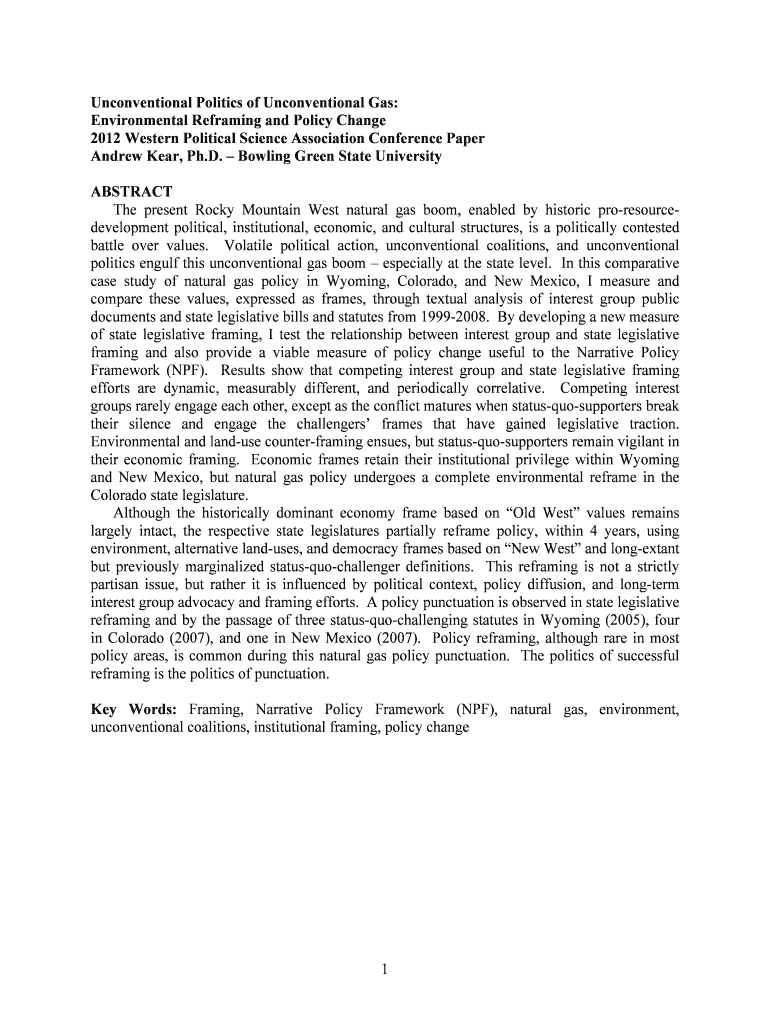
The term "Unconventional Politics of Unconventional Gas - WPSA Western" refers to the complex interplay of political dynamics associated with the development and regulation of unconventional gas resources in the Western United States. This encompasses various political, economic, and environmental concerns that influence policy-making in states like Wyoming, Colorado, and New Mexico. The "unconventional gas" typically refers to sources such as shale and coalbed methane, which require advanced techniques like hydraulic fracturing for extraction. The Western Political Science Association (WPSA) provides a scholarly platform for discussing these dynamics, offering insights into how political frameworks evolve in response to the economic and ecological challenges posed by unconventional gas development.
How to Use the Unconventional Politics of Unconventional Gas - WPSA Western
Understanding the unconventional politics of unconventional gas involves examining case studies, policy analyses, and theoretical models that reveal the complex relationships between different stakeholders. Researchers and policymakers can utilize this understanding to evaluate how diverse political agendas impact the regulatory landscape. By studying documented shifts in policy or legislative action over time, stakeholders can identify patterns and anticipate future regulatory changes, which is crucial for developing strategies that balance economic growth with environmental stewardship.
Key Elements of the Unconventional Politics
Several critical elements define the unconventional politics of unconventional gas. These include:
- Competing Interest Groups: Economic vs. environmental interests are typical, with developers advocating for less restrictive regulations and environmental groups pushing for more stringent controls.
- State Legislation: Different states often have varying approaches to regulating unconventional gas, influenced by local politics and economic dependencies.
- Framing and Reframing Strategies: How issues are framed in political debates significantly affects policy outcomes. For instance, economic development might be framed as job creation, while environmental concerns may focus on sustainable land use.
State-Specific Rules and Regulations
Different Western states have distinct rules governing the exploration and extraction of unconventional gas. Key differences can be observed in:
- Wyoming: Known for its pro-development stance, emphasizing economic benefits and energy independence.
- Colorado: Has implemented stricter environmental regulations, often driven by grassroots activism and public concern.
- New Mexico: Balances between economic growth and traditional environmental values, reflecting a mix of Old West and New West philosophies.
Examples of Political Dynamics in Unconventional Gas
Examining specific case studies provides insight into the broader themes of political dynamics:
- Wyoming (): Rapid regulatory adaptation aligned with economic expansion in the gas industry, yet facing increasing pressure from environmental advocates.
- Colorado (2000s): Shift toward more stringent regulations as public awareness about environmental impacts increased, resulting in a policy environment more receptive to environmental framing.
- New Mexico (Early 2000s): Efforts to balance traditional energy development with emerging environmental, economic growth considerations created a nuanced policy environment.
How to Obtain Information on this Topic
Researchers seeking to understand the unconventional politics of unconventional gas may utilize several resources:
- Scholarly Articles and Journals: Publications from institutions such as the WPSA offer peer-reviewed insights.
- Government Reports: State-specific legislative documents can provide context on regulatory approaches.
- Industry Analysis: Reports from energy companies may offer economic impact assessments.
- Environmental Impact Studies: These studies help assess the ecological consequences of unconventional gas development.
Steps to Analyze Unconventional Gas Politics
Conducting a comprehensive analysis involves several steps:
- Identify Stakeholders: Determine the interest groups involved, such as government bodies, industry players, and environmental NGOs.
- Gather Data: Use surveys, interviews, and case studies to collect qualitative and quantitative information.
- Evaluate Policy Impact: Assess how regulations have changed over time and their socioeconomic consequences.
- Analyze Framing Techniques: Look at how different groups frame their narratives and the resultant policy impacts.
Important Terms Related to Unconventional Gas Politics
Understanding key terminology is crucial for navigating the discourse:
- Hydraulic Fracturing: A technique for extracting unconventional gas, often central to regulatory debates.
- Policy Framing: The way issues are presented and perceived in political discourse, influencing decision-making.
- Legislative Reframing: The process by which policymakers shift their stance based on new framing strategies or stakeholder pressures.
Legal Use and Compliance Requirements
Entities involved in unconventional gas extraction must comply with a complex web of regulations, which may include:
- Environmental Protection Laws: Such as the Clean Air Act or Clean Water Act.
- State-Specific Permits: Required for drilling and exploration activities.
- Land-Use Regulations: Restrictions on where and how extraction can occur to minimize environmental impact.
By effectively navigating the unconventional politics of unconventional gas, stakeholders can better position themselves to handle the socio-political and regulatory changes in this evolving sector.




