







Definition & Meaning
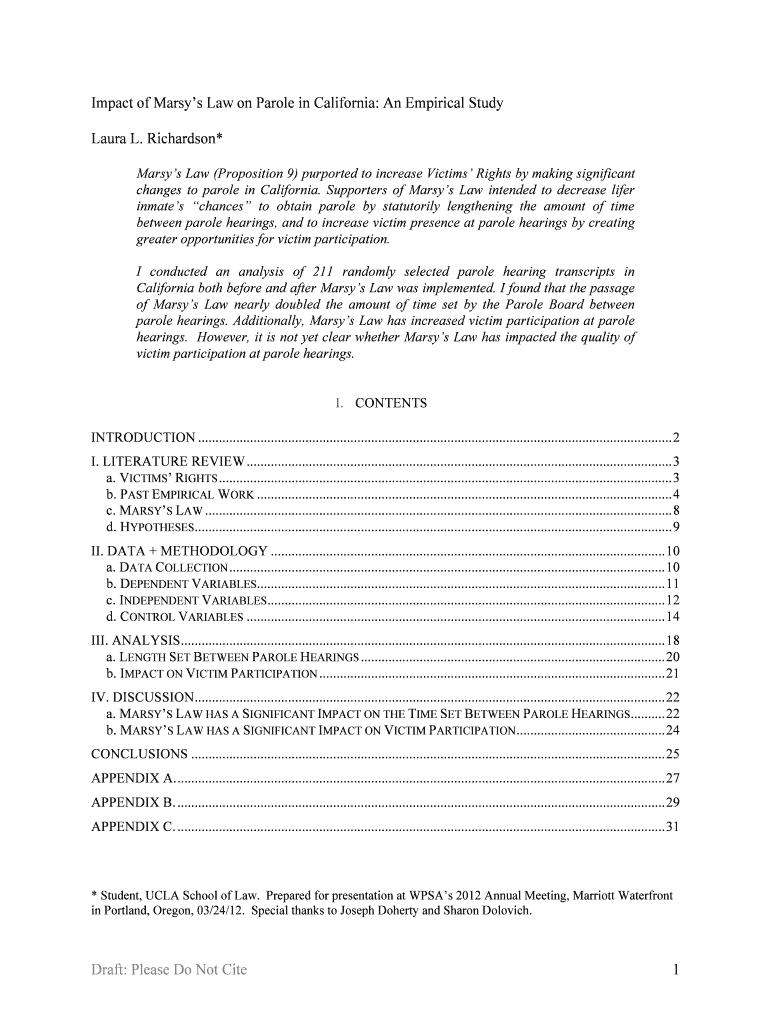
Marsy's Law, officially known as Proposition 9, was enacted in California as part of a broader initiative to expand victims' rights within the criminal justice system. It focuses on ensuring victims have a more active role in parole hearings and other legal processes related to those who have committed crimes against them. The empirical study on Marsy's Law analyzes its impact specifically on the parole process in California, delving into changes in parole hearing intervals and victim participation rates.
Key Provisions of Marsy's Law
- Victims' Rights Expansion: Marsy's Law establishes rights such as notification of parole hearings and the chance to be heard during these processes.
- Parole Hearings: The law affects the scheduling and structure of parole hearings, often resulting in extended periods between hearings.
- Victim Participation: A significant component is the empowerment of victims to participate more effectively in parole decisions.
Impact on Parole Hearings in California
The study reveals significant changes to parole procedures post-implementation of Marsy's Law, focusing on the elongation of time intervals between parole hearings and the rise in victim engagement.
Increased Time Between Hearings
- Extended Delays: The duration between parole hearings has almost doubled, which can affect inmates' chances of parole.
- Implications for Inmates: Longer gaps may reduce opportunities for parole, impacting rehabilitation prospects and long-term planning within the prison system.
Rise in Victim Participation
- Statistical Increase: Victim participation rates in parole hearings increased by 7%, highlighting the law's influence.
- Quality of Participation: While participation rates have risen, the study questions the substantive quality and impact of victim contributions in these proceedings.
Key Elements of the Empirical Study
Understanding the core components of the empirical study provides insight into its scope and findings.
Methodology
- Transcript Analysis: The study analyzed 211 parole hearing transcripts to gauge the law's impact.
- Focus Areas: Researchers concentrated on hearing frequency and victim involvement to determine changes resulting from Marsy's Law.
Major Findings
- California Penal Code Changes: The study underscores modifications to the penal code, driven by the aim to protect and empower victims.
- Future Projections: It suggests ongoing analysis to monitor long-term impacts on the parole system and victim experiences.
State-Specific Rules for California
California-specific regulations related to Marsy's Law emphasize local legislative nuances and their implications for the parole process.
Legislative Context
- California's Unique Position: As a pioneering state in victim rights expansion, California's adaptation of Marsy's Law serves as a model for other states.
- Implications for Other Jurisdictions: The evolution of these laws in California may influence similar legislative efforts across the United States.
Examples of Marsy's Law in Action
Illustrating real-world applications of Marsy's Law can elucidate its practical effects on parole hearings and victim participation.
Case Studies
- Case Study A: A case where victim input during parole altered the outcome, showcasing increased advocacy opportunities.
- Case Study B: An example of a parole hearing where extended time between sessions affected the inmate's rehabilitation path.
Practical Scenarios
- Impact on Judicial Decisions: The study examines how enhanced victim involvement can sway release decisions.
- Enhanced Victim Support: Instances where victims have felt more supported and informed about criminal proceedings post law enactment.
Legal Use of the Study's Findings
The empirical study's findings can inform legal practices and policy decisions concerning Marsy's Law.
Applications in Legal Proceedings
- Policy Adjustments: Legal professionals and policymakers might use these findings to adjust parole procedures.
- Victim Advocacy: Activists and advocates could leverage study insights to push for further enhancements in victims' rights.
Important Terms Related to Marsy's Law
Understanding pertinent terminology is critical for comprehending the study's findings and implications.
Glossary of Terms
- Victim Participation: Involvement of victims in legal proceedings post-crime.
- Parole Hearing Interval: The scheduled time between parole hearings for inmates.
- Empirical Study: Research based on observed and measured phenomena to provide evidence-based conclusions.
Who Typically Uses the Study
Different stakeholders utilize the study's insights for diverse purposes within the legal system.


Primary Users
- Legal Practitioners: Lawyers and judges involved in parole hearings and victim rights cases.
- Policy Makers: Individuals crafting policies related to the criminal justice system.
- Academics: Researchers studying the impact of legal reforms on criminal justice processes.
Versions or Alternatives to the Study
An exploration of different approaches or supplementary studies that can complement the understanding of Marsy's Law.
Supplementary Research
- Comparative Studies: Analyses comparing Marsy's Law impact in California versus other states with similar legislation.
- Longitudinal Studies: Research assessing the law's long-term impacts on parole outcomes and victim satisfaction.
Why This Study Matters
Highlighting the significance of the empirical study demonstrates its value to the broader context of criminal justice and victims' rights.
Importance
- Influence on Lawmaking: Provides a data-driven foundation for potential adjustments to victim-related legal processes.
- Advancements in Victim Rights: Contributes to a more empowered and participative role for victims within the justice system.




