







Definition and Meaning
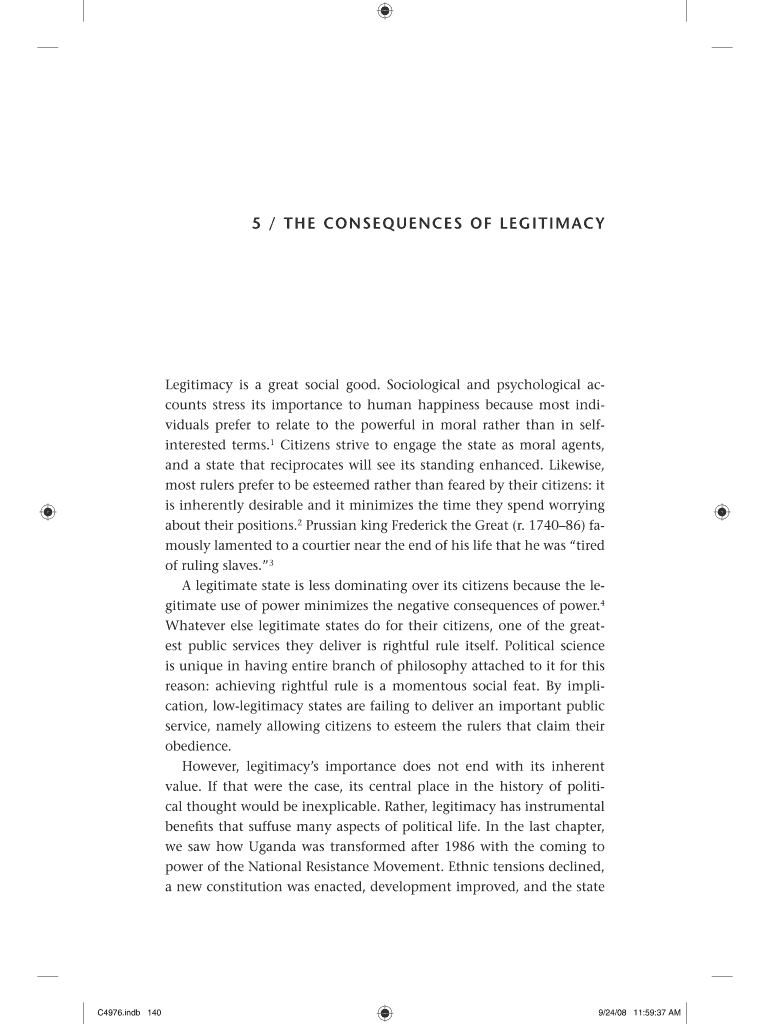
"5 the consequences of legitimacy - Portland State University" refers to a conceptual framework used to understand the impact of legitimacy on political and societal structures. Legitimacy in a political context holds significant importance as it affects state effectiveness, citizen compliance, and overall societal stability. The framework explores how legitimacy acts as a moral and instrumental force, enhancing political outcomes such as democratization, state-building efforts, and stability. It critically contrasts with structural or realist political theories, advocating that legitimacy is central to political analysis due to its influence on internal conflicts, democratic processes, and international relations.
How to Use the Framework
Understanding the framework involves analyzing political scenarios where legitimacy plays a crucial role. Scholars and practitioners can apply this model to examine:
- Democratization Processes: Investigate how legitimacy affects transitions towards democracy or its breakdowns.
- State Building: Evaluate how nations develop governmental systems that are perceived as legitimate by their citizens.
- Conflict Analysis: Explore the interplay between legitimacy deficits and internal conflicts within states.
- Policy Development and Analysis: Use legitimacy as a lens to develop policies that ensure their acceptance and effectiveness.
Steps to Complete the Analysis
Conducting an analysis using this framework involves several steps:
- Identify the Political Issue: Determine the specific political issue or scenario to be analyzed.
- Assess Legitimacy: Measure how legitimacy is conceived and its current status within the context.
- Analyze Consequences: Explore how the level of legitimacy affects political stability, state effectiveness, and societal compliance.
- Evaluate Outcomes: Assess the outcomes of strong or weak legitimacy on political and societal structures.
- Propose Solutions: Develop strategies to improve or maintain legitimacy within the analyzed context.
Key Elements of the Framework
Three key elements are central to understanding this framework:
- Perceived Legitimacy: Citizens' acceptance and belief in their political system's validity.
- Institutional Effectiveness: How legitimacy influences governmental efficiency and policy implementation.
- Citizen Compliance: The relationship between legitimacy and voluntary societal adherence to laws and norms.
Who Typically Uses the Framework
The framework is commonly used by:
- Political Scientists: To explore the dynamics of power and legitimacy.
- Policymakers: To design and evaluate policies with legitimacy considerations.
- Sociologists: To understand social structures and citizen-state interactions.
- International Relations Experts: To assess the role of legitimacy in global politics.


Important Terms Related to Legitimacy
Several terms are closely related to the study of legitimacy:
- Political Legitimacy: The recognized right of a government to rule.
- Social Legitimacy: Society's collective endorsement of an institution or government.
- Authority: The power to enforce laws and ensure compliance.
- Sovereignty: Supreme power or authority within a territory.
State-Specific Rules
Though legitimacy is a universal concept, its application and implications can vary by state. Differences might include:
- Governance Structures: The type of government influences how legitimacy is obtained and maintained.
- Cultural Factors: Societal values and norms affect perceptions of legitimacy.
- Historical Context: Historical experiences shape the understanding and prominence of legitimacy in political discourse.
Why This Framework Matters
Legitimacy is vital for:
- Ensuring Stability: A legitimate government is less likely to face revolts or public disobedience.
- Fostering Development: Legitimacy can lead to better governance and economic growth.
- Enhancing Compliance: When citizens perceive their government as legitimate, they are more likely to comply with laws voluntarily.
Understanding the "5 the consequences of legitimacy - Portland State University" framework offers profound insights into political processes, enabling more effective policy development and governance strategies.




