01. Edit your form online
Type text, add images, blackout confidential details, add comments, highlights and more.

Type text, add images, blackout confidential details, add comments, highlights and more.

Draw your signature, type it, upload its image, or use your mobile device as a signature pad.

Send it via email, link, or fax. You can also download it, export it or print it out.
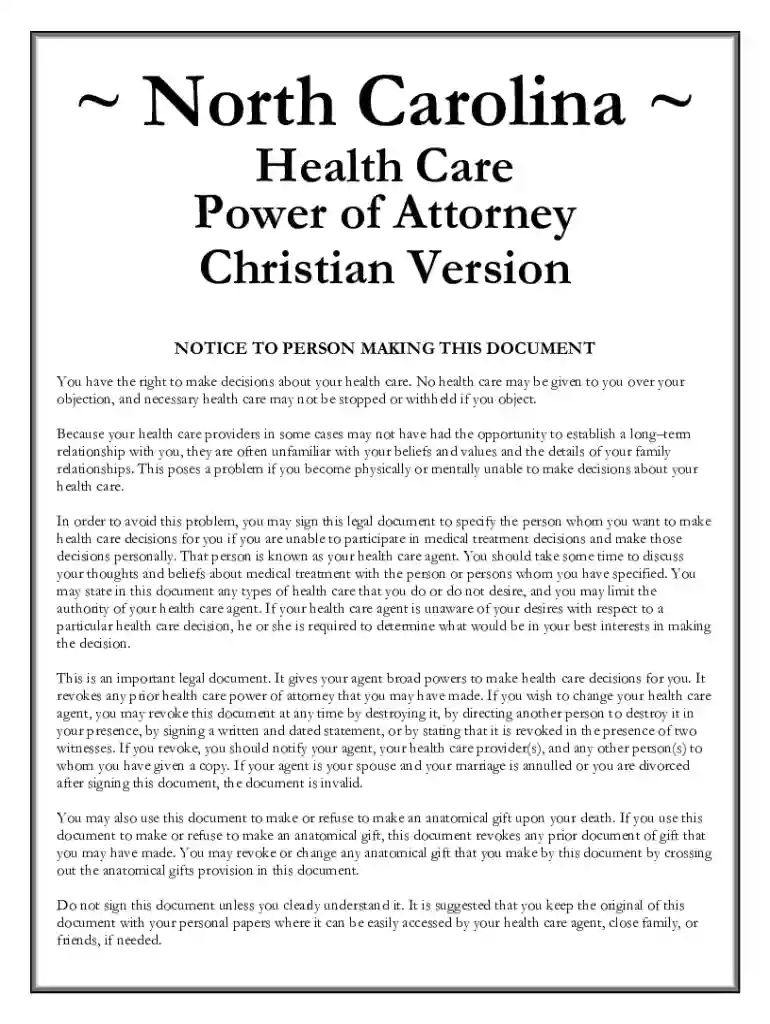
The North Carolina Medical Power of Attorney Form is a legal document that empowers an appointed health care agent to make medical decisions on behalf of an individual if they become unable to do so themselves. This form is crucial for ensuring that the individual's medical preferences are honored during incapacitation. It grants authority to the agent to oversee a range of medical issues and make decisions that align with the individual’s values and beliefs, including life-sustaining treatments and anatomical gifts.
In North Carolina, the Medical Power of Attorney Form is recognized as a legal instrument designed to facilitate medical decision-making for incapacitated individuals. However, the form must comply with state-specific requirements, such as witness and notarization provisions. Witnesses should not be related to or financially responsible for the principal. Furthermore, the form complies with legal standards, ensuring it adheres to the ESIGN Act for electronic signatures when executed digitally.
To complete the North Carolina Medical Power of Attorney Form, ensure you have:
This form is primarily used by individuals planning their medical care preferences and ensuring these are honored even when they can't communicate due to incapacity. Typical users include elderly individuals, those with chronic health conditions, or anyone wishing to ensure their medical wishes are respected. The form is common among people who hold strong personal or religious beliefs about medical treatments and life-saving measures.
Consider a situation where an individual slips into a coma following a serious accident. The medical power of attorney allows the health care agent to decide on treatment plans without delay, reflecting the individual’s pre-set directions regarding life support and surgical interventions. Another scenario involves terminal illness: the agent could enforce the principal's wish to refuse aggressive treatments, opting for hospice care instead, as previously discussed and documented.
The North Carolina Medical Power of Attorney Form is available in both digital and paper formats. The digital version can be completed and digitally signed, providing convenience and speed, especially useful in urgent medical circumstances. It also facilitates easier sharing with medical professionals and institutions. The paper version, however, remains widely accepted, particularly in environments less prone to digital adoption. Both versions serve the same legal purpose when properly executed.
At DocHub, your data security is our priority. We follow HIPAA, SOC2, GDPR, and other standards, so you can work on your documents with confidence.