
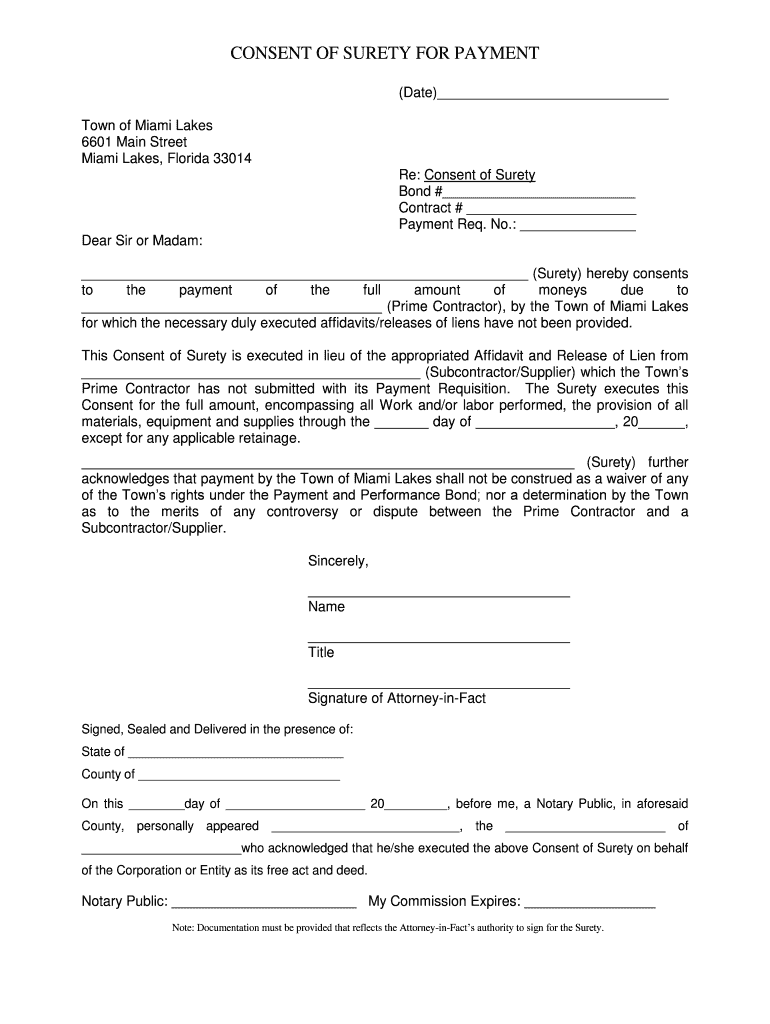







Definition & Meaning
The "Consent of Surety for Payment" is a legal document issued by a surety company that indicates its approval for a payment to be made to a contractor. This document assures the party responsible for the payment, often referred to as the obligee, namely the Town of Miami Lakes in some instances, that the surety agrees to allow the payment even if certain conditions, like missing affidavits or releases of liens from subcontractors or suppliers, have not been met. This form ensures that the surety acknowledges the payment but retains its rights under the Payment and Performance Bond.
Key Purpose
- Provides assurance that payment can be made safely.
- Confirms that the surety company consents to the payment despite potential issues, preserving contractual obligations.
Relevant Use Cases
- Commonly used in construction projects to ensure payments to primary contractors.
- Vital in situations where subcontractor documentation is delayed but work must proceed.
How to Use the Consent of Surety for Payment
This form is primarily utilized in transactions involving construction and development projects. It becomes necessary when payments to contractors need to occur, but documentation from subcontractors is incomplete.
-
Verify Contractual Obligations:
- Ensure the contract requires surety approval before payments.
- Review the terms of the Payment and Performance Bond.
-
Initiate Agreement with the Surety:
- Contact the surety to inform them of the upcoming payment.
- Discuss any missing documentation and seek explicit consent.
-
Obtain the Consent Document:
- The surety company will prepare and possibly issue the document.
- Carefully review the document for any specific conditions attached.
Key Elements of the Consent of Surety for Payment
The document must include several critical components to be valid and effective in its function.
Essential Inclusions
-
Identification of Parties:
- Clear identification of surety, obligee, and contractor.
-
Statement of Consent:
- Explicit declaration that the surety consents to the payment.
-
Project Details:
- Specificity regarding the project related to the payment.
Additional Clauses
-
Reservation of Rights:
- It should clarify that the surety reserves all rights under the bond.
-
Reference to the Bond:
- Include a reference number or other details of the bond involved.
Steps to Complete the Consent of Surety for Payment
Completing this form involves a series of procedural steps to ensure all necessary information is accurately captured and the document is legally binding.
-
Prepare Initial Documentation:
- Gather necessary contracts, bonds, and any existing affidavits.
-
Complete Identification Sections:
- Fill in details for the principal, obligee, and surety.
-
Outline Payment Details:
- Clearly state the amount and nature of the payment involved.
-
Review and Confirm Legal Statements:
- Ensure all parties agree with the legal language and statements within the form.
-
Sign and Seal the Document:
- The surety and all involved parties should execute the document, including any necessary seals.
Common Challenges
- Ensuring all related documentation is properly aligned with the form.
- Verifying that the signatures meet compliance requirements.
Legal Use of the Consent of Surety for Payment
This document has significant legal implications for all involved parties, especially within U.S. jurisdictions.
Binding Nature
- Once signed, it legally binds the surety company to its agreement, allowing payments to proceed.
- The document does not waive any legal rights under the initial bond but serves as a temporary solution.
U.S. Legal Context
- The document must align with U.S. state-specific laws and guidelines concerning construction and payment bonds.
Important Terms Related to the Consent of Surety for Payment
Understanding the terminology associated with this form is crucial for its correct application and comprehension.
Key Terms
- Surety: The company that provides the bond and offers the assurance of payment.
- Obligee: The entity requiring the bond, such as a government or municipality.
- Principal: The contractor or party performing the work or service.
Who Issues the Form
Typically, the surety company responsible for the bond agreement is the entity that generates and issues the "Consent of Surety for Payment" document.
Procedures for Issuance
- The principal may request issuance from the surety.
- Ensure the form is filled with accurate and comprehensive details before submission.
Surety Companies
- Larger construction-specific surety companies often have established processes for handling such requests and may offer standardized forms.
Penalties for Non-Compliance
Failure to secure a proper consent before proceeding with payment can have legal and financial repercussions.
Potential Risks
-
Contractual Breaches:
- Payment without surety consent might breach bonding terms, resulting in financial losses or legal disputes.
-
Legal Actions:
- Missteps in managing consent could lead to claims against the bond by the obligee or subcontractors.
State-Specific Rules for the Consent of Surety for Payment
Different states across the U.S. may have varying regulations and requirements concerning the utilization of this form.
Key State Variations
- Some states might have additional affidavits or notarization requirements.
- Local construction laws may influence how consents are structured and executed.
Compliance Tips
- Consult with legal professionals to ensure the form meets state requirements.
- Regularly update knowledge of any legislative changes affecting surety agreements.
By providing comprehensive detail on these aspects, users can better understand, execute, and comply with the "Consent of Surety for Payment" requirements.




