






Definition & Meaning
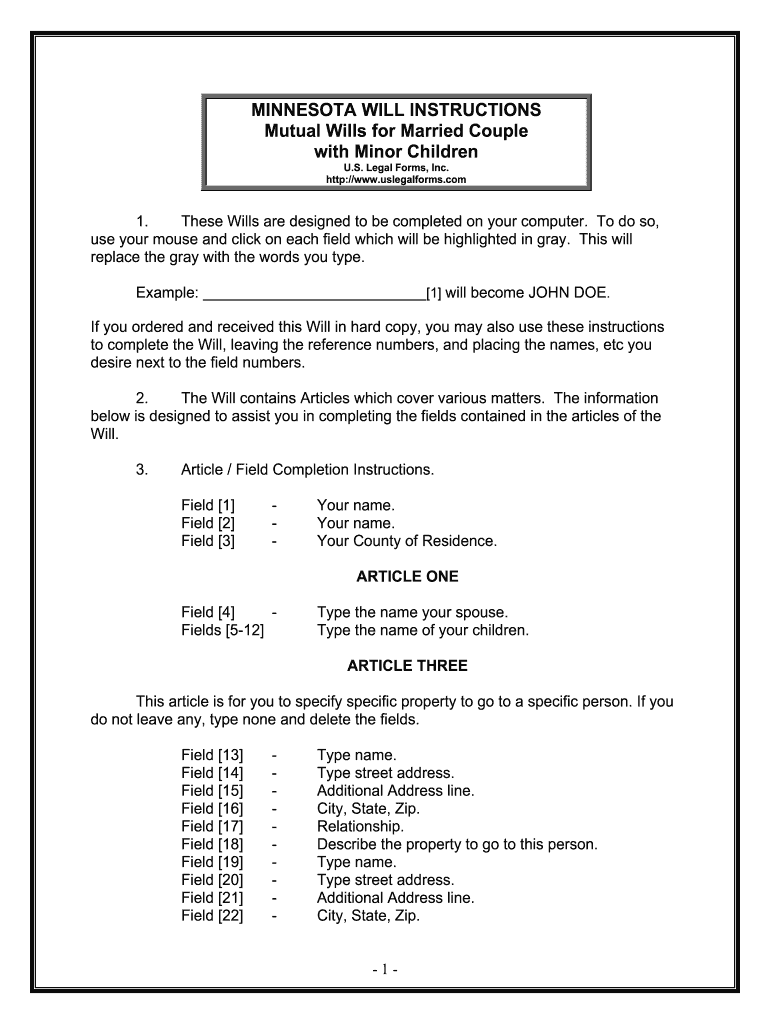
The "Minnesota Mutual Wills Package with Last Wills and Testaments for Married Couple with Minor Children" serves as a legal tool designed specifically for married couples in Minnesota who have minor children. This package allows couples to collectively create comprehensive wills that address the distribution of their property and the appointment of guardians for their minor children. Mutual wills bind each spouse, ensuring that their mutual wishes concerning property and the welfare of their children are honored after both parties pass away. The package typically includes legal language and provisions that explicitly underscore the intent to create interdependent wills, which cannot be modified unilaterally by one spouse.
Key Elements of the Minnesota Mutual Wills Package
The Minnesota Mutual Wills Package contains several key elements that facilitate the creation of a comprehensive testamentary plan for married couples with minor children:
- Personal Information: Sections for detailing the full names, addresses, and personal identification details of the spouses.
- Property Distribution: Provisions for the specific distribution of property and assets among the surviving spouse and children.
- Appointment of Guardians: Clauses allowing parents to name guardians for their minor children, ensuring they are cared for by trusted individuals.
- Alternate Beneficiaries: Sections that allow for the naming of secondary beneficiaries in case the primary ones cannot inherit.
- Trustee Appointment: Enabling the selection of a trustee to manage any assets held in trust for minor children until they reach a designated age.
- Legal Provisions: Standard clauses that fulfill legal requirements for will validity in Minnesota, including signatures and notarization guidelines.
Steps to Complete the Minnesota Mutual Wills Package
Completing the Minnesota Mutual Wills Package involves specific steps ensuring all necessary legal criteria are met:
- Gather Necessary Information: Collect personal, property, and financial information of both spouses, including details of any minor children.
- Consult Legal Counsel: Although the package offers guidance, consulting with legal counsel can provide tailored advice and ensure compliance with state laws.
- Draft Wills: Use the provided templates in the package to fill out each section carefully, particularly around property distribution and guardianship.
- Review and Modify: Both spouses should review the documents to ensure all wishes are accurately reflected and make any necessary amendments.
- Execution and Notarization: Once finalized, both parties need to sign the will in the presence of witnesses, and it may be beneficial to have the document notarized to strengthen its legal validity.
Legal Use of the Minnesota Mutual Wills Package
The legal use of this will package is strictly governed by Minnesota state laws. It is intended to create legally binding agreements between spouses regarding estate distribution and child guardianship. The mutual nature of these wills means they are resistant to unilateral changes, providing assurance that the wishes agreed upon by both parties will be respected and enforced in probate, should both spouses die. Legal safeguards ensure that the document satisfies testamentary requirements, such as capacity, voluntary intent, and the presence of appropriate witnesses.
State-Specific Rules for the Minnesota Mutual Wills Package
While mutual wills packages exist in other states, the Minnesota-specific version accounts for unique state laws and regulations:
- Testator Requirements: The legal age and mental capacity criteria that must be met by both spouses.
- Witness and Notarization: The number of witnesses required and the benefits of notarizing the document for probate.
- Children's Trusts: Provisions for creating and managing trusts for minor children under Minnesota law until they reach the age of majority or a specified age.
Important Terms Related to Minnesota Mutual Wills Package
Understanding the following terms is crucial when dealing with the Minnesota Mutual Wills Package:
- Testator: The individual creating the will; in this context, both spouses serve as testators.
- Beneficiary: The persons named to receive benefits from the will assets; usually children, in this case.
- Guardian: The individual appointed to take care of the minor children if both parents pass away.
- Executor: A person designated to execute the terms of the will and manage the estate's affairs.
Examples of Using the Minnesota Mutual Wills Package
Several scenarios illustrate the practical application of this wills package:
- Scenario One: A married couple with two young children decides to draft mutual wills to ensure their children are cared for by a trusted relative in the event of their deaths. The wills include provisions for setting aside funds for education through a trust.
- Scenario Two: A couple has substantial assets, including real estate and investments. By using the package, they can clearly outline how these assets should be split between surviving children, and legal guardians are empowered to manage each child’s inheritance until the age of maturity.
Who Typically Uses the Minnesota Mutual Wills Package
This wills package is most commonly used by:
- Married couples with minor children who need to make provisions for guardianship and asset distribution.
- Couples with substantial assets who want to ensure a fair and clear division of their estate.
- Spouses wishing to create an irrevocable agreement that binds mutual decisions concerning estate planning, ensuring long-term security for their dependents.
Selecting these blocks ensures comprehensive coverage of essential aspects about the Minnesota Mutual Wills Package with Last Wills and Testaments for Married Couple with Minor Children, focusing on practical utility, legal compliance, and practical examples.