




01. Edit your form online
Type text, add images, blackout confidential details, add comments, highlights and more.

Type text, add images, blackout confidential details, add comments, highlights and more.

Draw your signature, type it, upload its image, or use your mobile device as a signature pad.

Send it via email, link, or fax. You can also download it, export it or print it out.
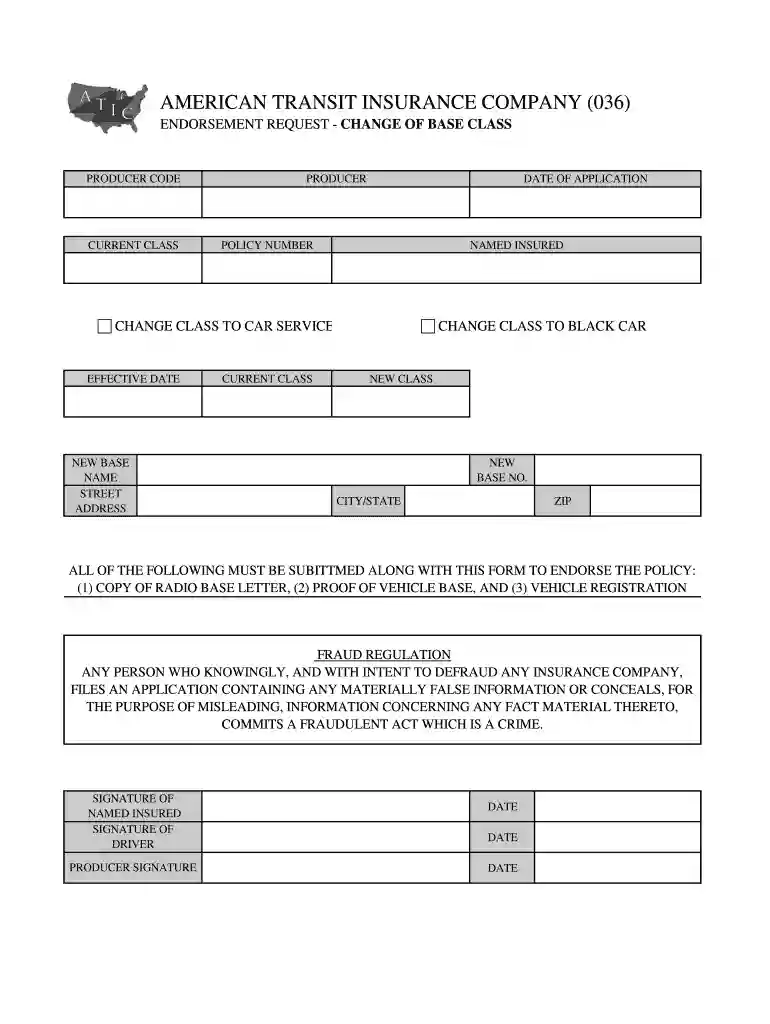
The American Transit Insurance Company (036) endorsement request form is designed to facilitate the process of changing the base class of an insurance policy. This form captures critical information such as the current and new classifications, effective date of change, and necessary documentation, including proof of vehicle base and registration. It serves as an official request to modify existing insurance terms, reflecting new circumstances or operational changes that a policyholder wishes to address.
Gather Necessary Information: Before completing the form, collect all pertinent details including the current policy classification, desired new classification, and the effective date for the change.
Document Verification: Ensure you have supporting documentation ready, such as vehicle base proof and registration, which the form might require for processing the change.
Careful Form Completion: Fill out the form meticulously, entering the requested information accurately to avoid delays or rejections. Double-check each section for completeness.
Submission Requirements: Attach all required documents and any supplementary information that may support your request. This might include validation of the operational need for the class change.
Fraud Regulation Compliance: Acknowledge and understand the fraud regulation warning provided on the form, which cautions against falsifying information.
To access the American Transit Insurance Company (036) form, contact your insurance provider directly. Many insurers offer these documents through their customer service channels or online portals. Ensure you’re retrieving the most recent version to avoid submission issues due to outdated formats.
Policy Information: Details of the current and requested insurance classifications.
Effective Date: Specific date when the change should commence.
Submission Requirements: Includes necessary documentation such as proof of vehicle base and registration.
Certification and Signature: A section where the policyholder certifies the accuracy of information and agrees to terms.
Policy Classification: The categorization of an insurance policy based on the risk level or type of vehicle covered.
Endorsement: A formal amendment to an insurance policy that alters its terms or coverage.
Vehicle Base: The primary location where the insured vehicle is garaged, which can impact insurance rates and eligibility.
This form is commonly used by policyholders who need to adjust their insurance classifications due to changes in their personal or business circumstances. This could include individuals who have relocated, require different vehicle coverage, or businesses that have altered their operational routes or functions.


The American Transit Insurance Company (036) form must be used in compliance with legal requirements set forth by both the insurance provider and state regulatory bodies. Proper completion ensures that the policy adjustments are legally binding and recognized by law, protecting the interests of both the insurer and insured.
When submitting the American Transit Insurance Company (036), include all relevant documents, such as:
Proof of Vehicle Base: Documentation verifying the primary location of vehicle storage.
Registration: Up-to-date vehicle registration papers.
Supporting Documentation: Any additional documents that substantiate the reason for classification change, such as proof of business operations or residency verification.
Failure to accurately complete or submit the American Transit Insurance Company (036) can result in delayed processing or denial of the endorsement request. Additionally, providing false information may have legal repercussions, including penalties for insurance fraud, and can adversely affect future insurance transactions and claims.
At DocHub, your data security is our priority. We follow HIPAA, SOC2, GDPR, and other standards, so you can work on your documents with confidence.


by UI Law Courts jurisdiction over this action is based on diversity of citizenship. You may extend the insurance that applies to Business Personal
INSURANCE COMPANIES AUTHORIZED TO DO BUSINESS IN THE STATE OF NEW JERSEY AND THEIR CODE NUMBERS. LAST UPDATED July 30, 2026.Read more


