







Definition & Meaning
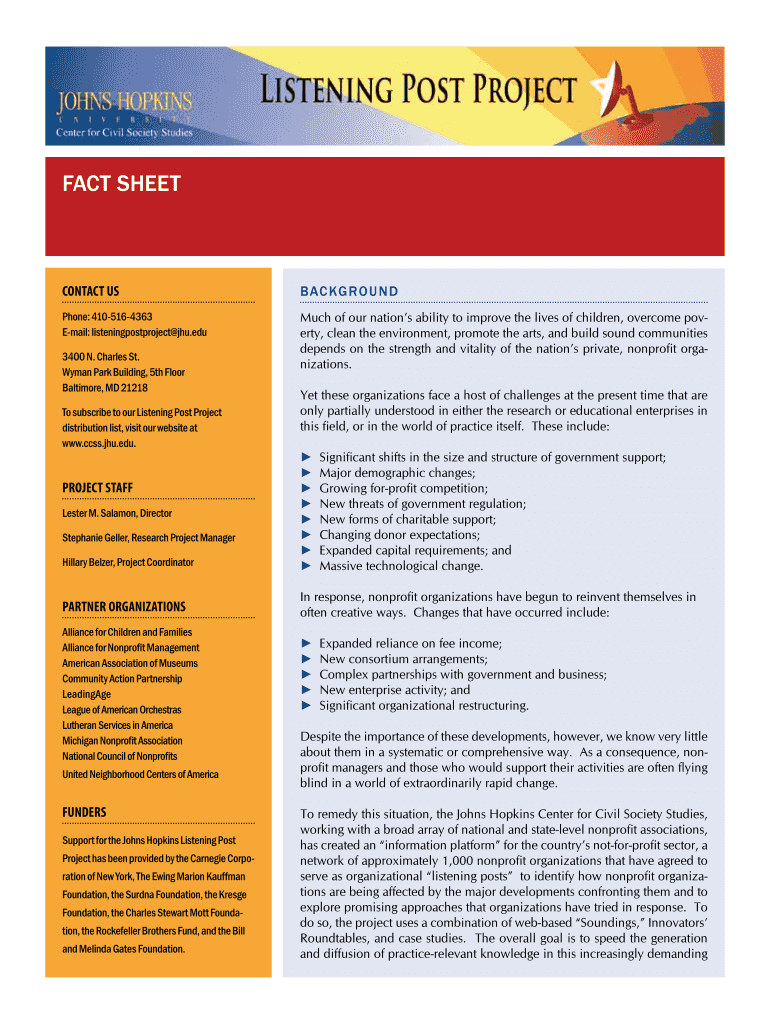
The "FacT SHEET - Center for Civil Society Studies" serves as an informational guide produced by an academic entity focused on nonprofit organizations and civil society. This document provides insights into the key activities, research, and outreach endeavors conducted by the Center for Civil Society Studies. Typically, fact sheets like this one are used to distribute concise information quickly and efficiently, summarizing important aspects of a specific topic in a structured manner.
Key Elements of the FacT SHEET
Understanding the core components of the "FacT SHEET - Center for Civil Society Studies" is essential for users seeking detailed knowledge on the services and research offered by the Center. Key elements often include:
- Mission Statement: Describes the overall goals and objectives of the Center.
- Research Initiatives: Outlines ongoing projects and areas of study.
- Notable Accomplishments: Highlights significant achievements and contributions to the field of civil society.
- Partnerships: Lists collaborating organizations, institutions, or governmental bodies.
- Resources Available: Provides information on reports, publications, and tools for nonprofit organizations.
How to Use the FacT SHEET
Utilizing the "FacT SHEET - Center for Civil Society Studies" effectively involves understanding its primary purposes. The fact sheet serves as a quick reference document for:
- Academics and Researchers: To gain an overview of the Center’s projects and data sources.
- Nonprofit Organizations: To identify relevant resources and potential collaboration opportunities.
- Policy Makers: To inform decisions with concise and accurate information.
- General Public: Educating individuals interested in civil society’s impacts on social issues.
Steps to Complete the FacT SHEET
While the "FacT SHEET - Center for Civil Society Studies" may not require completion in a traditional form submission sense, it’s useful to know how to effectively gather and compile necessary data. Consider these steps:
- Identify the Needed Information: Review what the fact sheet aims to convey.
- Collect Relevant Data: Gather information from reliable sources, focusing on accuracy.
- Organize the Information: Structure the data logically, breaking it down into sections.
- Format for Clarity: Utilize bullet points or short paragraphs emphasizing key points.
- Review and Update Regularly: Ensure the information remains current and relevant.
Why Should You Refer to the FacT SHEET
The "FacT SHEET - Center for Civil Society Studies" serves several purposes for various stakeholders. Here's why it's an essential document:
- Insightful Information: Offers quick access to relevant and critical information about the Center's initiatives.
- Informed Decision-Making: Assists policymakers and nonprofit leaders in making informed decisions based on the latest research.
- Academic Reference: Aids researchers by providing foundational information for further academic study.
- Community Engagement: Empowers community advocates with data and insights to support their work.
Who Typically Uses the FacT SHEET
Several groups find the "FacT SHEET - Center for Civil Society Studies" particularly beneficial, including:
- Nonprofit Leaders and Advocacy Groups: To understand challenges and opportunities in the nonprofit sector.
- Academic Researchers and Students: For conducting research and studies related to civil society.
- Policy Makers and Government Officials: To receive informed updates about the state and impact of nonprofit organizations.
- Journalists and Media Professionals: To gain background information and data for reporting purposes.


Examples of Using the FacT SHEET
The "FacT SHEET - Center for Civil Society Studies" can be utilized in various real-world contexts, such as:
- Grant Proposals: Nonprofits using data from the fact sheet to enhance applications.
- Academic Presentations: Researchers referencing the fact sheet in lectures or reports.
- Public Awareness Campaigns: Advocacy groups leveraging information to focus their initiatives.
- Policy Formulation: Legislators citing data to support new governance or funding strategies.
Important Terms Related to the FacT SHEET
Understanding specific terminology relevant to the "FacT SHEET - Center for Civil Society Studies" enhances its utility:
- Nonprofit Sector: Organizations that operate for purposes other than generating profit.
- Civil Society: The aggregate of non-governmental organizations and institutions that manifest interests and will of citizens.
- Research Initiatives: Systematic investigations to establish facts or principles.
- Public Policy: Principles on which social laws are based, affecting nonprofit governance.
Legal Use of the FacT SHEET
The "FacT SHEET - Center for Civil Society Studies" is meant for informational purposes and should be used in compliance with copyright and intellectual property laws. Users must ensure:
- Proper Attribution: Citing the source when referencing the fact sheet’s content.
- Non-Commerical Use: Using the information for educational or advocacy purposes rather than for profit.
- Data Accuracy: Verifying any supplementary data referenced alongside the fact sheet’s material.




