
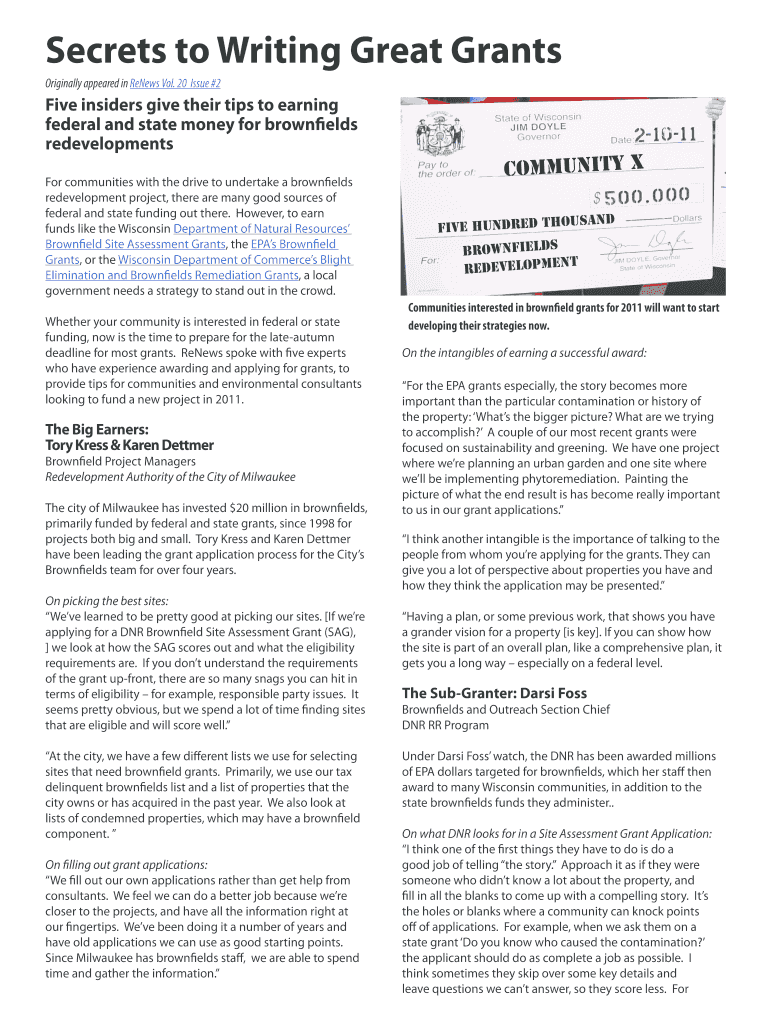







How to Use the Secrets to Writing Great Grants - Wisconsin Department of Natural
The "Secrets to Writing Great Grants - Wisconsin Department of Natural" document serves as a valuable resource for those seeking guidance in writing effective grant applications. It lays out strategies and insights from experts on how to secure funding for projects related to environmental and natural resources, such as brownfields redevelopment. This guide is essential for communities aiming to prepare successful grant applications by emphasizing strategic site selection, crafting engaging narratives, and directly engaging with funding agencies.
Practical Steps for Utilizing the Document
-
Identify Target Grants: Understand which specific grants are applicable to your project by researching and comparing available funding opportunities.
-
Tailor Applications: Use the document's insights to tailor your application, highlighting strategic site selection and demonstrating the community impact and financial commitment.
-
Engage Agencies: Proactively engage with funding agencies to align your project goals with funding priorities as outlined in the guide.
Steps to Complete the Secrets to Writing Great Grants - Wisconsin Department of Natural
Completing a grant application involves multiple detailed steps that the document addresses. Here's a brief overview to guide you through the process:
-
Understand Eligibility Requirements: Examine the eligibility criteria for each grant carefully to ensure your project qualifies.
-
Gather Necessary Documentation: Prepare all required documents, such as financial statements, project proposals, and community endorsements, to support your grant application.
-
Write a Compelling Narrative: Leverage the strategies in the document to convey the significance of your project, focusing on the community impact and sustainability.
-
Submit the Application: Follow the submission guidelines meticulously, adhering to deadlines and utilizing the recommended methods for your chosen grant program.
Additional Considerations
- Review and Revise: Have several stakeholders review the application to ensure clarity, accuracy, and completeness.
- Track Application Status: After submission, monitor the progress of your application and be prepared to provide additional information if requested by the funding agency.
Eligibility Criteria
Eligibility for grants discussed in the guide primarily involves meeting specific project requirements that align with federal and state priorities. Key criteria include:
-
Project Type: Only projects related to environmental restoration or natural resource management may be considered.
-
Community Impact: Demonstrating measurable benefits for the local community is crucial.
-
Financial Commitment: Asserting a strong financial backing or matching funds enhances eligibility.


Common Eligibility Scenarios
- Municipalities looking to revamp contaminated land into public spaces.
- Nonprofits seeking funds for conservation or educational projects.
Key Elements of the Secrets to Writing Great Grants - Wisconsin Department of Natural
The guide emphasizes several core elements essential for crafting successful grant applications:
-
Strategic Site Selection: Identifying and choosing sites that offer the most significant community impact potential.
-
Compelling Narratives: Writing narratives that succinctly communicate the project's importance, objectives, and anticipated outcomes.
-
Funding Agency Engagement: Building relationships with funding bodies to understand their priorities and interests better.
Notable Features
- Expert Insights: The guide includes commentary and strategies from professionals experienced in securing grant funding.
- Comprehensive Checklists: Utilize provided checklists to ensure all critical components are addressed in the application.
Important Terms Related to Secrets to Writing Great Grants - Wisconsin Department of Natural
Understanding key terms used in the context of grant writing can significantly help when applying for funding. Some essential terms include:
-
Brownfields: Previously used or industrial sites that may be contaminated but have potential for redevelopment into useful community spaces.
-
Redevelopment: The process of improving land or buildings for new use, especially concerning sites with previous environmental challenges.
-
Community Impact: The tangible benefits that a project delivers to the local population, such as job creation or environmental enhancement.
Examples
-
Project Narrative: The part of the application that tells the story of your project, clarifying goals and expected results.
-
Financial Commitment: Including budget plans and confirmations of funding sources beyond the grant itself.
Application Process & Approval Time
Understanding the timeline and process for application approval is crucial for planning and execution:
-
Pre-application Preparation: Engage in extensive preparatory work, often requiring months of planning before submission.
-
Submission Deadline: Typically established by the funding agency, it marks the last date by which applications can be received.
-
Evaluation Period: Applications are usually reviewed over several months, with feedback provided for further clarification if needed.
-
Approval Notification: Selected projects receive funding and formal notification with detailed grant terms and compliance requirements.
Examples of Using the Secrets to Writing Great Grants - Wisconsin Department of Natural
The document includes practical examples illustrating previous successful grant applications. These examples show:
-
Case Studies: Detailed descriptions of successful projects and their community impacts.
-
Successful Narratives: Samples of effective project narratives that triggered funding prospects.
-
Lessons Learned: Common pitfalls in grant applications and how they were avoided or resolved by previous applicants.
Real-world Applications
-
Urban Redevelopment: Transforming old industrial sites into vibrant community parks.
-
Conservation Efforts: Grants applied to protect endangered species habitats within state lands.
By integrating these strategies and examples into your grant application process, your community can better position itself to secure essential funding for impactful projects.


