
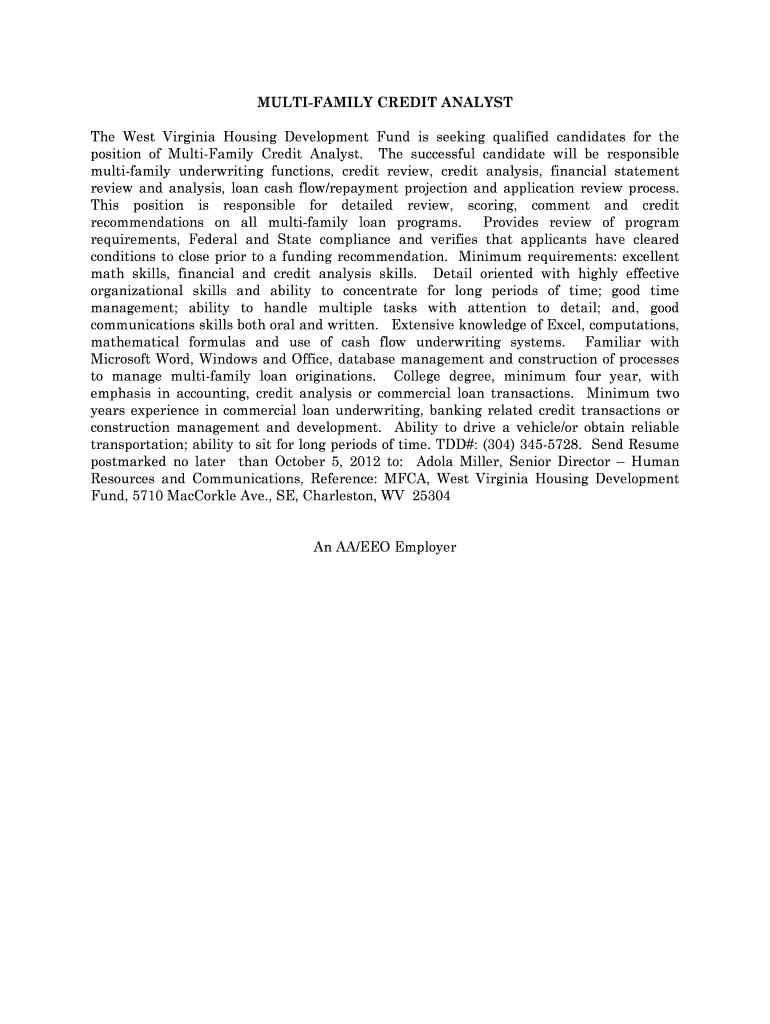







Definition and Overview of the Multi-Family Credit Analyst
A Multi-Family Credit Analyst is a professional responsible for evaluating the creditworthiness of entities involved in multi-family housing projects. These analysts work predominantly with financial institutions or housing development funds to assess loan applications, conduct risk analyses, and ensure compliance with relevant financial regulations. This role is critical in determining whether a loan applicant can reliably repay a loan and in advising on credit terms. Their expertise is vital for decision-making processes regarding real estate investments and lending.
How to Use Multi-Family Credit Analysis
Utilizing multi-family credit analysis involves several steps to assess potential borrowers or investment opportunities.
-
Gathering Financial Data: Analysts start by collecting detailed financial records from applicants, including income statements, balance sheets, and cash flow projections.
-
Evaluating Credit Histories: An examination of credit reports to understand the creditworthiness of both individuals and entities involved.
-
Risk Assessment: Employing various financial models to gauge the risks associated with offering credit under different terms.
-
Compliance Check: Ensuring all transactions meet the necessary regulatory standards.
-
Reporting and Recommendations: Compiling detailed reports to advise stakeholders or decision-makers on the viability of credit offerings.
Steps to Complete a Multi-Family Credit Analysis
-
Initial Consultation: Meet with potential borrowers to understand their needs and objectives.
-
Review Applications: Assess loan applications and related documentation for completeness and accuracy.
-
Conduct Financial Analysis: Use financial statements to evaluate profitability, liquidity, and solvency.
-
Assess Market Conditions: Consider the broader economic factors that might impact the real estate market and the specific project.
-
Report Findings: Prepare a comprehensive report that highlights identified risks and provides credit recommendations.
-
Decision Making: Assist in finalizing credit terms based on the analysis, or determine if the application should be declined.
Key Elements of a Multi-Family Credit Analysis
-
Credit Scores: A numerical representation of an entity's creditworthiness that influences lending decisions.
-
Debt-to-Income Ratio: Measures leverage and identifies potential financial strain on the borrower.
-
Collateral Evaluation: Analysis of assets offered to secure the credit arrangement.
-
Market Analysis: Evaluation of current real estate market trends impacting multi-family investments.
-
Regulatory Compliance: Ensuring that all activities meet federal and state regulations, including adherence to the Fair Housing Act.
Important Terms Related to Multi-Family Credit Analysis
-
Underwriting: The process of evaluating the viability of a borrower's credit request.
-
LTV (Loan-to-Value) Ratio: Compares the amount of the loan to the value of the property purchased.
-
DSCR (Debt Service Coverage Ratio): Assesses the borrower's ability to cover debt payments with their income.
-
Credit Risk: The possibility of a loss resulting from a borrower's failure to repay a loan.
-
APR (Annual Percentage Rate): The interest rate for a whole year, rather than just a monthly fee/rate, as applied to loans expressed as a percentage.
Legal Use of Multi-Family Credit Analysis
Multi-family credit analysis supports legal compliance in lending decisions, ensuring projects align with federal housing regulations and state-specific lending laws. Analysts play a crucial role in maintaining integrity throughout financial transactions, adhering to regulations such as the Dodd-Frank Wall Street Reform and Consumer Protection Act, which governs financial industry accountability and consumer protection.
Penalties for Non-Compliance
Failure to adhere to established credit analysis practices and legal standards can lead to significant financial penalties, reputational damage, and potential legal action against the individual analyst or the employing organization. Non-compliance can also result in corrupt lending practices, contributing to larger financial risks like default and foreclosure, which can further exacerbate housing crises.
Who Typically Uses Multi-Family Credit Analysis
Multi-family credit analysis is primarily used by credit analysts, loan officers, and financial institutions involved in real estate lending, particularly within the realm of multi-family housing. Housing development funds and investment firms also rely on multi-family credit analysts to guide their financial decisions, optimize portfolios, and maintain compliance with regulatory requirements. These professionals work at various levels to ensure that multi-family housing projects are financially feasible and align with strategic investment goals.
Software Compatibility
To perform their duties effectively, multi-family credit analysts often utilize specialized software compatible with platforms like TurboTax and QuickBooks. These tools assist in managing complex financial data and streamline the credit analysis process by providing structured environments for data entry, financial forecasting, and reporting. Integration with existing financial systems ensures that analysts can access up-to-date financial information to make informed decisions.




