




01. Edit your vehicle form online
Type text, add images, blackout confidential details, add comments, highlights and more.

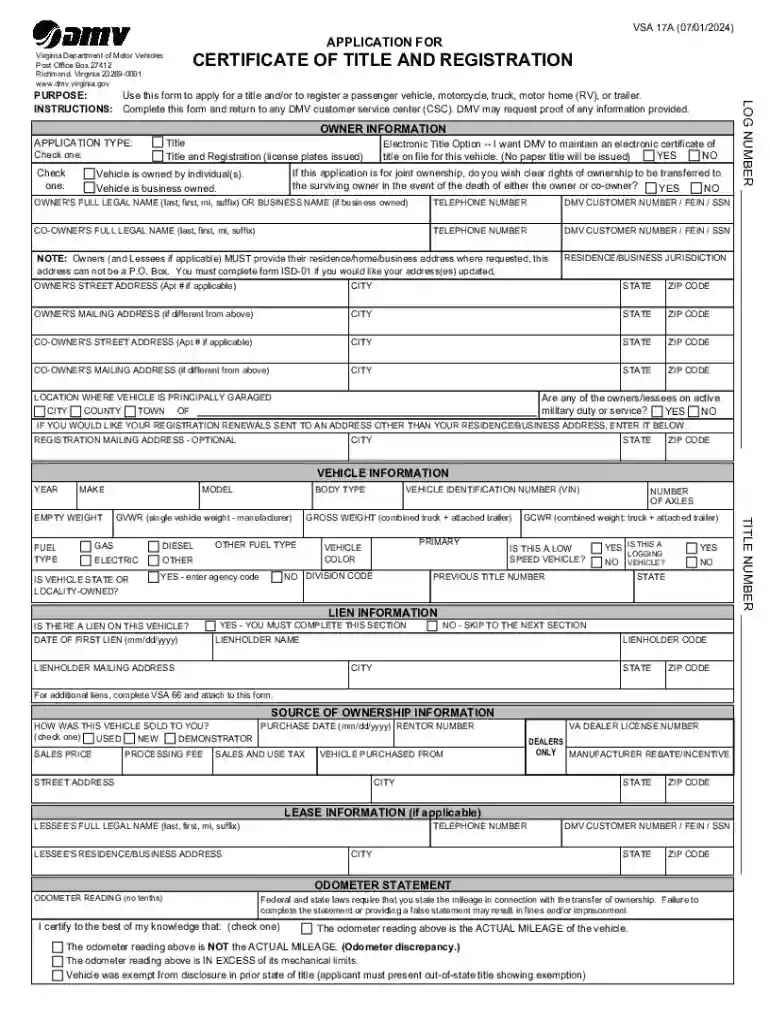
Type text, add images, blackout confidential details, add comments, highlights and more.

Draw your signature, type it, upload its image, or use your mobile device as a signature pad.

Send virginia dmv registration via email, link, or fax. You can also download it, export it or print it out.
Title and registration are essential components in vehicle ownership, representing the legal documentation required to prove ownership and authorize the vehicle for road use. The title is a legal document that serves as proof of ownership, issued by the Department of Motor Vehicles (DMV) or equivalent agency, detailing the vehicle's specifications, VIN, and owner's information. Registration, on the other hand, involves obtaining a license plate and a registration certificate, affirming the vehicle's approval for use on public roads.
The process is crucial for ensuring that vehicles are properly tracked for legal and taxation purposes, facilitating law enforcement and public safety. Without proper title and registration, vehicle owners may face legal issues, fines, and difficulty in proving ownership or selling the vehicle.
Securing a title and registration involves several steps, generally managed through the DMV or local motor vehicle agency. To start, gather the necessary documents and follow the application process specific to your state:
Every state may have unique requirements and processes, such as emissions tests or safety inspections. Check with your local DMV for precise instructions and requirements.
The following detailed steps outline the process of completing the title and registration, ensuring accuracy and compliance:
Missing a required document, incorrect entries in forms, or unpaid taxes are typical issues that can delay processing.
Obtaining title and registration is obligatory for several reasons, primarily to legally sanction vehicle ownership and use, and to ensure that vehicles are safe and conform to environmental standards.
Understanding terminology is pivotal for navigating the title and registration landscape:
These terms are frequently noted in paperwork and discussions regarding vehicle transactions and legal matters.
Title and registration laws ensure vehicles are driven legally and meet safety standards. Compliance is important, as non-compliance can lead to severe penalties like fines or vehicle impoundment.
Local law enforcement and DMV play critical roles in monitoring compliance and penalizing infractions.
An effective Title and Registration form features several important sections:
To effectively process a title and registration request, specific documents are mandatory:
Verify all documentation prior to DMV submission to prevent processing lags and ensure a smooth transaction.
Failure to adhere to title and registration laws can lead to various penalties, highlighting the importance of timely and accurate completion:
We've got more versions of the vehicle form form. Select the right vehicle form version from the list and start editing it straight away!
At DocHub, your data security is our priority. We follow HIPAA, SOC2, GDPR, and other standards, so you can work on your documents with confidence.




Mar 24, 2010 2. Once the title process has been completed, you must pay all taxes and fees, and your vehicle will be registered and license plates issued.Read more
Apply for title and/or license plates (registration) Apply online for both title AND get new plates Apply online for both title AND transfer existing plates.Read more


