







Definition and Meaning
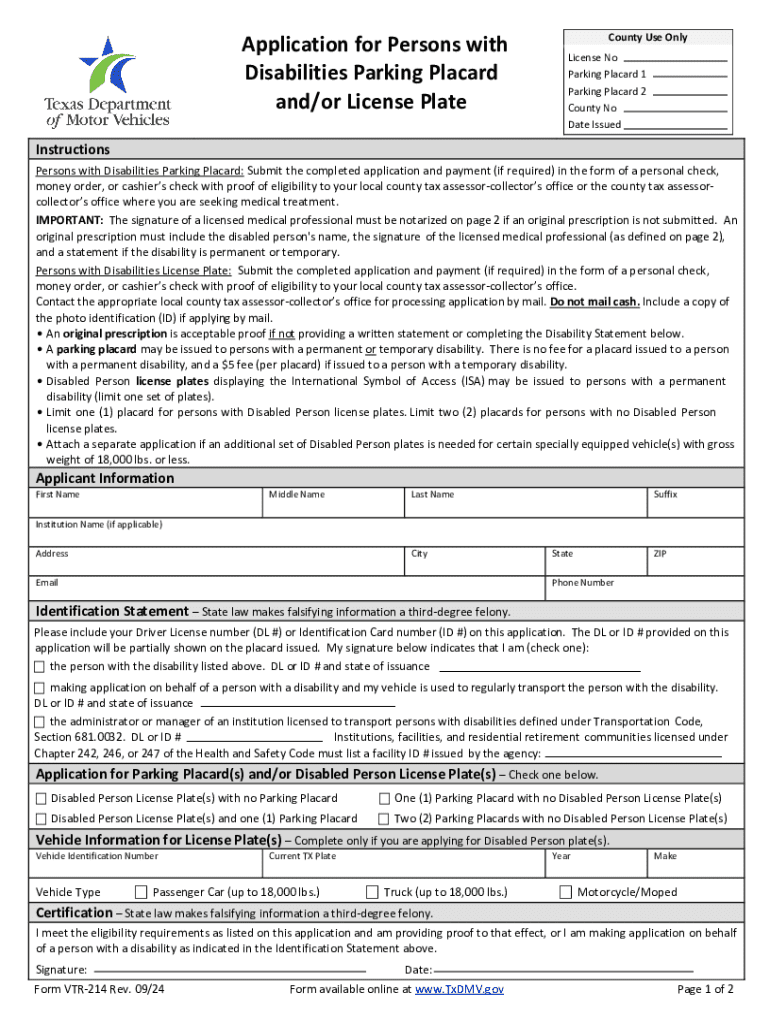
A Persons with Disabilities Parking Placard is a specially designated parking permit allowing individuals with qualifying disabilities to park in reserved parking spaces. These spaces are typically located closer to building entrances to accommodate mobility challenges. The primary function of these placards is to provide easier access to facilities for individuals with limited mobility due to a documented disability or health condition. According to Texas law, disabilities can include conditions that impair mobility, such as the inability to walk without assistance or reliance on a mobility device.
Application Process and Approval Time
To obtain a disability parking placard, applicants must complete a state-specific application form, which may vary from state to state. The application typically requires detailed personal information and documentation of the disability, often necessitating certification from a licensed medical professional. The approval time can vary depending on the state and the completeness of the application, but applicants can generally expect a decision within a few weeks. Some states offer expedited processing for urgent cases, such as terminal illnesses. The approval process ensures that only eligible individuals are granted disability placards, thereby maintaining the integrity of reserved parking spaces.
Eligibility Criteria
Eligibility for a disability parking placard depends on meeting specific medical or functional criteria. Common eligibility criteria include the inability to walk 200 feet without stopping to rest, use of portable oxygen, legal blindness, or the requirement for a mobility device such as a wheelchair or cane. Applicants may need to provide documentation from a healthcare provider to verify their condition. Each state may have slightly different criteria, so it is essential for applicants to check their specific state requirements.


How to Obtain Multiple Disability Parking Placards
An individual may be eligible to obtain more than one disability parking placard if additional vehicles require accommodations, even if only on a temporary basis. To apply for multiple placards, applicants typically need to provide justification for each placard requested, such as multiple family members with mobility constraints or the use of different vehicles for various activities. This involves completing the necessary paperwork and providing documentation to support the need for multiple placards. Approval is subject to state regulations, which aim to prevent misuse while supporting genuine needs.
State-Specific Rules
Various states have different regulations and rules governing the issuance and use of disability parking placards. While the general criteria for eligibility often overlap, specific types of placards, durations of validity, and replacement procedures can differ. For instance, some states may offer both permanent and temporary placards with varying validity periods, while others may have specific requirements for renewing or replacing expired or lost placards. These rules are designed to cater to the diverse needs of residents, ensuring broad access to accessibility resources.
Legal Use of Disability Parking Placards
It is crucial to understand the legal use of disability parking placards to avoid potential penalties. Placards must be displayed prominently in the vehicle to which they are registered when parked in designated spaces. Unauthorized use of a placard by individuals not entitled to its benefits is considered illegal and may result in fines or revocation of the placard. Users should understand that placard use is only intended for the benefit of the qualifying individual and not for general convenience. Compliance with these regulations helps maintain accessibility for those who genuinely need these accommodations.
Important Terms Related to Disability Parking Placards
Understanding the terminology associated with disability parking placards can aid in navigating the application and use process. Key terms often include "mobility impairment," "certifying authority," and "temporary placard." Mobility impairment typically refers to any condition significantly limiting a person's ability to move. A certifying authority is a licensed medical professional authorized to confirm an applicant’s disability. A temporary placard is issued for a short duration to accommodate conditions expected to improve, such as after surgery. Familiarity with these terms can help applicants accurately complete applications and understand correspondence related to their placards.
Required Documents
Applicants for disability parking placards must provide certain documents to establish eligibility and comply with state requirements. Generally, a completed application form, a doctor's certification of disability, and proof of identity, such as a driver's license or state ID, are needed. In some cases, additional documentation may be required to support the request for more than one placard. Proper documentation ensures that the application process is smooth and minimizes the likelihood of delays or rejections.
Compliance and Penalties
Failure to comply with the rules and regulations associated with disability parking placards can result in several penalties. These may include fines for using a placard without proper authorization, fraudulent applications, or misrepresentation of eligibility status. States enforce these penalties to protect the integrity and purpose of the disability parking system. Understanding and adhering to these guidelines ensures that the system remains fair and accessible to those legitimately in need, promoting respect and compliance in the community.




