14D Answer and Counterclaim-Irreconcilable Differences Answer and Counterclaim-Irreconcilable Differ 2026

Get Form
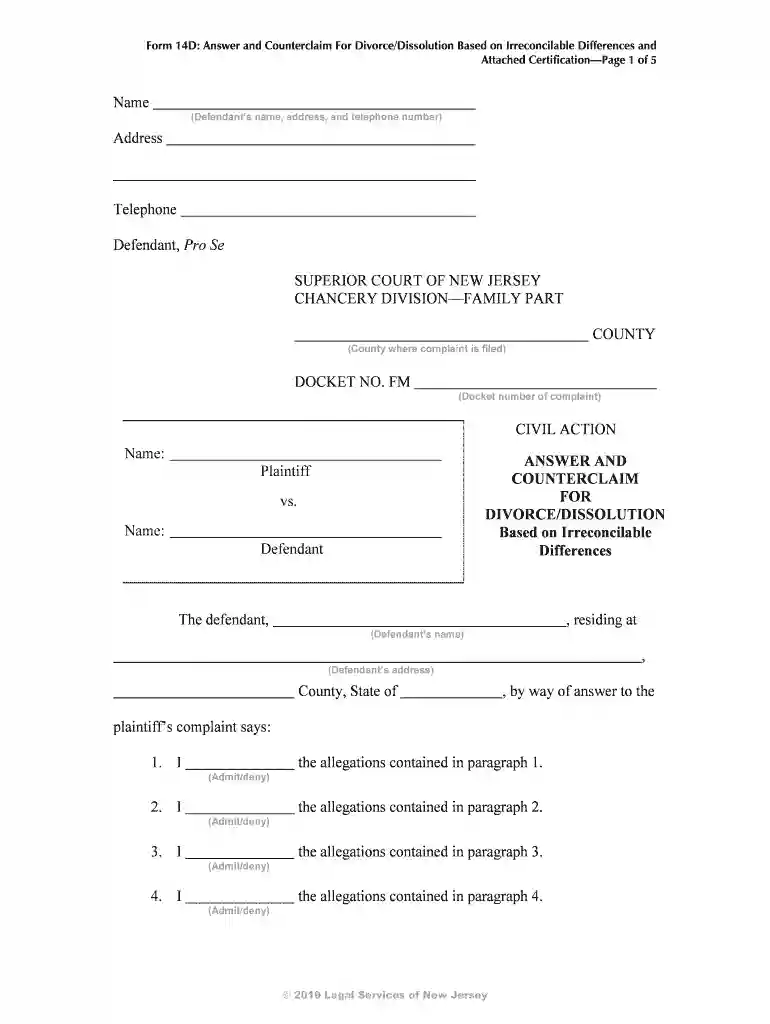
14D Answer and Counterclaim-Irreconcilable Differences Answer and Counterclaim-Irreconcilable Differ Preview on Page 1

Here's how it works

01. Edit your form online
Type text, add images, blackout confidential details, add comments, highlights and more.

02. Sign it in a few clicks
Draw your signature, type it, upload its image, or use your mobile device as a signature pad.

03. Share your form with others
Send it via email, link, or fax. You can also download it, export it or print it out.

Definition and Meaning

The Form 14D Answer and Counterclaim-Irreconcilable Differences is utilized in the Superior Court of New Jersey. It allows a defendant to officially respond to a divorce complaint based on claims of irreconcilable differences between spouses. The form serves multiple purposes. It provides a structured approach for the defendant to admit or deny specific allegations and file a counterclaim for divorce. This legal document is critical in detailing the defendant's stance on the marital dissolution, ensuring the court receives a comprehensive view of both parties’ positions in the matter.

Key Elements of the Form

The Form 14D is structured to capture extensive information relevant to the divorce proceedings. Critical components include:

  • Admission or Denial: Sections for the defendant to indicate agreement or disagreement with the plaintiff's claims.
  • Counterclaim: Space to outline any counterclaims for divorce, allowing the defendant to express their own grievances or causes for divorce.
  • Marriage Details: Information pertaining to the marriage duration, location, and current status.
  • Children Information: Sections to provide details about any children from the marriage, including custody or support considerations.
  • Prior Legal Actions: Any previous court actions relevant to the marriage or involved parties.

How to Obtain the 14D Answer and Counterclaim

To procure the Form 14D Answer and Counterclaim, defendants may access it through several channels:

  1. Online: The New Jersey Courts website houses downloadable versions of the required forms.
  2. Clerk's Office: Visit the Superior Court of New Jersey's clerk office to obtain a physical copy.
  3. Legal Representation: An attorney may provide and assist in filling out the form, ensuring compliance with all legal stipulations.

Software Compatibility

For digital convenience, the form can be edited using a variety of software solutions. Platforms like DocHub provide tools for editing, annotating, and securely handling legal documents in diverse formats such as PDF and DOC. These tools can help streamline the process, whether handling documents digitally or preparing them for physical submission.

Steps to Complete the 14D Answer and Counterclaim

Completing the Form 14D involves several critical steps:

  1. Personal Information: Provide accurate personal details, including full names and addresses of both parties.

  2. Response to Claims: Systematically review each allegation in the complaint. Clearly specify which claims are admitted or denied.

  3. Counterclaims and Relief Sought: Detail the nature of any counterclaims, including desired outcomes like asset distribution, child support, or custody arrangements.

  4. Supporting Documentation: Attach any necessary documents that support your counterclaims.

  5. Review and Sign: Double-check all information for accuracy. Sign the form, ensuring the signature is notarized if required.

Who Typically Uses the 14D Answer and Counterclaim

The Form 14D is commonly utilized by defendants in divorce proceedings within the state of New Jersey where irreconcilable differences are cited as grounds for divorce. Typically, individuals who suspect or disagree with the claims presented by the plaintiff use this form to assert their legal responses and counterpositions.


decoration image ratings of Dochub

Eligibility Criteria

  • Residency: Either party must have been a New Jersey resident for at least one year prior to filing.
  • Grounds for Divorce: Irreconcilable differences as a basis require that the differences have persisted for six months, making reconciliation unlikely.
decoration image

Legal Use of the Form

State-Specific Rules

The Form 14D is governed by New Jersey state laws, which provide specific guidance on handling cases of irreconcilable differences. Legal professionals can offer critical insights into how these state-specific rules might influence the completion and submission of the form.

  • Filing Deadlines: Deadlines may vary based on case progression, but generally, the form must be filed promptly in response to a divorce complaint.
  • Submission Method: The form can be submitted electronically, via mail, or in person at the specified legal offices.

Important Terms

Understanding legal terminology within the form is crucial. Terms such as "counterclaim," "relief sought," and "irregularities in legal procedure" require precise interpretation to ensure proper application.

Examples of Using the Form

Real-world scenarios illustrate the utility of the Form 14D:

  • Case Study 1: A defendant contesting alleged adultery might use this form to deny claims while filing a counterclaim based on irreconcilable differences.
  • Case Study 2: A spouse seeking shared custody can detail their stance using this form, emphasizing the best interest of the children.

Required Documents

Alongside the completed Form 14D, certain documents might be required:

  • Proof of Marriage: A marriage certificate may be necessary to substantiate claims of marriage.
  • Financial Statements: These documents can help clarify requests for asset division or alimony.
  • Child Custody Agreements: If applicable, any existing agreements must be included to inform custody discussions.

Conclusion

The Form 14D serves as a fundamental tool for defendants in New Jersey navigating the complex terrain of divorce proceedings under the category of irreconcilable differences. By adhering to specific guidelines and leveraging technological tools like those provided by DocHub, individuals can efficiently manage and complete this essential legal form.

be ready to get more

Complete this form in 5 minutes or less

Get form

Got questions?

We have answers to the most popular questions from our customers. If you can't find an answer to your question, please contact us.
Contact us
You should respond to the counterclaim as though it were a Statement of Claim and you were drafting a Defence: respond to every paragraph you can do this paragraph by paragraph if necessary; deny any allegations of fact that you do not admit you will be deemed to admit facts that you forget to plead to; and.
While the answer is simply admitting or denying information from the complaint, the counterclaim can be used to put forth alternative versions of the facts or a completely different reason for the divorce. The counterclaim functions just like a complaint, you do not need to prove anything in the counterclaim.
When a plaintiff sues you for money or the return of property, you can defend yourself in civil court. You have another legal remedy if the plaintiff is actually at fault. You can counter sue. Countersuing involves suing the plaintiff while his or her case is still pending against you by filing a counterclaim.
Pleading is one of the first stages of a lawsuit. In a pleading, the parties formally submit their claims and the defenses against the oppositions claims. The parties can make specific pleas, such as a guilty plea or a not guilty plea.
A counterclaim is a claim for relief by the defendant against the plaintiff. The answer or response (Responsive Pleading) to the complaint may include a counterclaim.

Security and compliance

At DocHub, your data security is our priority. We follow HIPAA, SOC2, GDPR, and other standards, so you can work on your documents with confidence.

Learn more
ccpa2
pci-dss
gdpr-compliance
hipaa
soc-compliance
be ready to get more

Complete this form in 5 minutes or less

Get form