01. Edit your form online
Type text, add images, blackout confidential details, add comments, highlights and more.

Type text, add images, blackout confidential details, add comments, highlights and more.

Draw your signature, type it, upload its image, or use your mobile device as a signature pad.

Send it via email, link, or fax. You can also download it, export it or print it out.
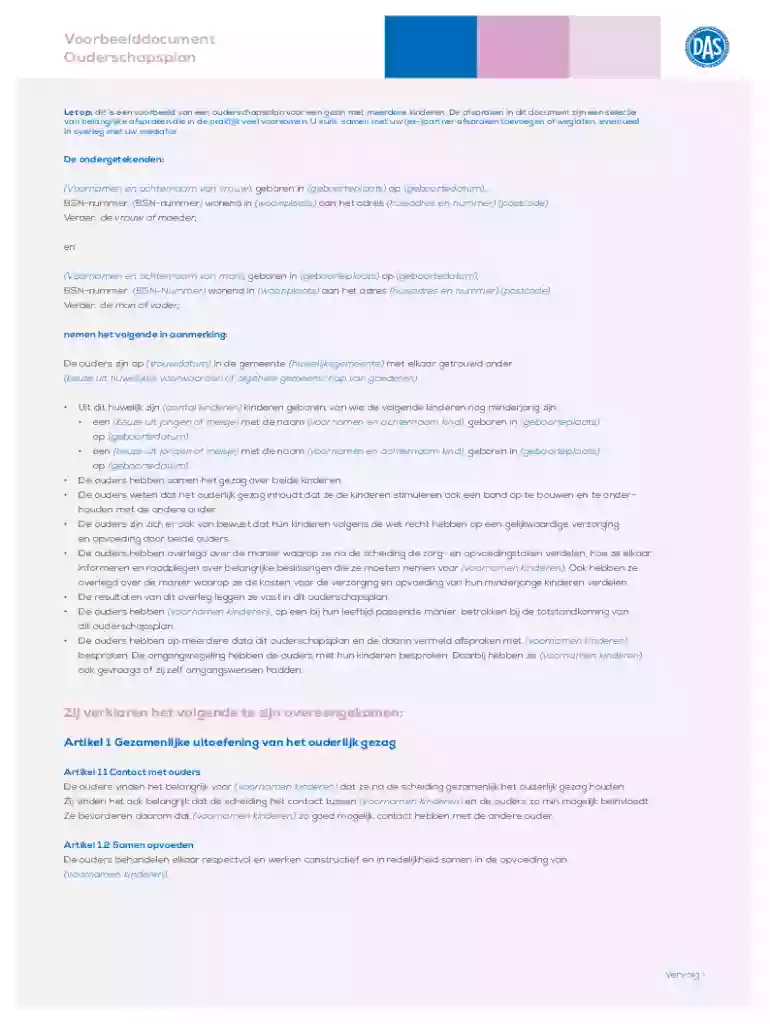
A "ouder(s)chapsplan" or parenting plan is a formal agreement crafted by parents outlining responsibilities and arrangements concerning their child's welfare after separation or divorce. This document plays a crucial role in establishing clear expectations and responsibilities, covering aspects like custody arrangements, visitation schedules, and decision-making authority regarding the child's upbringing. By providing a framework, it ensures that both parents maintain a shared approach to parenting, minimizing conflicts and promoting the child's well-being.
An effective ouderschapsplan should include several essential components to guide parents in their shared parenting responsibilities. These elements include:
Creating a comprehensive ouderschapsplan involves several structured steps to ensure all necessary aspects are covered:
Wat moet er in een ouderschapsplan staan? is primarily used by separated or divorced parents who wish to establish a clear, binding agreement concerning the co-parenting of their children. It is also beneficial for unmarried parents who are cohabitating but want to formalize parental responsibilities. Additionally, family law professionals, such as attorneys or mediators, frequently utilize these plans to assist clients in navigating post-separation parenting dynamics.


The legal framework of an ouderschapsplan provides enforceability and structure, ensuring both parents adhere to the agreed terms. In the United States, while specific laws may vary by state, most jurisdictions recognize a parenting plan as a legal document once it is incorporated into a court order. This integration into legal proceedings provides a mechanism for enforcement should either parent fail to comply with the established arrangements, offering protection and recourse for the involved parties.
While the basic elements of a parenting plan are consistent across states, specific state laws can influence the document's formulation and legal standing. For example:
Understanding these variations ensures that the parenting plan aligns with specific state guidelines, which is crucial for its enforceability.
Several key terms are integral to understanding and creating a complete parenting plan:
Real-world scenarios illustrate the practical application of a parenting plan. Consider a divorced couple living in different cities:
These examples highlight the plan's flexibility in accommodating diverse family needs while fostering cooperative parenting.
At DocHub, your data security is our priority. We follow HIPAA, SOC2, GDPR, and other standards, so you can work on your documents with confidence.