




01. Edit your form online
Type text, add images, blackout confidential details, add comments, highlights and more.

Type text, add images, blackout confidential details, add comments, highlights and more.

Draw your signature, type it, upload its image, or use your mobile device as a signature pad.

Send it via email, link, or fax. You can also download it, export it or print it out.
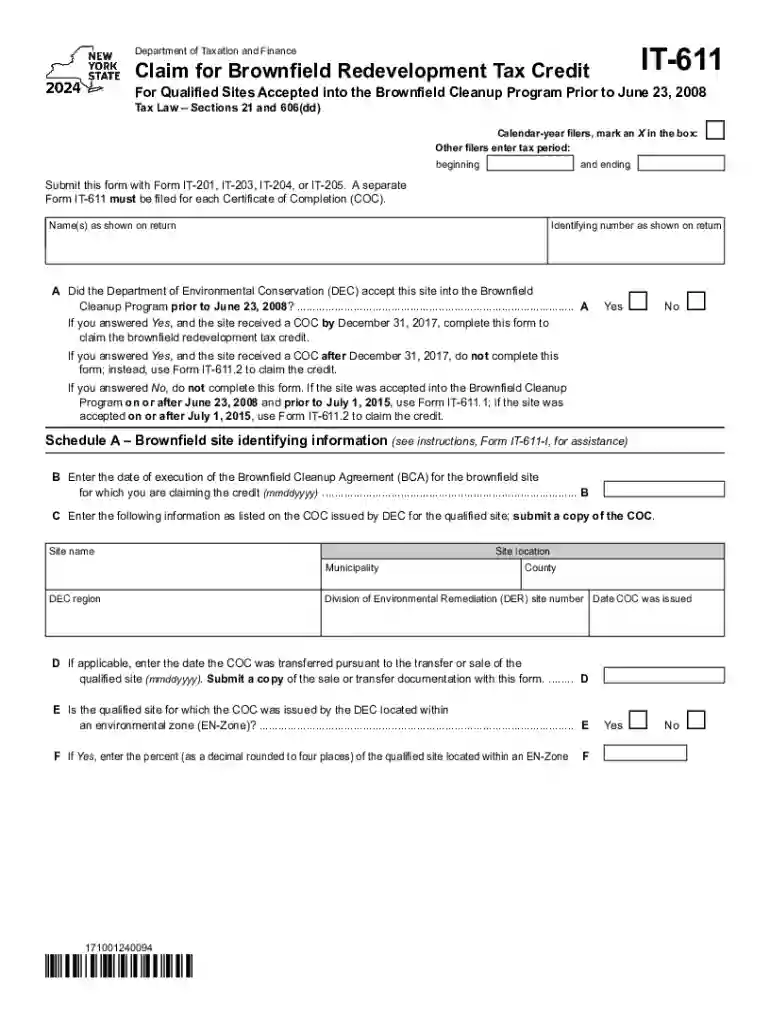
Form IT-611 is a comprehensive document issued by the Department of Taxation and Finance for the purpose of claiming the Brownfield Redevelopment Tax Credit for the tax year 2024. This form is specifically designed for sites that have been accepted into the Brownfield Cleanup Program (BCP) before June 23, 2008. It is an essential tool for taxpayers looking to leverage tax credits for environmental remediation and redevelopment projects, providing detailed sections for various credit components. The form requires information about site identification, credit components, and associated remediation costs, making it a crucial part of the tax filing process for eligible parties.
To obtain Form IT-611, taxpayers can download it directly from the Department of Taxation and Finance’s website or request a physical copy through mail. Completing the form involves meticulously detailing qualified expenses and credits related to brownfield redevelopment. Taxpayers should ensure they have detailed records of site preparation costs, tangible property expenses, and groundwater remediation costs to accurately fill out the required sections. It's advisable to consult with a tax professional or legal advisor to ensure accurate completion and compliance with all tax regulations.
Identify Qualified Sites: Begin by determining if your site qualifies under the Brownfield Cleanup Program before proceeding with the form.
Gather Required Documents: Collect documentation pertaining to site redevelopment, including expense records and proof of participating in the BCP.
Complete Site Identification Details: Fill in all necessary fields regarding the brownfield site, ensuring accuracy to avoid delays in processing.
Specify Credit Components: Document all qualifying costs, including site preparation, tangible property investments, and groundwater remediation expenses.
Review Instructions for Certificates: Follow the specific directions outlined for the Certificate of Completion, ensuring to submit all related documentation.
Submit the Form: Once completed, attach Form IT-611 to your state tax return, and submit as instructed in the form guidelines.
Eligibility for Form IT-611 revolves around participation in the BCP as well as the date of site acceptance. Only sites accepted into the program before June 23, 2008, are eligible. Applicants must demonstrate significant investment in environmental cleanup and redevelopment, substantiating claims with proper documentation. Ensure all criteria are met before submitting to avoid penalties or rejection.


The legal framework underpinning Form IT-611 requires strict adherence to guidelines established by the Department of Taxation and Finance. This includes providing truthful and complete information, timely submission, and maintaining documentation for all claimed expenses. Non-compliance or submission of fraudulent information may result in legal penalties or forfeiture of tax credits.
Taxpayers must be aware of several deadlines related to Form IT-611. The form should be completed and filed alongside state tax returns by April 15, 2025, unless an extension is granted. Failure to file by the deadline or to seek an extension may result in penalties. It's crucial to track these dates to ensure compliance and appropriate credit allocation.
Claiming the Brownfield Redevelopment Tax Credit via Form IT-611 can significantly benefit eligible taxpayers by reducing the financial burden of cleanup and redevelopment projects. It encourages sustainable development and revitalization of contaminated sites, directly impacting urban renewal efforts while offering financial incentives to participants. Businesses and individuals participating in these programs not only contribute to environmental health but also enjoy substantial tax deductions.
Examining practical examples, John Smith, a business owner in New York, utilized Form IT-611 to claim over $100,000 in tax credits after successfully completing remediation of a former industrial site. Similarly, XYZ Corporation leveraged this credit to offset costs on a large-scale redevelopment project, resulting in significant tax savings. Such scenarios underscore the form’s practical utility for qualifying entities seeking to engage in environmental revitalization initiatives.
We've got more versions of the Form IT-611 Claim for Brownfield Redevelopment Tax Credit Tax Year 2024 form. Select the right Form IT-611 Claim for Brownfield Redevelopment Tax Credit Tax Year 2024 version from the list and start editing it straight away!
At DocHub, your data security is our priority. We follow HIPAA, SOC2, GDPR, and other standards, so you can work on your documents with confidence.




brownfield redevelopment that has occurred in the City of Atlanta. The City was supportive in the redevelopment of an old abandoned steel mill in Midtown to
Form IT-611 must be filed for each Certificate of Completion (COC). complete this form to claim the brownfield redevelopment tax credit.


