






Definition and Meaning
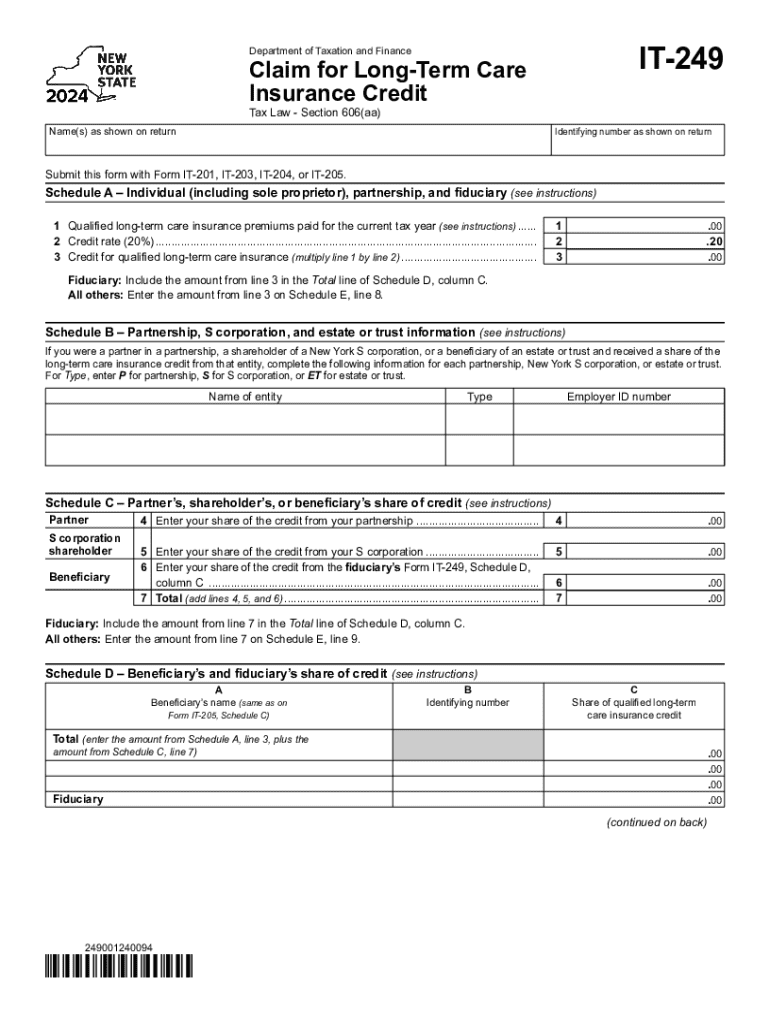
Form IT-249 Claim for Long-Term Care Insurance Credit Tax Year 2024 is a tax form issued by the New York Department of Taxation and Finance. This form is used to claim a credit for premiums paid on qualified long-term care insurance policies under Tax Law Section 606(aa). It helps individuals, partnerships, S corporations, and fiduciaries reduce their state tax liability by offsetting the costs associated with long-term care insurance.
Contextual Insight
- Long-Term Care Insurance: Policies designed to cover services that assist with daily living activities for individuals with chronic illnesses or disabilities.
- Tax Credit: A dollar-for-dollar reduction in tax liability, which may differ from deductions that lower taxable income.
Key Elements of the Form IT-249
The form consists of several critical sections that require detailed information:
- Taxpayer Information: Includes personal details like name, address, and taxpayer identification number.
- Schedule of Premiums: Detailed list of qualified premiums paid during the tax year.
- Calculation of Credit: Section for calculating the total available credit, reflecting the amount paid in premiums.
Example Details
- Premium Payments: Taxpayers must report all eligible premium payments made in the year.
- Credit Computation: Deductions are calculated based on the limits set forth by the relevant tax code.
Steps to Complete Form IT-249
- Obtain the Form: Download from the New York Department of Taxation and Finance website or request a paper version.
- Fill in Personal Information: Include basic identification and contact information.
- List Premiums: Enter all long-term care insurance premiums paid in the appropriate schedule.
- Compute Credit: Use the provided instructions to calculate the credit due.
- Review and Submit: Double-check entries for accuracy and submit via accepted methods.
Practical Scenarios
- Example: An individual with a long-term care policy who paid $3,000 in premiums would enter this amount and apply the credit formula as per the form’s guidelines.
How to Use the Form IT-249
The form's primary function is to claim a credit for eligible long-term care insurance premiums. To maximize the benefit, ensure all premiums meet the qualification criteria outlined by the tax code.
Procedure to Claim
- Verification: Confirm that insurance policies qualify under the tax code specifications.
- Documentation: Keep all receipts and records of premium payments for proof and verification.
Eligibility Criteria
Eligibility for the Form IT-249 hinges on several factors relevant to both individuals and entities:
- Eligible Policies: Insurance plans that qualify under the IRS and New York tax codes.
- Residency Requirements: Must be a resident or have financial interests in the state of New York for the tax year in question.


Nuances and Edge Cases
- Multi-Policy Holders: Individuals with multiple policies should itemize all payments separately.
- Joint Filers: Consideration should be given to how premiums are reported when filing jointly.
State-Specific Rules for IT-249
New York has unique rules regarding long-term care insurance credits:
- Credit Limits: Specific to New York's taxation laws, which might influence the amount of credit allowable.
- Submission Details: Instructions for electronic and physical submissions are detailed to prevent filing errors.
Key Considerations
- Capping Credits: New York sets a limit on the total credit you can claim, irrespective of premiums paid.
- Carryover Provisions: Unused credits may sometimes be carried forward to other tax years.
Penalties for Non-Compliance
Failing to comply with the regulations surrounding the Form IT-249 can lead to penalties:
- Underpayment Penalties: If the credit calculation is incorrect, taxpayers may incur additional fees.
- Late Filing: Delays in submission can result in interest fees or a reduction in the eligible credit amount.
Examples of Non-Compliance
- Incorrect Calculations: Inaccurate calculations that overstate the credit.
- Missing Documentation: Failure to provide mandatory proof of premium payments.
Filing Deadlines and Important Dates
- Annual Filing Deadline: The deadline follows the New York State tax submission schedule, usually April 15.
- Extensions: Taxpayers can apply for extensions but not for the credit calculation itself.
Monitoring Changes
- Updates: Check for annual changes or amendments to tax laws that might affect credit claims.
- Relevant Authorities: The New York Department of Taxation and Finance regularly publishes updates on filing requirements.
IRS Guidelines
Integrating IRS guidelines with state requirements ensures compliance:
- Consistency: Ensure your claim for credits aligns with federal standards.
- IRS Forms: Coordinate with any IRS documentation required for federally recognized long-term care insurance policies.
Coordination
- Filing Simultaneously: Align state and federal submissions for seamless processing.
- Legal Interpretation: Consult a tax professional for interpretations of how state credits interplay with federal tax obligations.