







Definition & Meaning
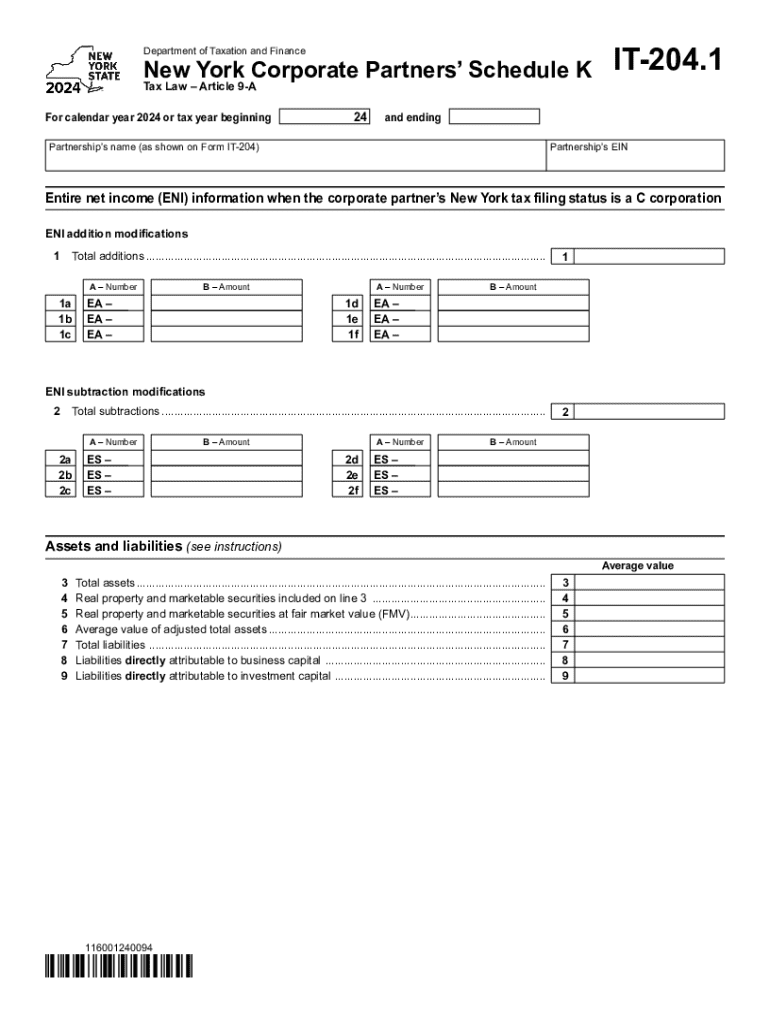
Form IT-204 1, known as the New York Corporate Partners Schedule K for tax year 2024, serves as a reporting framework for partnerships operating in New York State. This form details crucial financial and tax-related data relevant to partners within a corporate structure. The aim is to capture comprehensive information about a partnership's Entire Net Income (ENI), asset positions, liabilities, and investment capital to ensure compliance with the state's taxation requirements under Article 9-A. This process is crucial for accurate tax assessments and adherence to regulatory expectations, providing a clear depiction of a partnership's financial activities.
Key Data Points in Form IT-204 1
- Entire Net Income (ENI): Calculations and adjustments of the partnership's income.
- Asset and Liability Information: Detailed statements of the partnership’s financial standing.
- Investment Capital and Apportionment Data: Breakdown and distribution of investment activities.
- Modifications and Deductions: Adjustments related to exempt income, manufacturing receipts, and interest deductions.
How to Use the Form IT-204 1
Corporate partners must use Form IT-204 1 to accurately report financial data related to their partnership’s activities. The form is integral for ensuring that all aspects of the partnership's finances are included in the state’s tax calculations.
- Gather Financial Data: Collect all relevant financial data, including ENI, investments, and liabilities.
- Fill Each Section Accurately: Methodically complete each section, ensuring precise calculations.
- Review for Compliance: Double-check the form for completeness, accuracy, and compliance with NYS tax codes.
- Submit to NYS Department of Taxation and Finance: Ensure submission by appropriate deadlines to avoid penalties.
Practical Example
- A partnership in New York has multiple partners and diverse income streams including manufacturing receipts. Each partner uses Form IT-204 1 to report their share of income, deductions, and credits, reflecting their personal financial interest in the partnership operations.
Steps to Complete the Form IT-204 1
Filing Form IT-204 1 involves a series of detailed steps aimed at ensuring compliance and accuracy.
- Collect Partner-Specific Information: Gather details pertaining to each partner's financial transactions and allocations.
- Complete ENI Sections: Adjust and report entire net income, accounting for necessary deductions and exemptions.
- Document Investment Activities: Include information on asset acquisitions and sales, investment gains, and losses.
- Consolidate and Review Information: Ensure all entries are consistent with existing financial records.
- Sign and Submit: After thorough review, ensure that all required signatures are acquired and submit the form through designated channels.
Detailed Breakdown
- ENI Calculation: Utilize financial software compatible with NYS forms to assist in Accurate computation.
- Audit Trail: Maintain records of holdings, changes in investment capital, and allocations to prevent discrepancies.
Who Typically Uses the Form IT-204 1
Partners in corporate entities who engage in business activities within New York State are the primary users of Form IT-204 1. This includes:
- Corporate Partnerships: Entities structured as partnerships but operating within or in association with a corporation in New York.
- Multistate Businesses: Businesses that conduct operations across multiple states with physical or economic presence in New York.
- Investment Partnerships: Partnerships involved in capital-heavy enterprises or manufacturing sectors need to report nuanced financial interactions.


Case Study
- Scenario: A manufacturing partnership in NYC is excelling in growth, resulting in increased cross-border economic activities. To ensure compliance, all New York-centric revenue, deductions, and accrued liabilities need to be reported using Form IT-204 1 to reflect correct apportionment and avoid fiscal penalties.
Important Terms Related to Form IT-204 1
Understanding specific terminology is vital for correctly completing Form IT-204 1:
- Article 9-A: This defines the franchise tax regulations applicable to partnerships operating within New York.
- Exempt Income: Portions of income that are excluded from state taxation under specific conditions.
- Apportionment Data: Statistical allocation of income for multi-state businesses according to NYS tax laws.
- Asset and Liability Reporting: Detailed overview of owned items and owed debts as they pertain to ENI.
Terms in Context
A partnerships' liable for manufacturing-related operations must distinguish between regular income and exempt income when calculating their ENI under Article 9-A guidelines.
IRS Guidelines
The IRS offers guidance on federal tax compliance while completing the state-specific Form IT-204 1. It includes:
- Dual Filing Requirements: Ensure that both State and IRS expectations are met concurrently.
- Federal Ties to State Obligations: Recognize how federal tax items impact New York’s apportionment and deduction rules.
- Adoption of IRS Definitions: Utilize IRS classifications and definitions to accurately reflect state-level reporting.
Navigating Guidelines
- Example Use: When completing Schedule K, refer to IRS rules on income classification to determine accurate federal-state reporting, minimizing error and adjusting according to recognized standards.
Filing Deadlines / Important Dates
Timely filing of Form IT-204 1 is critical to remain in good standing with the New York State tax system.
- Annual Submission Deadline: Typically due on the 15th day of the third month post fiscal year-end.
- Extension Options: Eligible partnerships can apply for filing extensions, given substantiated cause or circumstances.
- Penalty Assessments: Late submissions may incur financial penalties; awareness and preparation are essential.
Planning Ahead
- Deadline Strategy: Ensure that financial audits and reviews are completed well before the filing deadline to prevent last-minute submissions and possible errors.
Digital vs. Paper Version
Both digital and paper versions of Form IT-204 1 are available for filing, though digital submission is encouraged for efficiency.
- Online Submission Benefits: Enhanced ease and speed of filing with instant acknowledgments of receipt.
- Security Measures: Digital channels are fortified with encryption protocols to protect sensitive taxpayer information.
- Paper-Based Filing: Reserved primarily for those without reliable digital access or preference for traditional methods.
Transition to Digital
- Scenario: A partnership transitioning from paper to digital filing equips its financial team with training on digital form completion, ensuring seamless and secure submission processes.




