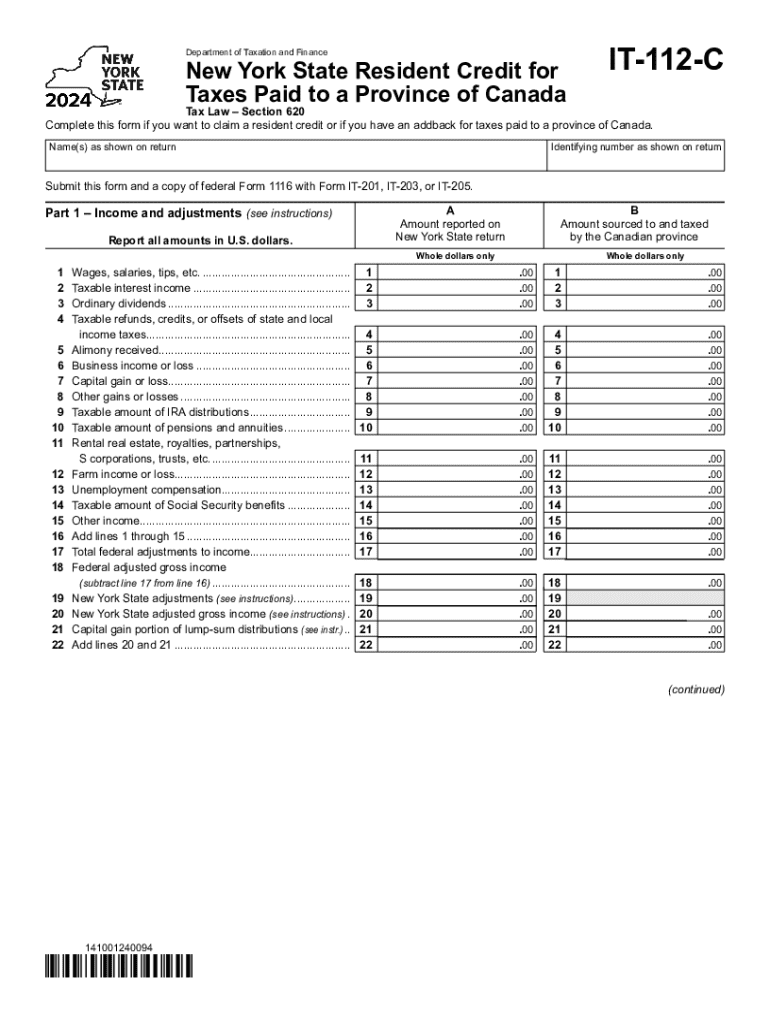







Definition and Meaning
The Form IT-112-C, otherwise known as the New York State Resident Credit for Taxes Paid to a Canadian province, is essential for New York residents who have income sourced from a Canadian province and are looking to claim a tax credit. This tax form serves as a functional means to avoid double taxation on the same income.
Key Points
- Purpose: Mitigates the impact of being taxed by multiple jurisdictions on the same income.
- Scope: Applicable for income earned from Canadian provinces by New York State residents.
- Requirement: Accompanies federal Form 1116 for comprehensive tax reporting.
Steps to Complete Form IT-112-C
Completing the Form IT-112-C involves several defined steps, ensuring accuracy and compliance with taxation rules.
-
Gather Your Documents:
- Ensure you have your federal Form 1116.
- Collect any official documentation that verifies income earned from Canadian provinces.
-
Fill in Personal Information:
- Input your name, Social Security number, and filing status.
-
Report Income and Taxes Paid:
- Provide detailed entries of income earned and taxes paid to Canadian provinces as required in the relevant sections.
-
Calculate the Credit:
- Follow the instructions to compute the allowable credit amount based on reported information.
-
Review for Accuracy:
- Double-check all entered data to verify the correctness of entries.
-
Attach Supporting Documents:
- Ensure supporting documents and federal Form 1116 are attached.
Eligibility Criteria
Eligibility to fill out the Form IT-112-C is clearly defined, mainly for residents of New York State with Canadian-sourced income.


Criteria Details
- Residency: Must be a resident of New York State.
- Income Source: Income must be attributable to a Canadian province.
- Verification: Must substantiate the claim with appropriate tax documentation from Canadian authorities.
Important Terms Related to Form IT-112-C
Understanding specific terminology is crucial when dealing with tax forms like the IT-112-C.
Glossary
- Double Taxation: The taxing of the same income or financial transaction in more than one jurisdiction.
- Foreign Tax Credit: A non-refundable tax credit for income taxes paid to a foreign government due to income taxation laws.
- Resident Credit: A credit allowed to state residents for taxes paid to other jurisdictions, offsetting state tax liabilities.
Legal Use of Form IT-112-C
Legal applications of Form IT-112-C are imperative for compliance with state tax laws, especially when foreign income is involved.
Use Cases
- Tax Credits: Legally reduces New York State tax due by the amount of tax paid to a Canadian province.
- Reporting Requirements: Aids in the accurate reporting of foreign earnings ensuring taxable income isn't incorrectly reported or taxed.
Key Elements of the Form IT-112-C
Several key elements define the composition of Form IT-112-C and its usage.
Main Sections
- Personal Details: Capture taxpayer's essential personal information.
- Income Details: Requires detailed reporting of Canadian-sourced income.
- Tax Calculation: Provides the framework for computing allowable credits.
State-Specific Rules for the Form IT-112-C
New York State has its unique statutes and guidelines governing the use of Form IT-112-C.
State Guidelines
- Tax Treatment: Compliance with state rules on tax credit acceptance and computation is essential.
- Documentation Requirements: New York mandates specific supporting documents to substantiate foreign earnings.
Filing Deadlines and Important Dates
Timely filing of Form IT-112-C is crucial to effectively claim tax credits and avoid penalties.
Important Dates
- Filing Deadline: Typically aligns with the deadline for New York State personal income tax returns.
- Extensions: Possible extensions might affect the submission timeline, depending on state-imposed regulations.
Examples of Using Form IT-112-C
Practical scenarios showcase how taxpayers can employ Form IT-112-C effectively.
Case Studies
- Scenario 1: A New York resident working remotely for a Canadian company can utilize this form to mitigate double taxation.
- Scenario 2: Investors in Canadian real estate who declare rental income will need to use this form to register taxes paid abroad.